



No new measures were certified in November for 2026. So far, voters in 28 states will decide on 56 ballot measures next year. At this point in the election cycle, an average of 52 ballot measures were certified between 2010 and 2024. An average of 161 statewide ballot measures—53 initiated measures and 108 referred measures—appeared on ballots in even-numbered years in that period.
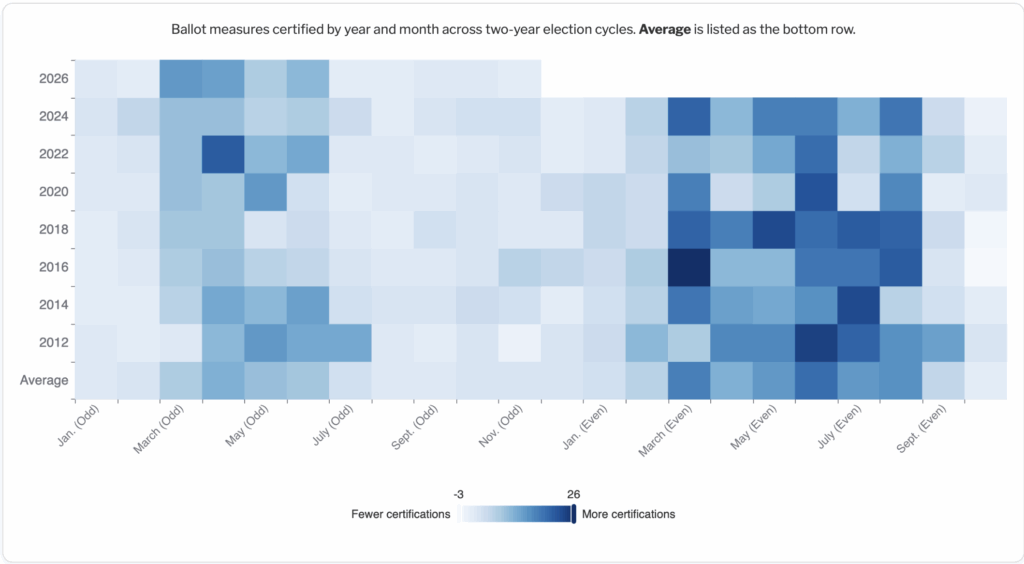
The following heatmap shows the number of statewide ballot measures certified each month from 2012 to 2026, grouped by two-year election cycles leading up to even-numbered general elections. Each row includes certifications from both the odd- and even-numbered years in that cycle, highlighting how active each month tends to be. The bottom row displays the monthly averages across all years.
In odd-numbered Novembers, an average of two measures was certified.
Massachusetts initiative signature deadline
The deadline to submit signatures to local registrars for verification in Massachusetts was Nov. 19. Campaigns behind 11 ballot initiatives filed signatures ahead of the formal deadline for submitting signatures to the secretary of the commonwealth on Dec. 3. If all 11 initiatives make the 2026 ballot, along with a veto referendum already certified for the ballot in the state, it will be the most citizen initiatives on the ballot in Massachusetts in the state’s history.
The Massachusetts Attorney General approved 44 ballot initiatives for circulation in September. The 11 ballot initiatives that met the signature deadline are indirect initiated state statutes that would enact various policies, including:
- limiting annual rent increases for residential units, with exceptions, to the Consumer Price Index (CPI) or 5%, whichever is lower;
- requiring cities and towns to allow single-family homes on residentially zoned lots that meet minimum standards preempting certain local zoning rules;
- adopting top-two primaries for state offices and requiring gubernatorial and lieutenant gubernatorial candidates to run as a joint ticket in primaries;
- requiring records that the state legislature and the governor’s office hold to be public records;
- changing how state legislators' stipends are calculated;
- decreasing the state's personal income tax from 5% to 4%;
- changing how the state calculates the limit on annual state tax revenue growth and how revenue subject to that limit is defined;
- creating a new state fund, the Nature for All Fund, which would receive revenue from the sales tax on sporting goods, recreational vehicles, and golf courses;
- repealing the state's laws that legalized, regulated, and taxed retail sales of recreational marijuana;
- permitting employees of the Committee for Public Counsel Services (CPCS), which includes public defenders, social workers, investigators, and administrative staff, to engage in collective bargaining with their employer; and
- allowing same-day voter registration.
In Massachusetts, citizens may propose initiated state statutes and initiated constitutional amendments. The power of initiative is indirect in Massachusetts, which means the Massachusetts General Court must consider any successful initiative proposals. The number of required signatures for an indirect statute is equal to 3% of the votes cast in the last gubernatorial election (74,574 signatures).
Once enough valid signatures are submitted, proposed statutory initiatives are presented to the legislature. The state Legislature has until the first Wednesday of May in the election year to pass the statute. If the legislature does not pass the proposed statute, proponents must collect a second round of signatures equal to 0.5% of the votes cast in the last gubernatorial election (12,429 signatures).
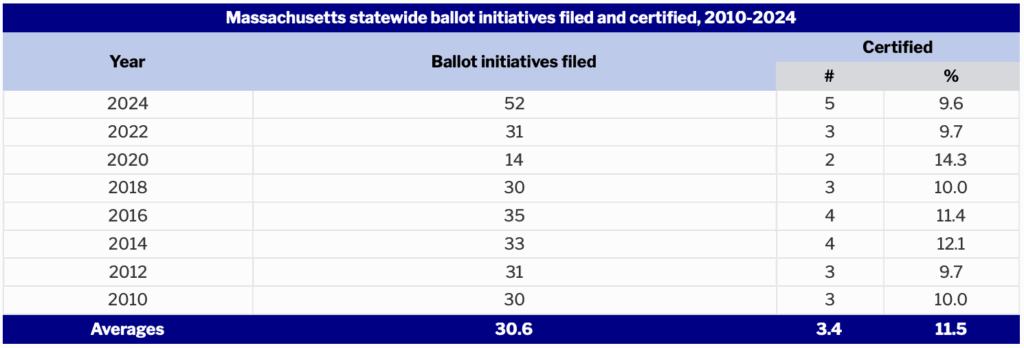
The table below shows the ballot initiative certification rates in Massachusetts from 2010 and 2024. The average number of initiatives filed was between 30 and 31, and the average number certified for the ballot was between three and four.
The veto referendum already certified for the ballot in Massachusetts for 2026 will allow voters to decide whether to retain or repeal House Bill 4885, which made several changes to the state's firearm regulations. Under HB 4885, the state would develop an electronic tracking system for firearms, prohibit assault-style firearms (as defined in law), require safety certificates to obtain firearm parts, mandate serial numbers for firearms, allow school administrators and licensed healthcare providers to request that a court issue an Extreme Risk Protection Order, and permit courts to order firearm surrenders when issuing a Harassment Prevention Order.
Signatures pending verification in Alaska and Colorado
In Alaska, a campaign to repeal top-four primaries and ranked-choice voting (RCV) general elections filed signatures for a 2026 initiative on Nov. 6. The initiative would adopt a party primary system. The top-four primaries and RCV were adopted in 2020.
The process is also indirect in Alaska. The number of signatures required for an indirect initiated state statute is equal to 10% of the votes cast in the preceding gubernatorial election (34,098 valid signatures). If enough signatures are verified, the initiative will go before the state legislature next year.
In Colorado, a campaign behind an initiative to change the penalties for selling or possessing fentanyl submitted signatures on Nov. 20. The initiative would increase the felony penalties for manufacturing, dispensing, sale, and possession of fentanyl and certain synthetic opioids; require mandated treatment for certain drug felony violations; and revise sentencing provisions to remove exceptions for crimes related to fentanyl and other drug-related deaths. The number of signatures required for an initiated state statute is 124,238 valid signatures, which is equal to 5% of the votes cast for the secretary of state in the preceding general election.
The initiative was filed in May 2025 and had a circulation deadline of Nov. 28.
The next scheduled signature deadline is in Ohio on Dec. 26 for indirect initiated state statutes. However, there are no indirect initiatives filed for 2026 in Ohio. A list of each state's petition requirements and deadlines can be found here.