


Welcome to the Thursday, Dec. 4, Brew.
By: Briana Ryan
Here’s what’s in store for you as you start your day:
- Eight marijuana and psychedelics-related ballot measures could be on the ballot in 2026
- After a tie vote, Society Hill, South Carolina, held a second mayoral runoff on Dec. 2
- Eleven ballot initiative campaigns in Massachusetts and two in Alaska and Colorado submit signatures for 2026
Eight marijuana and psychedelics-related ballot measures could be on the ballot in 2026
Heading into the 2026 elections, we’re taking a look at some of the themes we're seeing in potential ballot measures. So far, we have covered abortion-related measures. Today, we’re looking at marijuana and psychedelic-related measures.
In 2026, voters in six states may decide on marijuana and psychedelic-related measures. One measure has been certified for the Nov. 3 ballot in Idaho. Similar measures may also be on the Nov. 3 ballot in Alaska, Idaho, Massachusetts, Missouri, Nebraska, and Washington.
Currently, 40 states have medical marijuana programs, and 24 have legalized the possession and use of marijuana for recreational purposes. According to Psychedelic Alpha, Oregon, Colorado, and New Mexico allow the use of psychedelics for medical purposes.
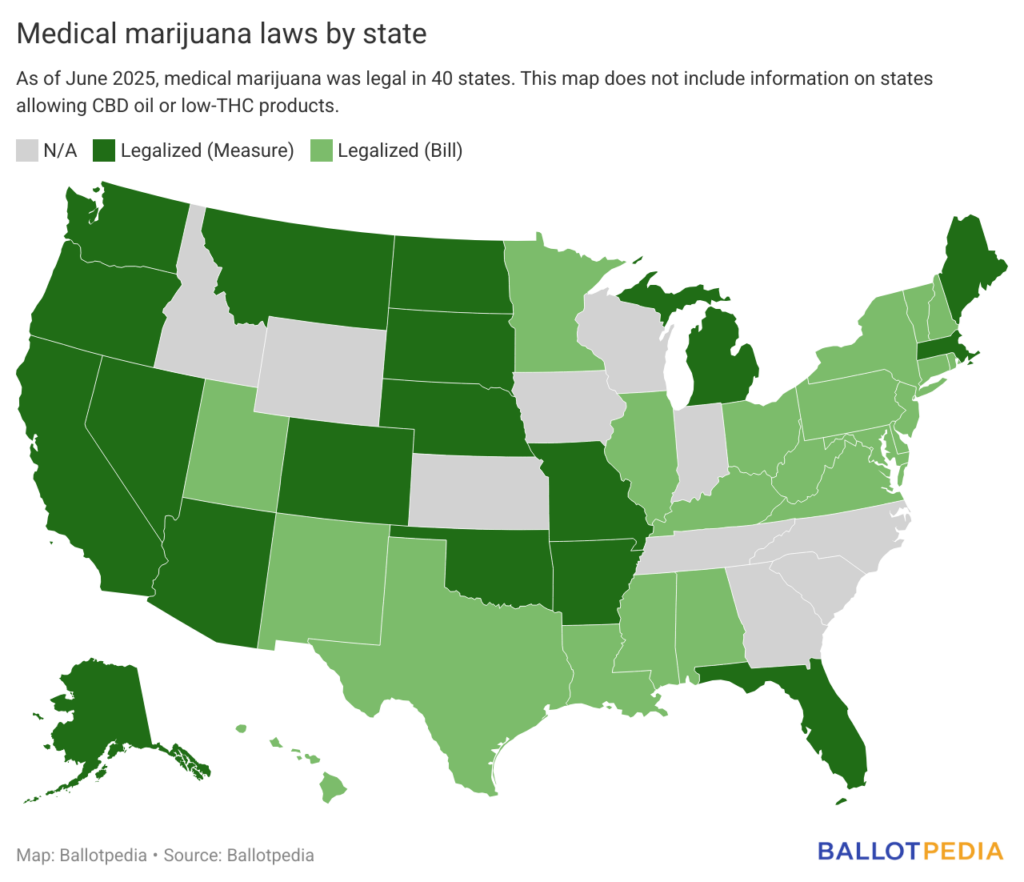
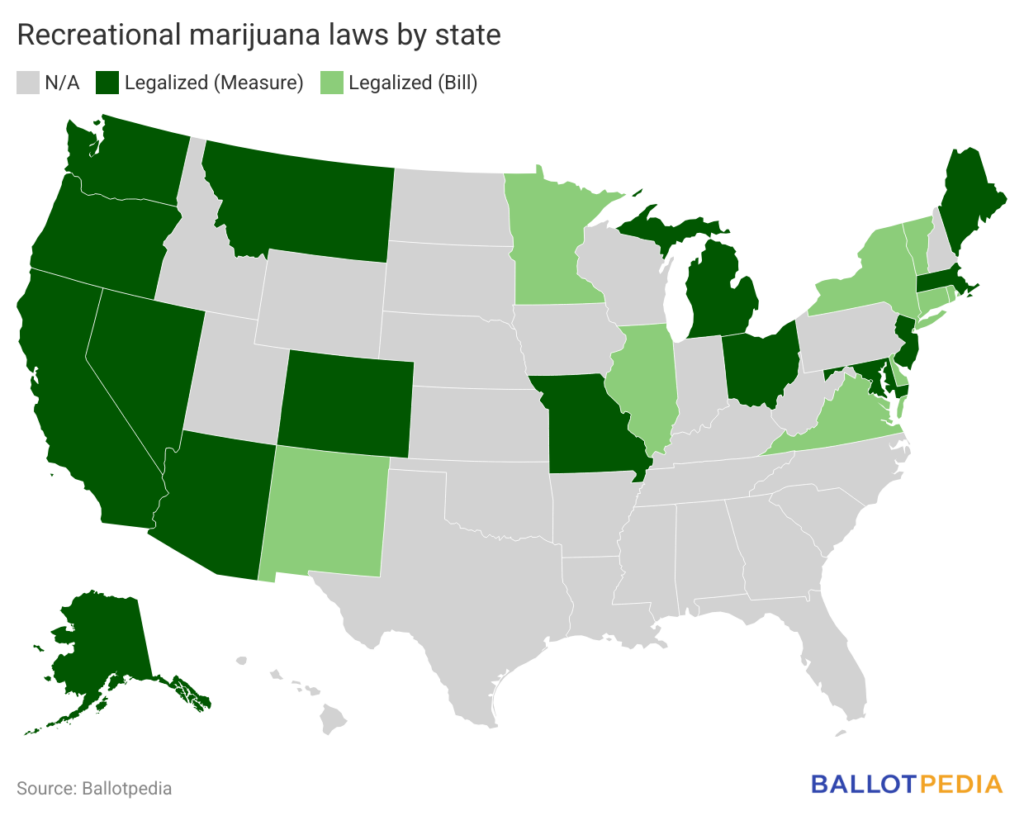
The certified measure in Idaho would provide that only the Idaho Legislature shall have the authority to legalize marijuana, narcotics, or other psychoactive substances, and remove the ability for citizens to initiate state statutes that would legalize these substances. This type of law is referred to as a subject restriction for ballot measures.
Two citizen initiatives in Idaho may also appear on the ballot. One would create a legal system for the cultivation and sale of marijuana in the state for medical use for individuals with a substantial health condition. The other would decriminalize the possession and use of marijuana for all purposes for people aged 21 and older.
Five other marijuana and psychedelic-related measures may appear on the ballot in five states:
- Alaska Decriminalization and Regulation of Psychedelic Substances Initiative would decriminalize and regulate the use, possession, and cultivation of specified psychedelic substances.
- Missouri Marijuana Regulations Amendment would recognize the right of individuals to use, possess, and cultivate marijuana.
- Nebraska Marijuana Legalization Initiative would establish a right to the use of marijuana for recreational purposes for individuals 21 years of age or older.
- Washington Reduce Cannabis Excise Tax Initiative would reduce the state cannabis excise tax from 37% to 7%.
- Massachusetts Alter Marijuana Regulation Laws Initiative would repeal laws that permit the sale, cultivation, and use of marijuana in the state.
The initiative in Massachusetts would repeal the majority of a 2016 initiative that legalized the use and possession of recreational marijuana. If the proposed initiative passes, the retail sale of recreational marijuana would be illegal. However, the possession of up to one ounce of marijuana would still be permitted, and the possession of between one and two ounces of marijuana would be punishable by civil penalties and fines instead of criminal penalties.
If the initiative is put on the ballot, Massachusetts would become the second state to vote on criminalizing marijuana, after Alaska in 1990. If the measure passes, it would be the first initiative to repeal a voter-approved measure legalizing marijuana.
Between 1972 and 2025, voters decided 83 measures related to marijuana and three measures related to psychedelics. During that period, voters approved 51 of the 83 marijuana-related measures and defeated 32. Of the psychedelics-related measures, voters approved two and defeated one.
No such measures were on the Nov. 4 ballot.
Click here for more on the history of marijuana ballot measures and laws.
After a tie vote, Society Hill, South Carolina, held a second mayoral runoff on Dec. 2
Voters in Society Hill, South Carolina—a town of roughly 500 people in the northern part of the state—returned to the polls for the third time in 30 days on Dec. 2, to decide the outcome of their mayoral race after two rounds of runoffs.
Cecil Graham and Councilmember Kevin Long appeared on the ballot in the general election on Nov. 4, but neither candidate received a majority vote, as is required under the town’s charter. Graham led with 61 votes to Long’s 51, but 50 additional votes went to write-in candidates.
As a result, the race advanced to a runoff on Nov. 18 between just Graham and Long. This ended in a tie, with both candidates receiving 76 votes, necessitating the second runoff on Dec. 2.
In the Dec. 2 runoff, Graham defeated Long. As of Dec. 3 at 10:43 a.m. EST, Graham won with 89 votes to Long’s 88.
While two rounds of runoffs are unique nationally, that’s not the case in Society Hill. The 2021 mayoral race also required two runoffs before the race was finally decided.
Most municipal elections in South Carolina fall into one of four categories:
- Nonpartisan general election and runoffs in which all candidates appear on the same general election ballot. If no candidate receives a majority vote, the top vote-getters advance to a later runoff, like in Society Hill.
- Nonpartisan plurality in which all candidates appear on the same general election ballot and the candidate who gets the most votes wins, regardless of if they win a majority.
- Nonpartisan primary and general election in which all candidates run in an earlier primary, which narrows down the field ahead of the general election.
- Partisan elections in which candidates run with specific party labels, nominated in things like primaries or conventions, before appearing on the general election ballot.
Municipalities also establish procedures for resolving tie votes. In some cases, they are decided with a coin toss. According to the Darlington County Elections Department, Society Hill conducts successive runoffs until a candidate wins by a majority or concedes.
We covered 409 elections in South Carolina on Nov. 4 as part of our expanded local election coverage. Nineteen of those elections resulted in runoffs that were held on Nov. 18, with the Society Hill mayoral race the only one to require a second runoff on Dec. 2.
Click here for more information about our local election coverage in South Carolina this year.
Eleven ballot initiative campaigns in Massachusetts and two in Alaska and Colorado submit signatures for 2026
Here’s the latest update on ballot measure certifications for 2026. No new measures were certified in November for 2026. So far, voters in 28 states will decide on 56 measures next year. At this point in the election cycle, an average of 52 measures were certified between 2010 and 2024. An average of 161 statewide measures—53 initiated measures and 108 referred measures—appeared on ballots in even-numbered years in that period.
In odd-numbered Novembers, an average of two measures were certified.
Massachusetts initiative signature deadline
The deadline to submit signatures to local registrars for verification in Massachusetts was Nov. 19. Campaigns behind 11 initiatives filed signatures ahead of the formal deadline for submitting signatures to the secretary of the commonwealth on Dec. 3.
If all 11 initiatives make the 2026 ballot—along with a veto referendum that’s already been certified—it will be the most citizen initiatives on the ballot in the commonwealth’s history. The 11 initiatives are indirect initiated state statutes that would enact various policies. Among the more noteworthy are:
- adopting top-two primaries for state offices and requiring gubernatorial and lieutenant gubernatorial candidates to run as a joint ticket in primaries,
- decreasing the state's personal income tax from 5% to 4%,
- and repealing the state's laws that legalized, regulated, and taxed retail sales of recreational marijuana.
Click here for a rundown of all 11 initiatives.
In Massachusetts, citizens may propose initiated state statutes and initiated constitutional amendments. The power of initiative is indirect in Massachusetts, which means the Massachusetts General Court must consider any successful initiative proposals. Campaigns must submit 74,574 valid signatures for an indirect statute. That’s 3% of the votes cast in the last gubernatorial election.
Once enough valid signatures are submitted, proposed statutory initiatives are presented to the General Court which has until the first Wednesday of May in the election year to pass the statute. If the General Court does not pass the proposed statute, proponents must collect an additional 12,429 valid signatures. That’s 0.5% of the votes cast in the last gubernatorial election.
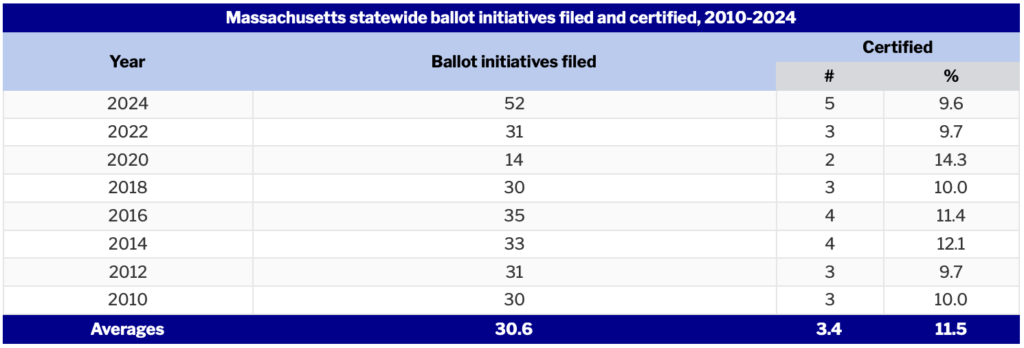
The table below shows the initiative certification rates in Massachusetts from 2010 and 2024.
The veto referendum already certified for the ballot will allow voters to decide whether to retain or repeal House Bill 4885, which made a number of changes to the state's firearm regulations. Among the bill’s provisions was one that allowed school administrators and licensed healthcare providers to request that a court issue an Extreme Risk Protection Order (ERPO).
Signatures pending verification in Alaska and Colorado
In Alaska, a campaign to repeal top-four primaries and ranked-choice voting (RCV) general elections filed signatures on Nov. 6. The initiative would adopt a party primary system. Voters enacted the top-four primaries and RCV in 2020.
The process is also indirect in Alaska. Proponents must submit 34,098 valid signatures in order for the initiative to go before the Alaska Legislature next year. That’s 10% of the votes cast in the last gubernatorial election.
In Colorado, a campaign to increase penalties for selling or possessing fentanyl submitted signatures on Nov. 20. Among its several provisions, the initiative would increase the felony penalties for manufacturing, dispensing, sale, and possession of fentanyl and certain synthetic opioids. Proponents must submit 124,238 valid signatures in order to qualify for the ballot. That’s 5% of the votes cast in the last secretary of state election.
Click here for more information on potential 2026 ballot measures.