


Welcome to the Wednesday, Dec. 10, Brew.
By: Briana Ryan
Here’s what’s in store for you as you start your day:
- A look at ballot measures affecting top-two, top-four primaries, RCV, state supreme court selection, and other electoral systems
- President Donald Trump has issued 196 endorsements so far this year
- Two Democrats are competing in the Jan. 31 special election runoff for Texas' 18th Congressional District
A look at ballot measures affecting top-two, top-four primaries, RCV, state supreme court selection, and other electoral systems
Heading into the 2026 elections, we're examining some of the themes we're seeing in potential ballot measures. So far, we have covered the following topics: abortion, marijuana and psychedelics, and citizenship voting requirements.
Today, we're focusing on measures related to electoral systems. So far, voters in seven states may consider measures related to electoral systems in 2026.
One electoral system-related measure is certified for the ballot. On Aug. 6, Kansas voters will decide on an amendment that would allow the direct election of Kansas Supreme Court justices and abolish the existing Kansas Supreme Court Nominating Commission.
Currently, the seven justices are selected through an assisted appointment method. The nominating commission is responsible for providing the governor with the names of nominees, who must then choose a justice from that list. The commission is composed of nine members: one lawyer and one non-lawyer from each congressional district, and one additional lawyer who serves as chairperson.
Nonpartisan elections for state supreme court justices are held in 13 states, while eight states hold partisan elections. The assisted appointment method, currently used in Kansas, is also used by 20 other states. Five states use the gubernatorial appointment method, and two states provide for legislative election.
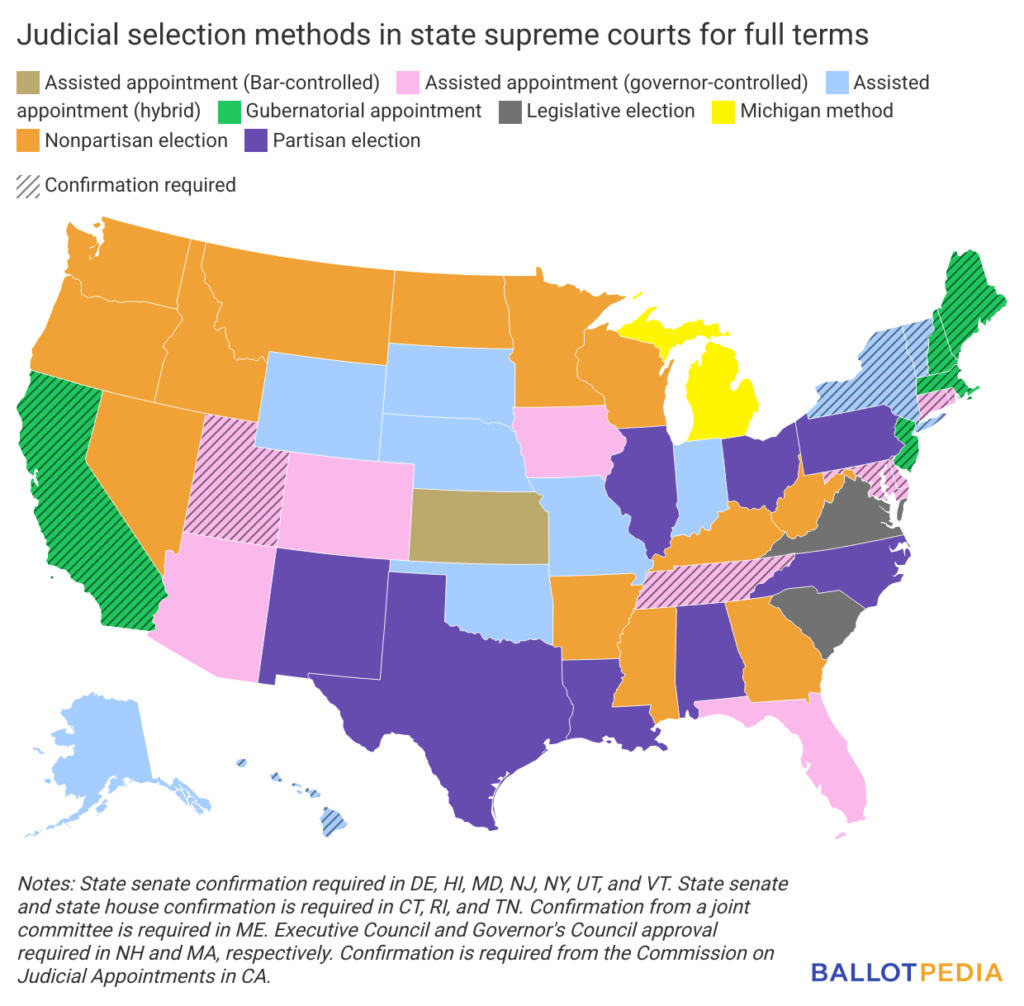
Signatures for two electoral system-related measures are pending verification:
Alaska voters could decide on an initiative that would eliminate the state's top-four primaries and ranked-choice voting(RCV) general elections. In Alaska, the initiative process is indirect, meaning that the Legislature can pass the measure if enough signatures are valid. Alaska has used the electoral systems since 2020, when voters approved a measure establishing them, 50.55% to 49.45%. In 2024, voters defeated a measure attempting to eliminate the systems, 50.1% to 49.9%.
Massachusetts voters could decide on an initiative that would replace partisan primaries with top-two primaries. In Massachusetts, the initiative process is indirect, meaning that the General Court can pass the measure if enough signatures are valid. If the General Court does not pass it, proponents must collect an additional 12,429 valid signatures.
Proponents for four electoral system-related measures are currently gathering signatures:
- In Michigan, proponents are gathering signatures for an amendment that would make multiple changes to election policy in the state, including implementing RCV in most federal, state, and local elections. Proponents must collect 46,198 valid signatures by July 6.
- In Montana, proponents are gathering signatures for two initiatives that would amend the state constitution to require that judicial elections be nonpartisan. While Montana statute already requires nonpartisan judicial elections, adding it to the constitution would require another constitutional amendment to change the elections from nonpartisan to partisan. Proponents of each measure must collect 60,241 valid signatures by June 19.
- In Nevada, proponents are gathering signatures for an amendment that would not require a voter to affiliate with a political party to participate in a publicly funded primary election. Proponents must collect 148,789 valid signatures by June 24.
- In Oklahoma, proponents are gathering signatures for an initiative that would establish top-two primaries in the state. Proponents must collect 172,993 valid signatures by Jan. 26.
During the last even-year election, voters decided on a record number of statewide measures on RCV, all of which voters rejected. In Colorado, Idaho, Nevada, and Oregon, voters rejected measures to adopt RCV. In Alaska, voters decided on an initiative to repeal RCV, which was adopted in 2020. In Missouri, voters approved an amendment that would preempt RCV.
There were other electoral system changes on the ballot, some of which could have led to the adoption of RCV. In Arizona, Proposition 140 would have replaced partisan primaries with primaries in which candidates, regardless of partisan affiliation, appear on a single ballot and a certain number advance to the general election, such as top-two or top-four primaries. Arizona Proposition 133, on the other hand, would have prohibited systems like top-two and top-four primaries, meaning Proposition 133 and Proposition 140 were competing measures. Both were rejected.
In Montana, voters rejected two electoral system measures, one to adopt top-four primaries and another to require a majoritarian vote system for general elections, such as runoff elections or RCV.
In South Dakota, voters defeated Amendment H, which would have replaced partisan primaries with top-two primaries.
Click here for more information on the status of statewide ballot measures for the 2026 elections.
President Donald Trump has issued 196 endorsements so far this year
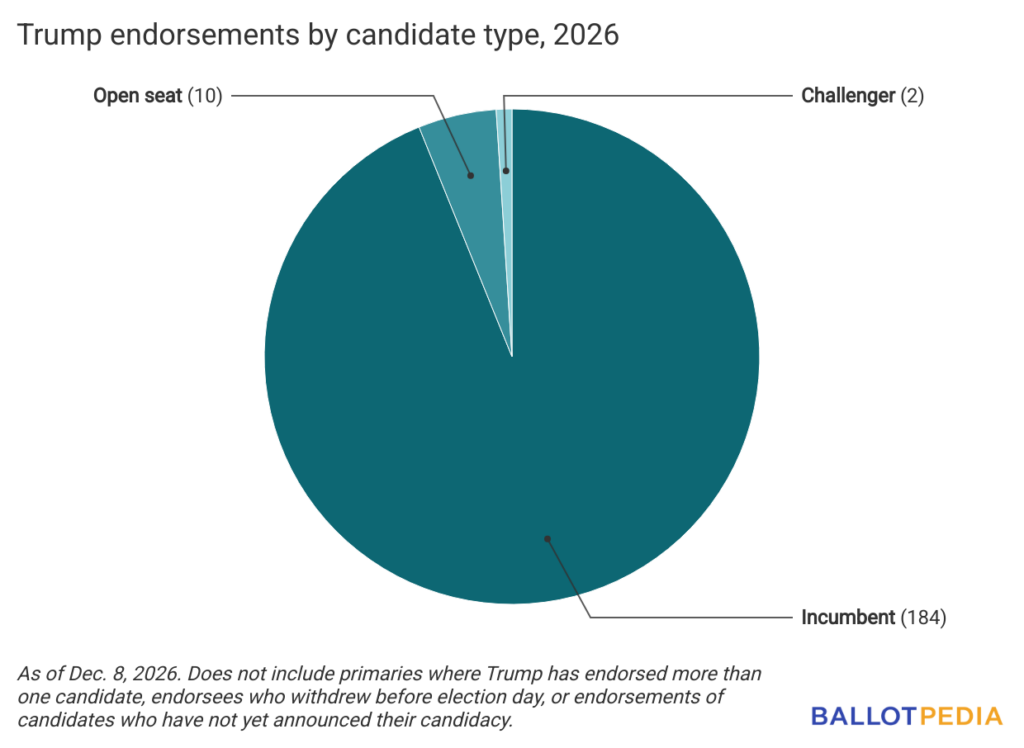
As of Dec. 8, President Donald Trump (R) has made 196 endorsements in 2026 primaries. Of these endorsements, 94% (184) are for incumbent Republicans, 5% (10) are for Republicans running for open seats, and 1% (2) are for Republicans challenging current incumbents.
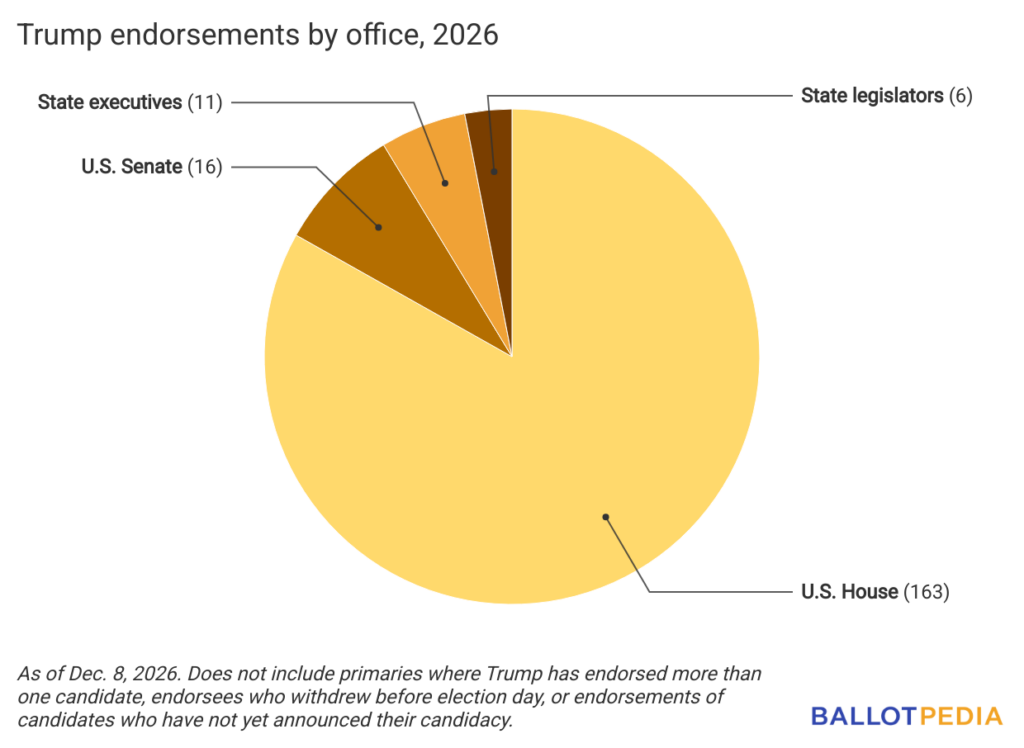
So far, Trump has issued endorsements in 38% (163 out of 435) of primaries for the U.S. House of Representatives, 46% (16 out of 35) of U.S. Senate primaries, 4% (11 out of 295) of state executive primaries, and 0.1% (six out of 6,155) of state legislative primaries.
Most of Trump’s endorsements so far—83% (163)—are in the U.S. House. His next most common endorsements are for U.S. Senate primaries at 8% (16), followed by state executive primaries at 6% (11), and state legislative primaries at 3% (6).
Trump’s 196 endorsements mark the third-highest total he has issued in a single primary cycle. His largest number of endorsements came in 2024, when he made 306, followed by 276 in 2022.
As of Dec. 8, we have identified 50 battleground primaries that are either Republican or allow candidates of all parties to run in the primary. Trump has endorsed candidates in seven of those primaries.
Two of these seven endorsements are in Republican primaries for state executive offices.
- Trump endorsed Georgia Lt. Gov. Burt Jones (R) in the state’s Republican gubernatorial primary. Incumbent Gov. Brian Kemp (R) is term-limited.
- Trump endorsed Joe Gruters (R) in the Republican primary for Florida Chief Financial Officer. Gruters is challenging incumbent Blaise Ingoglia (R).
The other five endorsements are in Republican U.S. House primaries:
- Texas’ 1st: Trump endorsed Rep. Nathaniel Moran (R), who faces Ryan Nichols (R) in the primary. Nichols received a pardon under Trump’s blanket pardon for defendants in cases related to the Jan. 6, 2021, breach of the U.S. Capitol.
- Kentucky’s 4th: Trump endorsed Ed Gallrein’s (R) primary challenge against Rep. Thomas Massie (R-Ky.). Massie has come into conflict with Trump’s legislative agenda at several points over the past year, including by being one of two Republicans to vote against the One Big Beautiful Bill Act in the U.S. House.
- Arizona’s 1st: Trump endorsed Arizona Republican Party Chair Gina Swoboda (R) in the open election to succeed Rep. David Schwiekert (R), who is running for governor of Arizona. Three independent election forecasters have rated the general election for the district as a Toss-Up, making it one of the seats likely to help determine the majority in the U.S. House.
- Arizona’s 5th: Trump endorsed former sheriff Mark Lamb (R) in the open election to succeed Rep. Andy Biggs(R), who is running for governor of Arizona.
- Tennessee’s 5th: Trump endorsed Rep. Andy Ogles (R), who faces former Tennessee Commissioner of Agriculture Charlie Hatcher (R) in the primary.
Click here to read more about Trump’s endorsements since 2018.
Two Democrats are competing in the Jan. 31 special election runoff for Texas' 18th Congressional District
On Jan. 31, Amanda Edwards (D) and Christian Menefee (D) will face off in a runoff election to represent Texas' 18th Congressional District. The winner will complete the term of Rep. Sylvester Turner (D), who died on March 5.
The two advanced to the runoff after no candidate won an outright majority in the Nov. 4 special election. In the special election—which included 16 candidates from all parties—Menefee won 30% of the vote to Edwards' 26%.
The winner of this election will be the fourth person to represent the district since 2024. Rep. Sheila Jackson Lee (D) represented the district from 1995 until her death in July 2024. On Nov. 5, 2024, Rep. Erica Lee Carter (D) won the special election to fill the vacancy, and Turner won the general election. Carter represented the district from Nov. 12, 2024, to Jan. 3, 2025, when Turner assumed office.
Now let's take a closer look at the runoff candidates.
Edwards served as an at-large representative on the Houston City Council from 2016 to 2020. Her priorities include addressing the cost of higher education, improving access to healthcare, and expanding resources for small business owners.
Menefee has served as Harris County Attorney since 2021. His priorities include protecting voting rights, lowering costs, and protecting access to contraception and fertility treatments.
According to The Texas Tribune's Natalia Contreras, "The 18th Congressional District, which includes inner Houston and surrounding Harris County areas, is home to more than 760,000 people. It was shaped by redistricting that followed the 1965 Voting Rights Act—signed into law by president Lyndon B. Johnson—and deliberately crafted to strengthen minority representation in Houston."
Click here for a deep dive into this runoff election.