


Voters in Alaska will decide on a ballot initiative to repeal the state's top-four ranked-choice voting system in 2026, unless the legislature approves substantially similar legislation during its upcoming session.
This would be the second time that voters have considered an initiative to repeal RCV in Alaska. RCV was first adopted in 2020, with the approval of Measure 2. In 2024, voters decided on an initiative to repeal RCV, which was defeated—49.9% 'Yes' to 50.1% 'No.' This was the narrowest ballot measure result in Alaska's history.
On Dec. 31, 2025, Lt. Gov. Nancy Dahlstrom (R) announced that 42,837 signatures were verified across 40 House districts, exceeding the requirement of 34,098 qualified signatures from at least 30 House districts.
In Alaska, a ballot initiative appears on the ballot at the first statewide election held at least 120 days after the legislature adjourns its session. The legislature could approve legislation that is "substantially the same as the proposed law," rendering the initiative void. The legislative session is expected to begin Jan. 20 and adjourn May 20. If the legislature instead adjourned one month earlier, on April 20, the initiative would be eligible to appear on the August 18, 2026, primary ballot. Otherwise, it would appear on the November 3, 2026, general election ballot.
The initiative would eliminate the state's top-four ranked-choice voting (RCV) system, which combines top-four primaries with ranked-choice voting in general elections.
The initiative would also repeal the campaign finance provisions enacted under Ballot Measure 2, which were designed to require persons and entities that contribute more than $2,000 per year from funds derived from donations, contributions, dues, or gifts to disclose the true sources of the political contributions. The ballot initiative defined true sources as persons and entities whose contributions are derived from wages, investment income, inheritance, or revenue from the sale of goods or services. Organizations that received less than $2,000 in dues or contributions per person per year were considered the true source.
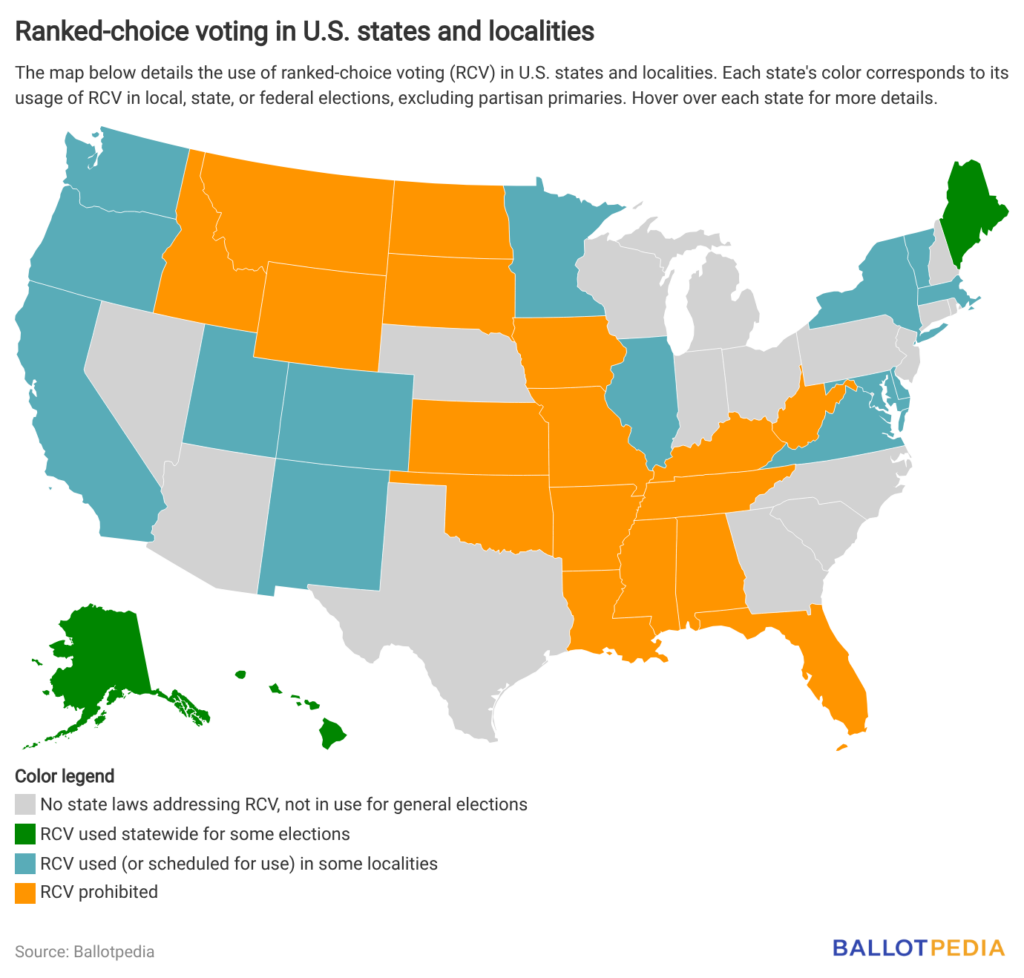
Currently, eight states, including Alaska, have laws authorizing or requiring the use of RCV for certain elections, while 17 states have laws prohibiting or restricting its use. Maine is the only state besides Alaska to use RCV in regular statewide elections. Hawaii also uses RCV in special federal elections.
Judy Eledge, chairperson of Repeal Now, said, "We really feel like there should be one vote, one person in the United States. We’re [one] of two states in the United States that has ranked choice voting. It’s extremely confusing to people, most certainly people that are maybe older and don’t understand it ... we’re just wanting to get rid of it because we just don’t think it’s a fair system."
Rebecca Braun, a member of the board of Alaskans for Better Elections, which supports RCV, said, "It might not be perfect, but I think that it’s better. I don’t think there’s any voting system that like has no distortions. Mathematicians study this, and there’s almost nothing where you have 100% perfect outcomes. But this seems like to me a better system."
This is the second measure to qualify for the 2026 ballot in Alaska. One initiative, which would establish campaign contribution limits for state and local offices, has already qualified for the ballot. Signatures are being collected for an initiative to change the voter qualification language to require that a person be a citizen and 18 years old to vote. Signatures must be submitted before the start of the legislative session, which begins Jan. 20, 2026.
Additional reading: