


Welcome to the Thursday, Jan. 8, Brew.
By: Lara Bonatesta
Here’s what’s in store for you as you start your day:
- Here's what the new U.S. Postal Service rule on postmarks means for absentee/mail-in voting
- Oregon voters to decide on veto referendum to repeal a gas tax increase and other parts of transportation bill in November
- The 2026 state legislative sessions have begun
Here's what the new U.S. Postal Service rule on postmarks means for absentee/mail-in voting
On Dec. 24, a new U.S. Postal Service (USPS) rule took effect, stating that mail is not necessarily postmarked on the day it is posted — implicating official documents that require postmarks, including tax returns, court documents, bill payments, and, in some states, absentee/mail-in ballots received after Election Day.
USPS officials have said the rule does not reflect a change in the agency's practices. In a section responding to concerns, the rulemaking documents state, "[T]he present rulemaking clarifies the meaning of the postmark, including for both election officials and voters who choose to use the mail to vote. ... [The rulemaking] educates voters who choose to use the mail to vote that they can take certain measures if they need a postmark date that aligns with the date of mailing[.]"
The new rule states that a postmark “does not necessarily indicate the first day that the Postal Service had possession of the mailpiece." Instead, postmarks “are generally applied by the Postal Service via automation on machines in originating processing facilities" and “do not necessarily represent either the place at which, or the date on which, the Postal Service first accepted possession of the mailpiece." The rule says that postmarks may be applied at a post office by customer request.
According to the Washington Post’s Anna Liss-Roy, “[A]t least one postal union leader says that this is a change from current practice and that, previously, mail would typically be postmarked for the day it came in, even if it was processed later. ‘I think it’s a huge deal,’ said Charles Charleston, president of the National Postal Mail Handlers Union Local 311, which represents mail handlers in Texas.”
The new rule has generated media attention as it relates to absentee/mail-in voting, and some election officials have urged voters to take the new rule, as well as earlier USPS processing changes, into account when voting.
“If you do want to wait until election day, you need to do 2 things. One, you need to use a ballot drop box instead of a mail drop box,” Elizabeth Gannon, executive director of the Peoria County Election Commission, told a local television station. “My second recommendation is to go into the postal office and have the clerk working put that postmark on your ballot, if that’s how you choose to return it.”
In comments to the Postal Service regarding the rule, the Montgomery County Board of Elections in Maryland said it was important for USPS to be transparent about any changes "to explain to voters how many days in advance they may need to mail their ballot for it to be postmarked by Election Day."
Fourteen states — Alaska, California, Illinois, Maryland, Massachusetts, Mississippi, Nevada, New Jersey, New York, Oregon, Texas, Virginia, Washington, and West Virginia — allow ballots received by a certain point after Election Day to be counted as long as they were postmarked on or before Election Day. Some states also require other election-related documents, such as voter registration applications, to be postmarked by a certain date if they are mailed.
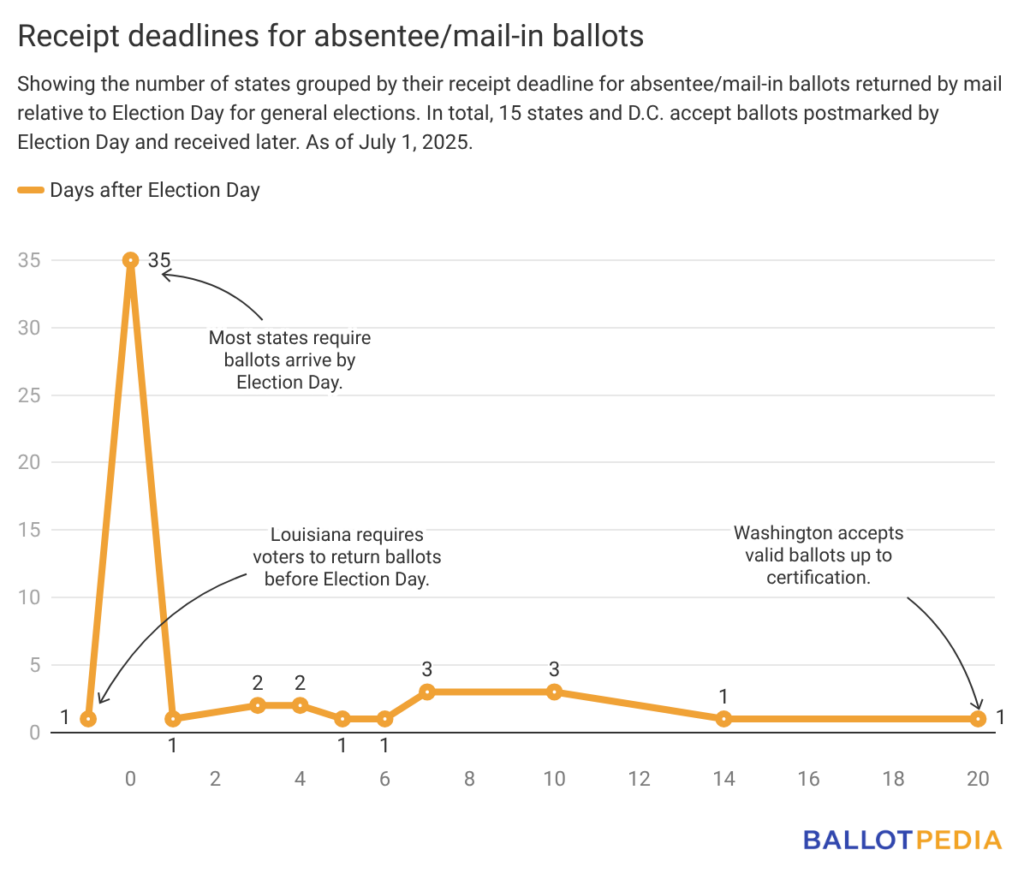
Thirty-six states require ballots be received by election officials on or before Election Day to be counted.
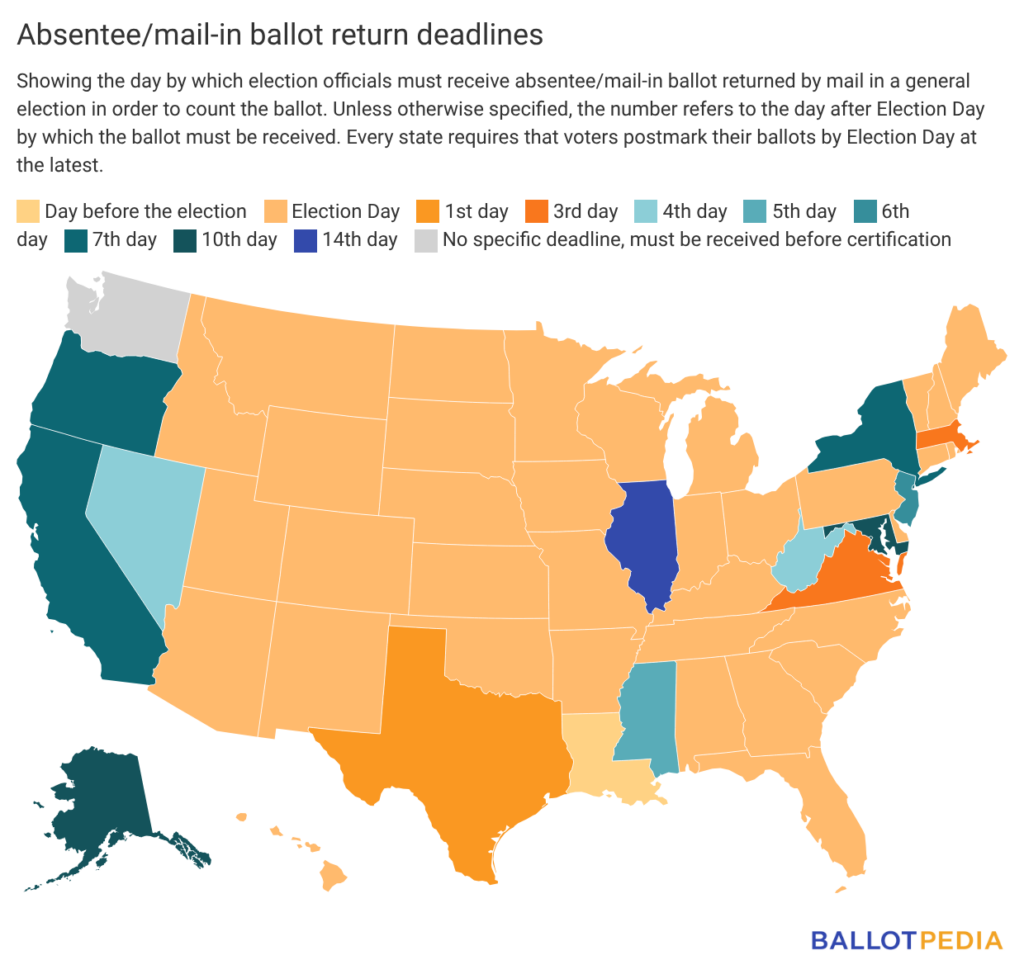
More states joined this group in 2025, with four states enacting laws requiring absentee/mail-in ballots to be received by the close of polls on Election Day. Those states are Kansas, North Dakota, Ohio, and Utah. North Dakota, Ohio, and Utah have Republican trifectas. In Kansas, the Republican-controlled Legislature overrode Democratic Gov. Laura Kelly’s veto.
In November, the U.S. Supreme Court agreed to hear Watson v. Republican National Committee, a case challenging the legality of a Mississippi law permitting absentee ballots postmarked by Election Day to be counted if they are received within five business days after the election.
In March, President Donald Trump (R) issued an executive order instructing the attorney general to take action to prevent states from counting absentee/mail-in ballots that arrive after Election Day. The order has since been challenged in court.
In the 2026 legislative sessions, lawmakers in three states have introduced or pre-filed bills related to absentee/mail-in voting deadlines, though only one bill pertains to when ballots must be received. Virginia SB 58 would allow ballots postmarked by Election Day and received by 5 p.m. on the third day after the election to be counted. Currently, ballots must be received by noon on the third day after the election.
Click here to learn more about absentee and mail-in voting.
Oregon voters to decide on veto referendum to repeal a gas tax increase and other parts of transportation bill in November
On Dec. 30, a veto referendum targeting the repeal of parts of a recently passed transportation funding bill, including an increase in the state’s gas tax, qualified for the Nov. 3 ballot in Oregon. The Oregon secretary of state’s office reported that 163,451 (85%) of the 191,828 signatures accepted for verification were valid. The required number of signatures was 78,116 (4% of the votes cast in the last gubernatorial election).
The referendum targets several sections of House Bill 3991, which the Democratic-controlled Legislature passed along party lines during a special session in September and Gov. Tina Kotek (D) signed on Nov. 7. The referendum would repeal parts of the bill that would increase the state's gas tax from $0.40 to $0.46, and also increase a payroll tax for transportation from 0.1% to 0.2%. The referendum would also repeal increases in vehicle registration fees. The Legislative Revenue Office estimated the increases would generate $791 million in the 2025-27 budget cycle.
Because the veto referendum qualified for the ballot, these increases, which were set to take effect on Jan. 1, have been paused until voters decide on the referendum.
Twenty-three states allow citizens to initiate veto referendums. Oregon is one of 18 states where a 'yes' or 'for' vote means that the targeted legislation would be upheld, and a 'no' or 'against' vote means the law would be repealed. In three states, a 'yes' or 'for' vote means that the challenged legislation would be repealed. In California and Nebraska, voters are given explicit language, such as “Keep the law” or “Retain.”
Oregon voters last voted on a veto referendum in January 2018, when they approved Measure 101, upholding sections of House Bill 2391, which set certain assessments and taxes on healthcare insurance and the revenue of certain hospitals to provide funding for Medicaid expansion. Since 1900, Oregon voters have decided on 67 veto referendums—upholding 27 laws and repealing 42.
This is the first measure to be certified for the 2026 ballot in Oregon. As of Jan. 1, 73 ballot initiatives have been filed with the secretary of state, with eight cleared for signature gathering. In even-year cycles between 2010 and 2024, proponents filed an average of roughly 63 initiatives. An average of four initiatives qualified for statewide ballots in each even year.
Click here to learn more about the veto referendum in Oregon and here to learn more about Oregon’s 2026 ballot measures.
The 2026 state legislative sessions have begun
As state legislatures across the country begin to convene for their 2026 sessions, let's take a look at their start dates.
According to the latest update from the 2026 MultiState Insider Resource, as of Jan. 7, 14 states have started their legislative sessions. One state, Indiana, convened in December. Two states, California and Ohio, convened on Jan. 5. Five states convened on Jan. 6. Six states convened on Jan. 7.
Arizona, Georgia, Idaho, Iowa, Kansas, and Washington are scheduled to begin their legislative session next on Jan. 13. Five states are scheduled to begin their legislative sessions in February, one in March, and two are scheduled in April.
The two latest states — Arkansas and North Carolina — will begin their sessions in April.
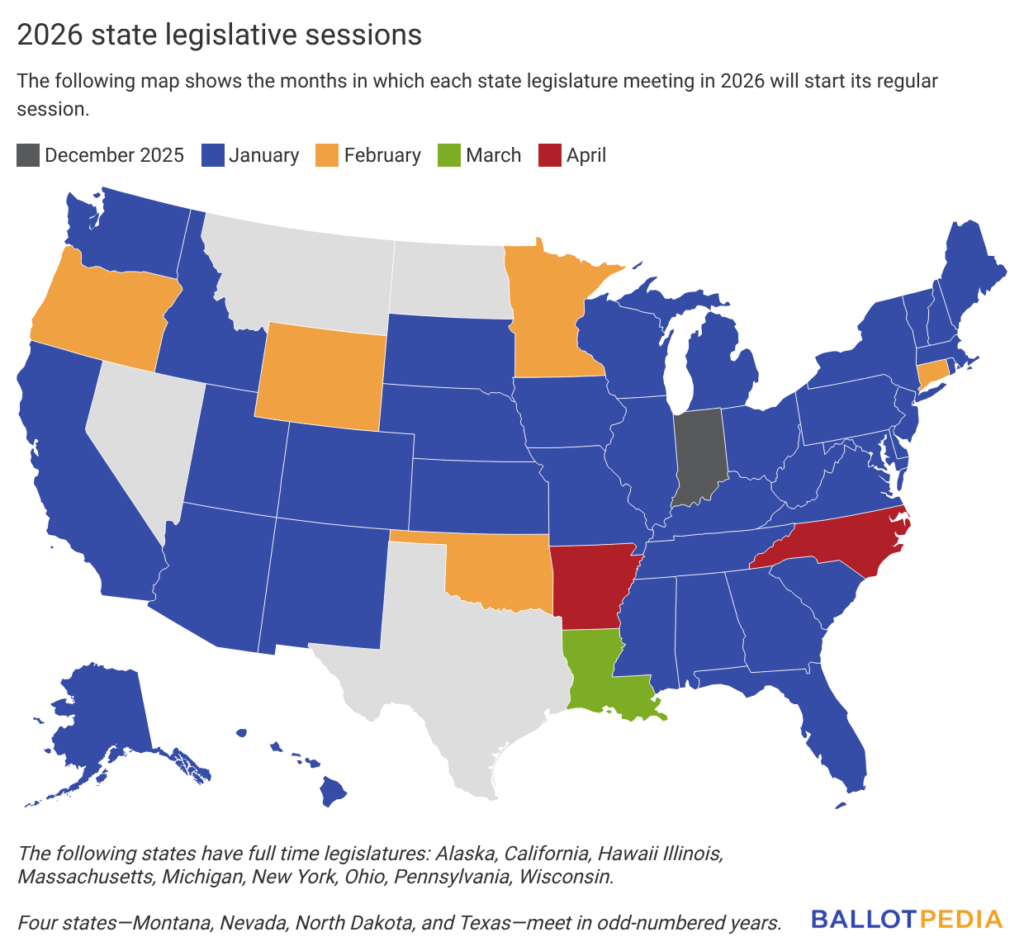
Ten state legislatures have full-time legislators, meaning they meet throughout the year. All other legislators are considered part-time because they only meet for a portion of the year. Arkansas, New Mexico, Oregon, and Wyoming will have the shortest sessions, lasting about a month.
There will be one more Democratic trifecta in 2026 than in 2025. Virginia will change from a divided government to a Democratic trifecta when governor-elect Abigail Spanberger (D) is sworn in on Jan. 14. As a result, there will be 23 Republican trifectas, 16 Democratic trifectas, and 11 divided governments.
Forty-six state legislatures hold sessions every year. In four states—Montana, Nevada, North Dakota, and Texas—the legislature meets only in odd-numbered years. Click here to learn more about the 2026 legislative sessions.