



Federal grants make up a significant share of state budgets, and states use a wide range of statutory frameworks to review, approve, and manage these funds. These frameworks determine which actors—governors, legislatures, agencies, auditors, or the public—play a role in evaluating grant applications, accepting federal dollars, and regulating how entities administer those funds. Collectively, these activities comprise states' oversight of federal funds.
Federal grants totaled about $1.12 trillion in 2023, accounting for 36.7% of all state revenue. Federal funds as a portion of total revenue differs widely across states: Louisiana received the highest share from federal sources at 51.6%, while Hawaii had the lowest at 26.6%. In total dollars, California received the most intergovernmental revenue at $137.7 billion, and South Dakota received the least at $2.6 billion.
States vary significantly in how they structure oversight of these funds. This diversity reflects broader federalism concerns—such as how states balance fiscal dependence with administrative autonomy, and how they respond to federal mandates that may influence state policy priorities. Click here for state-specific details about the organization of oversight systems.
In some states, governors play an important role in providing oversight of grants, while in others they play none. Some states provide that a specific agency manage federal grants, while elsewhere agencies' role remains undefined. These variations extend to other aspects of state oversight. See below for 50-state breakdowns of specific types of oversight provisions, and click here to find more details about all of these topics and more on federal grants in the states.
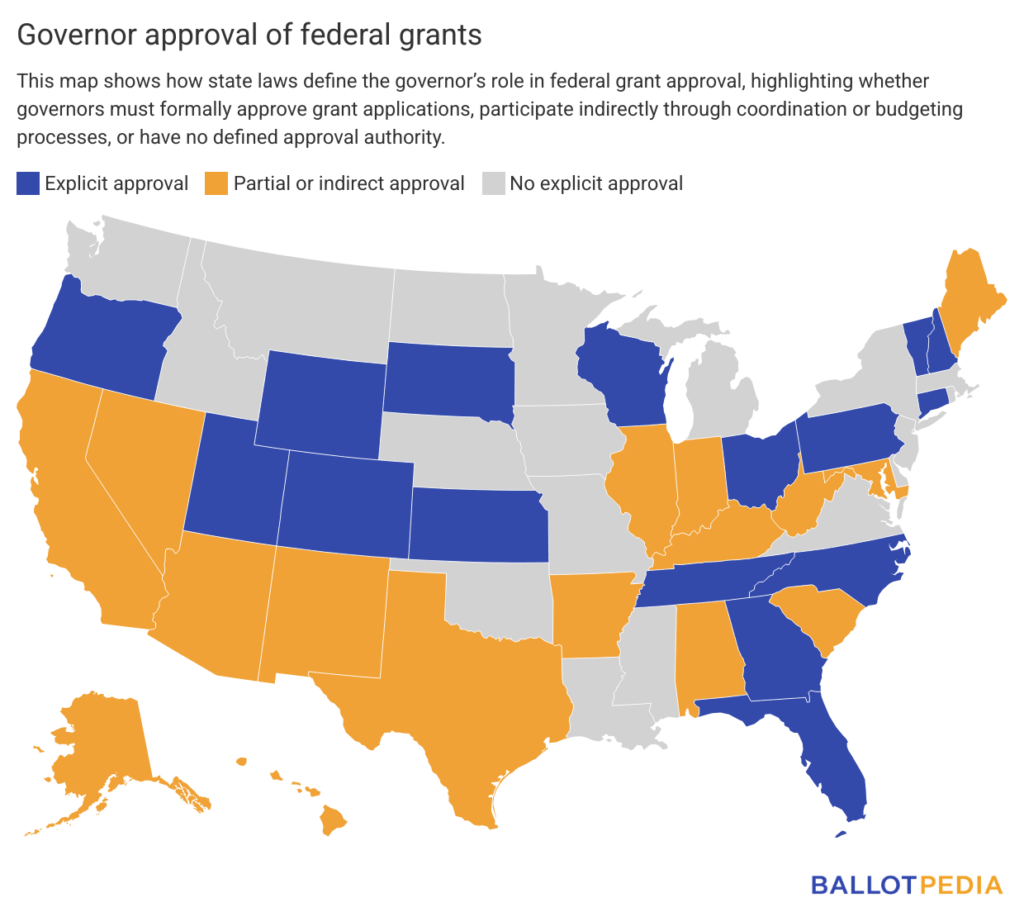
Executive (gubernatorial) approval
This section addresses whether governors have a formal approval role in the grant application process. States can also employ other forms of executive oversight. State executive approval of federal grants includes:
- Explicit approval: 16 states require governors to approve federal grants.
- Partial or indirect approval: 16 states involve governors through coordination, notification, or budget review.
- No approval role: 18 states assign approval authority to agencies, budget offices, or legislatures.
Legislative approval
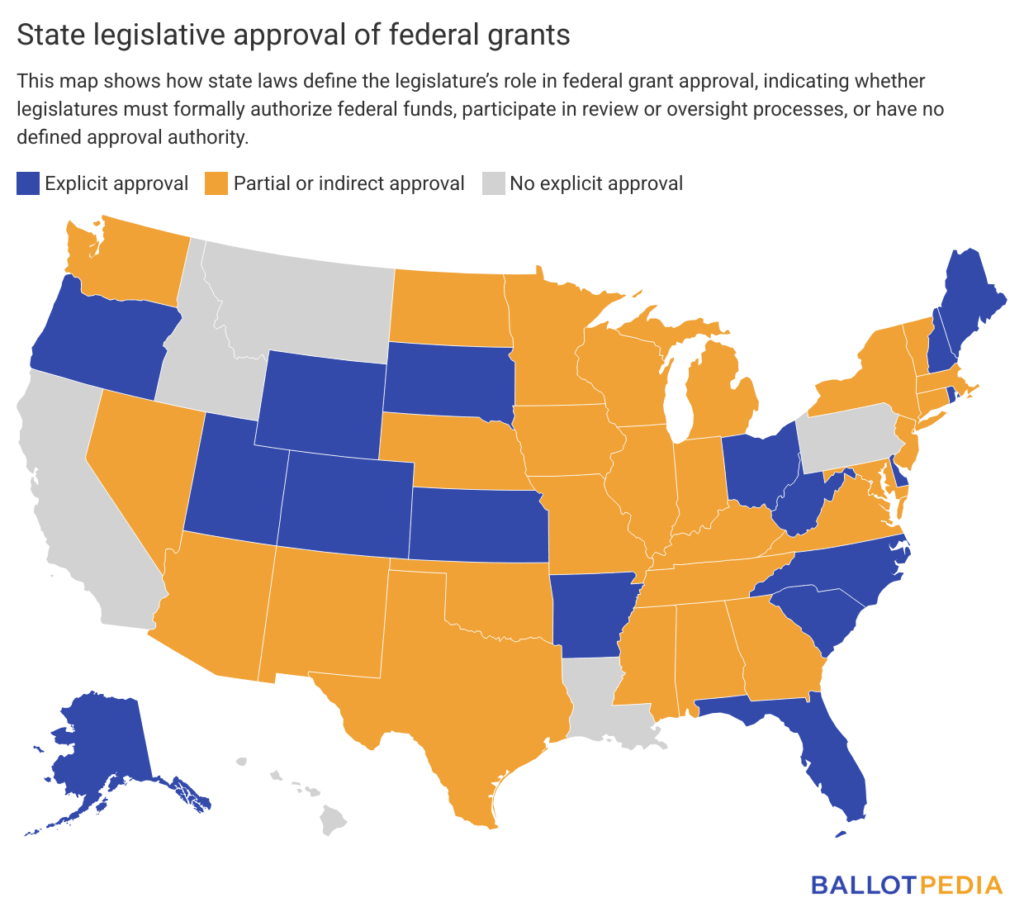
States can also employ many forms of legislative oversight, and many states designate an approval role to the legislature. State legislative approval of federal grants includes:
- Explicit approval: 17 states require legislative approval—either by the full legislature or a designated committee.
- Partial or indirect approval: 27 states rely on reporting, fiscal review, or notification without formal approval.
- No approval role: 6 states assign no statutory approval responsibility to lawmakers.
Agency oversight
The amount of responsibility that states assign to agencies in oversight of federal grants varies. Twenty-five states centralize grant management in a single administrative or budget office, 15 states distribute duties across multiple agencies, and 10 states do not assign a defined oversight role to any central agency.
Public oversight
State public oversight of federal grants rules include nine states that require public hearings, databases, or other public-facing disclosures related to federal grants; two states provide limited transparency; the remaining 39 states have no statutory public-access requirements.
Contingency plans
State contingency plans for federal grants are limited. Only four states require agencies to prepare plans for reduced or withdrawn federal funding. The other 46 states have no mandatory contingency-planning requirements.
Additional reading: