



On January 12, 2026, former U.S. Rep. Mary Peltola (D) announced her campaign for U.S. Senate against incumbent Dan Sullivan (R). With Peltola’s entry into the race, we’re taking a look at Alaska’s use of ranked-choice voting (RCV) since its adoption in 2020 and how it's played out in other statewide elections.
Peltola was first elected in a special election in 2022, re-elected for a full term that year, and defeated in 2024. Notably, these were the first elections in Alaska's history where the state used ranked-choice voting to determine a winner.
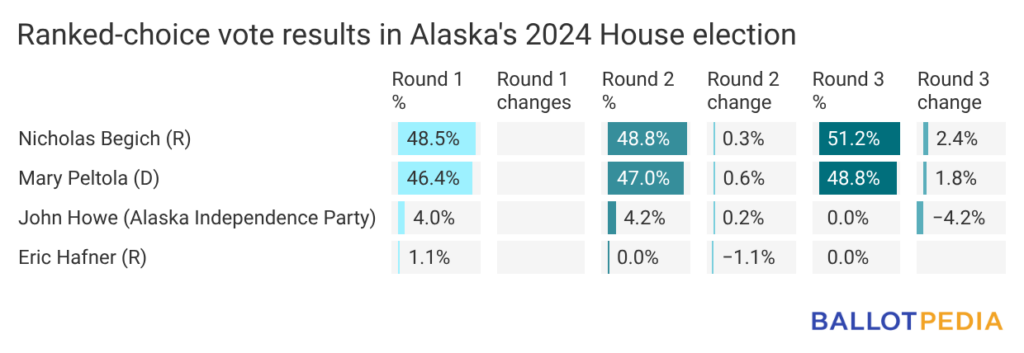
- The first election to use the system in Alaska was the special House election to fill late Rep. Don Young’s (R) seat in 2022. In that election, Peltola defeated former Gov. Sarah Palin (R) 51.5% to 48.5% in the second round of RCV.
- In the November 2022 election, Peltola defeated Palin 55% to 45% in the third round.
- In November 2024, Nicholas Begich (R) defeated Peltola 51% to 49% in the third round.
Alaska has held one other U.S. Senate election since adopting RCV in 2020. In 2022, incumbent Lisa Murkowski (R) defeated Kelly Tshibaka (R) 53.7% to 46.3% in the third round.
Alaska began using ranked-choice voting as a result of a 2020 ballot measure that passed with 51% in favor and 49% against. In this new system, the four candidates who receive the most votes advance to the general election, regardless of their party affiliation. In the general election, voters rank candidates in order of preference. If in the initial count no candidate receives 50% of the vote, the candidate with the fewest votes is eliminated, and those votes are reallocated according to how those voters ranked the remaining candidates. This process continues until a candidate has at least 50% of the vote.
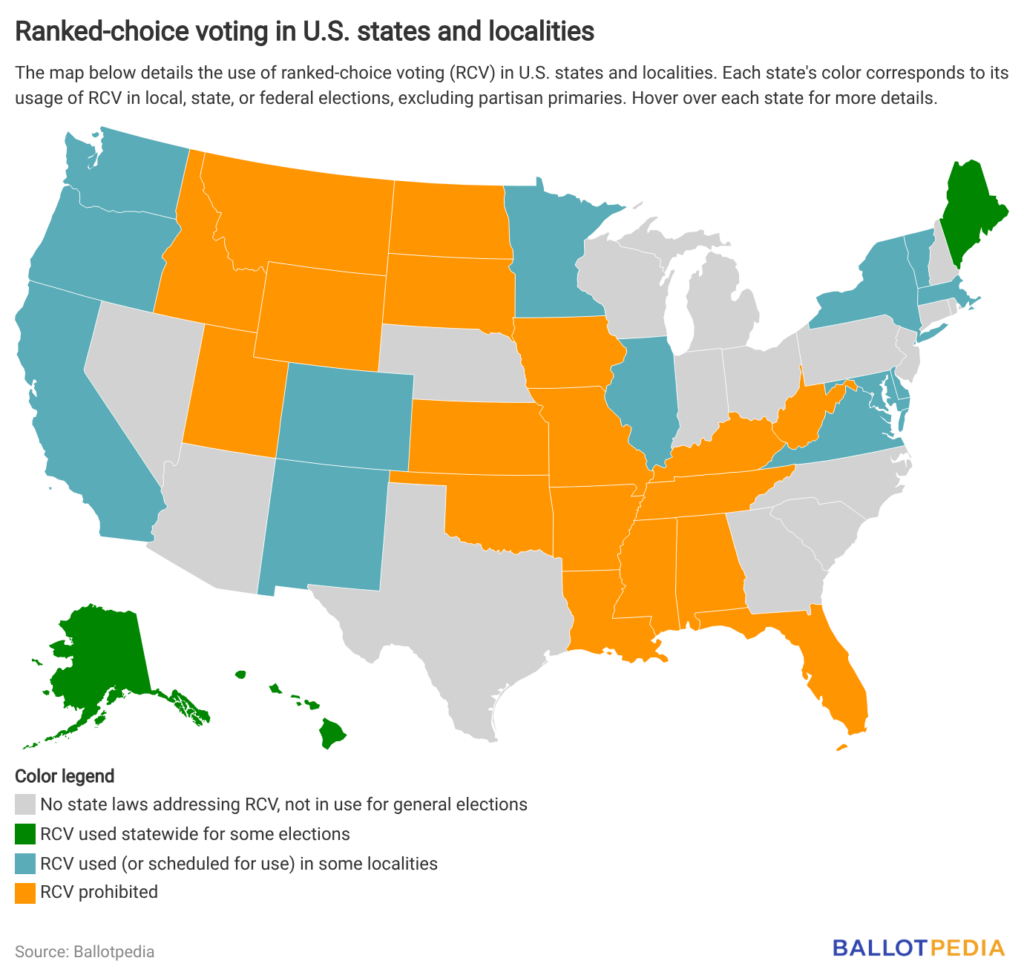
Alaska is one of three states, along with Hawaii and Maine, to use RCV. Washington, D.C., also uses it. Eighteen states have banned RCV, and 13 have localities that use it, while it is not in use statewide.
Since the initiative for ranked-choice voting passed, there have been attempts to repeal it. In 2024, an indirect initiated state statute to repeal ranked-choice voting appeared on the ballot and was defeated by just 743 votes or 0.24% of the vote. This was the narrowest result for a ballot measure in Alaska's history. This year, another measure to repeal ranked-choice voting will appear on the ballot alongside the state’s races for U.S. Senate, governor, state House, and state Senate.