



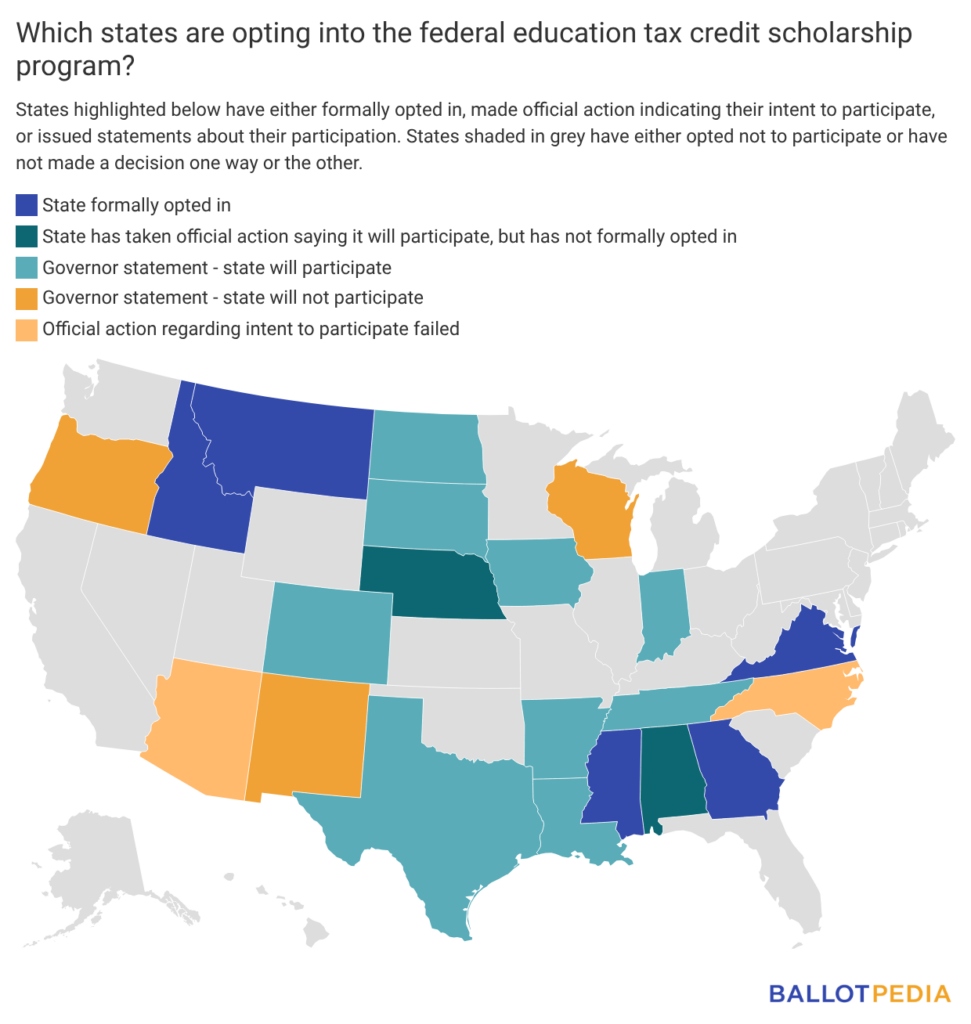
As of Jan. 26, 11 states had taken action this month to indicate participation in the federal school choice tax credit program.
- Five states—Georgia, Idaho, Mississippi, Montana, and Virginia—formally opted into the program by submitting Internal Revenue Service (IRS) Form 15714, according to public records.
- Two states—Alabama and Arizona—took official action to participate in the program through an executive order and legislation, respectively, but did not formally opt in. Arizona Governor Katie Hobbs (D) vetoed the legislation on Jan. 16.
- Governors of four states—Arkansas, Indiana, Iowa, and North Dakota— said their states would participate in the program, but did not formally opt in, according to public records.
Twenty-one states in total have indicated participation in the program. Entities designated under each state's law to make elections on behalf of the state regarding federal tax benefits can decide to opt a state in; this includes governors, agencies, legislatures, or other individuals.
States must opt in to participate in the federal school choice tax credit. They must provide the U.S. Treasury with a list of eligible scholarship-granting organizations (SGOs), who will administer scholarships using the tax-deductible donations gathered through the federal program.
The IRS issued a notice on Dec. 12, 2025, allowing states to submit IRS Form 15714 to make an advance election to participate in the program. The notice said that the deadline and procedure for "perfecting the [a]dvance [e]lection by submitting the State SGO list will be provided in future guidance."
Virginia submitted a list of twelve SGOs that it said was subject to change as guidance from the IRS was issued. Mississippi Governor Tate Reeves (R) and North Dakota Governor Kelly Armstrong (R) said they would designate a list of eligible SGOs in the coming months. Besides the three states, Ballotpedia did not identify public statements about SGO lists as of Jan. 27.
Partisan breakdown
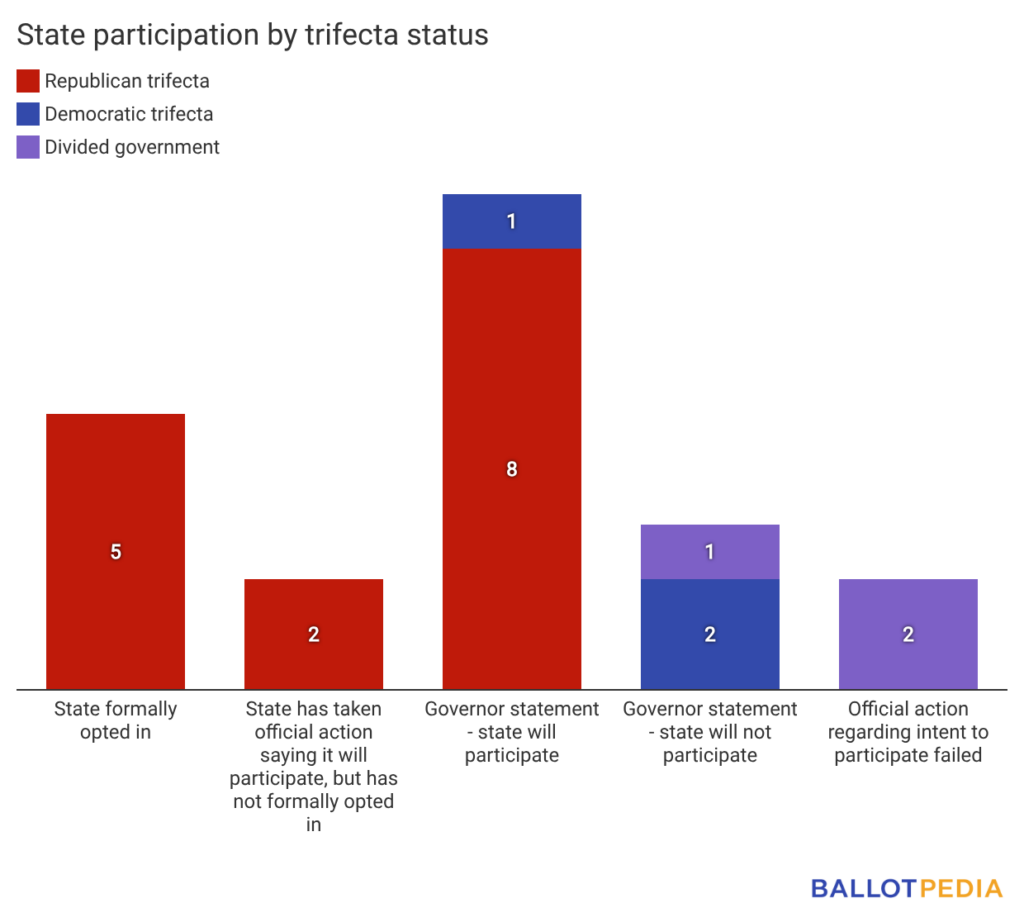
Of the states that have taken action regarding participation in the federal school choice tax credit scholarship program, 14 have Republican trifectas, four have Democratic trifectas, and three have divided governments.
Of the states with Republican trifectas:
- Four states—Georgia, Idaho, Mississippi, and Montana—have formally opted into the program by submitting IRS Form 15714.
- Two states—Alabama and Nebraska—have taken official action—both through executive orders—to indicate participation in the program.
- Eight states—Arkansas, Indiana, Iowa, Louisiana, North Dakota, South Dakota, Tennessee, and Texas—have said they will participate in the program, but have not taken official action.
Of the states with Democratic trifectas:
- One state—Virginia—formally opted into the program by submitting IRS Form 15714, though then-Governor Glenn Youngkin (R) opted the state in before his successor Abigail Spanberger (D) was sworn in on Jan. 17. The state had a divided government at the time it opted in.
- One state—Colorado—said it would participate in the program, but has not taken official action.
- Two states—New Mexico and Oregon—said they would not participate in the program.
Of the states with divided government:
- The legislature in all three states—Arizona, North Carolina, and Wisconsin—passed legislation to opt the state into the program, but the governors of Arizona and North Carolina vetoed the legislation. Wisconsin's legislation was pending Governor Tony Evers' (D) action as of Jan. 27, though Evers said in Sept. 2025 that he wouldn't opt Wisconsin into the program.
Background
The One Big Beautiful Bill Act (OBBBA) established the federal school choice tax credit scholarship when President Donald Trump (R) signed the bill into law in July 2025. It is a nonrefundable tax credit that allows individuals to receive up to $1,700 of federal tax credits for donations to SGOs. States must opt in to participate.
SGOs are non-profit organizations that manage contributions and distribute scholarship funds to eligible families or individuals, who can use the funds on a variety of private or public educational expenses, including private school tuition, tutoring services, and textbooks. Because many states have some form of state-level tax credit for certain educational expenses, SGOs already exist in many states, with some providing services in multiple states.
Students in states that do not opt in cannot receive scholarships funded under the program, but donors in those states can still receive a federal tax credit by donating to SGOs in participating states. In order to qualify for a scholarship under the program, students must live in households earning no more than 300% of the area's median gross income and be eligible to enroll in K-12 schools.
The U.S. Treasury must issue regulations for the program. The Internal Revenue Service (IRS) issued a notice requesting comments on proposed implementation of the program on Nov. 26. Though the comment period closed on Dec. 26 after gathering over 2,000 comments, the IRS was accepting late comments as of Jan. 16.
To learn more about how the federal school choice tax credit scholarship works, click here.
Additional reading: