


Welcome to the Thursday, Feb. 5, 2026, Brew.
By: Lara Bonatetsa
Here’s what’s in store for you as you start your day:
- Maria Lazar and Chris Taylor are running in the nonpartisan Wisconsin Supreme Court election on April 7
- Maine is one of four states that could decide on a ballot initiative that would restrict school sports eligibility based on sex
- Special election today in New Jersey’s 11th Congressional District
Maria Lazar and Chris Taylor are running in the nonpartisan Wisconsin Supreme Court election on April 7
Maria S. Lazar and Chris Taylor are running in the general election for Wisconsin Supreme Court on April 7. Incumbent Rebecca Bradley is not running for re-election.
Wisconsin’s supreme court elections are officially nonpartisan, but candidates often take stances on specific issues and receive backing from the state's political parties during their campaigns. Lazar's campaign website says that she is not a member of a political party. Media outlets have identified her as a conservative, and she worked in the state attorney general's office under Republican J.B. Van Hollen. Taylor is a former Democratic member of the Wisconsin Assembly.
Liberals are expected to have a majority on the Court until at least 2028. Bradley is a member of the Court's conservative minority. If Lazar wins, the Court would maintain its 4-3 liberal majority. If Taylor wins, the liberal majority would increase from 4-3 to 5-2.
Lazar is a judge for District II of the Wisconsin Court of Appeals. She was a judge on the Waukesha County Circuit Court from 2015 to 2021 and an assistant attorney general for the Wisconsin Department of Justice from 2010 to 2015. Before that, she worked in private practice. On her campaign website, Lazar describes her judicial philosophy: "First, our written laws are a fundamental pillar in our democracy, and a judge must be independent of agendas, parties, and bias. Next, the law is to be a level playing field: no person is above or beneath the law."
Taylor is a judge for District IV of the Wisconsin Court of Appeals. She was a judge on the Dane County Circuit Court from 2020 to 2023 and a Democratic state legislator from 2011 to 2020. She also previously worked as the public policy director for Planned Parenthood of Wisconsin. Taylor's campaign website states, "Her judicial philosophy is people-centered, grounded in making sure individuals get a fair chance in our courts, and that their Constitutional rights are protected. … She is a strong advocate for maintaining the independence of the judiciary, which must also serve as a check on the other branches of government."
Liberals have had a 4-3 majority since the April 2023 election, when Janet Protasiewicz won an open seat, defeating Daniel Kelly 55.4% to 44.4% and shifting ideological control of the Court for the first time in 15 years. In April 2025, liberals retained their 4-3 majority when Susan Crawford defeated Brad Schimel 55.0% to 44.9%. The last time a conservative won an election for the Wisconsin Supreme Court was in 2019, when Brian Hagedorn defeated Lisa Neubauer 50.2% to 49.7%.
Campaign finance reports covering the second half of 2025 show that Taylor raised $2 million and Lazar raised $198,000 by Dec. 31. The 2023 and 2025 Wisconsin Supreme Court elections broke records as the most expensive judicial races in U.S. history at the time of each election. According to WisPolitics, candidates and satellite groups spent more than $100 million in the 2025 election and more than $56 million in the 2023 election.
The 2025 election also had record voter turnout for a Wisconsin spring election in a non-presidential election year, at 50%. The previous record was in 2023, when turnout was 39.7%.
Wisconsin is also holding elections for three intermediate appellate court judges in April. In November, the state will hold elections for U.S. House and governor, as well as other state executive and state legislative offices.
Click here to read more about Wisconsin’s 2026 Supreme Court election.
Maine among four states with potential ballot initiatives that would restrict school sports eligibility based on sex
On Feb. 2, the campaign Protect Girls Sports in Maine submitted more than 82,000 signatures in support of a ballot initiative that would require that public school sports teams designated for girls or boys be limited to students of the corresponding sex, as recorded on their original birth certificates.
The Maine Secretary of State’s office is now checking the validity of the signatures. To be put before the Legislature, the initiative needs 67,682 valid signatures.
Maine’s initiative process is indirect: if an initiative has enough valid signatures, it will be presented to the Legislature. Legislators can then adopt the initiative or reject it. If legislators take no action or reject the initiative, it is placed on the ballot for voters to decide. Maine is one of nine states that have indirect initiatives.
If the proposed initiative in Maine qualifies for the ballot, it will be placed on the November 2026 statewide ballot.
According to the initiative’s wording, public schools would be required to designate athletic teams as male, female, or coeducational. Students would be permitted to participate on coeducational teams or a team matching the sex on their original birth certificate. Female students would be allowed to participate on male-designated teams when no female-designated team is available for that sport. Public schools would also be required to maintain separate restrooms, locker rooms, shower rooms, and other private spaces for each sex.
Similar initiatives in other states
Similar measures have been introduced in Colorado, Nevada, and Washington. In Colorado and Nevada, the initiatives are currently gathering signatures to qualify for the 2026 ballot.
The Washington measure is also an indirect initiative. The measure is now awaiting action from the Washington Legislature and will be placed on the November 2026 ballot if it is not approved.
While the Maine initiative would define a student’s sex based on the original birth certificate, the Washington initiative would instead rely on a signed statement from the student’s personal health care provider verifying the student’s sex. That verification could be based on one or more of the following: the student’s reproductive anatomy, genetic makeup, or normal endogenously produced testosterone levels.
No state has previously put a ballot measure before voters that would require public schools to limit participation on male and female sports teams to students of the corresponding sex. Although 27 states have enacted laws addressing this issue, voters have never decided such policies through ballot measures.
Support and opposition for the measure
Through Dec. 31, the PAC Safeguard Girls Sports raised $800,000. Republican donor Richard Uihelin donated that total amount. No committee had filed to oppose the measure.
U.S. Sen. Susan Collins (R), former Gov. Paul LePage (R), and the Republican Party of Maine, among others, support the measure. The Maine Women’s Lobby, Equality Maine, the Maine Council on Aging, and the Maine Chapter of the American Academy of Pediatrics have announced they oppose the initiative.
In 2025, Legislative Document 233 and Legislative Document 1134, two bills that would have prohibited males from participating in programs or using facilities designated for females, were introduced in the Maine Legislature. Neither bill received a vote in the Legislature during the 2025 session.
Click here to learn more about the proposed initiative in Maine.
Special election today in New Jersey’s 11th Congressional District
Voters are headed to the polls today, Feb. 5, to choose a nominee in the special Democratic primary for New Jersey's 11th Congressional District. Eleven candidates are running. John Bartlett, Brendan Gill, Tom Malinowski, Analilia Mejia, and Tahesha Way lead in endorsements and media attention. The previous incumbent, Mikie Sherrill (D), resigned on Nov. 20, after she was elected New Jersey's 57th governor.
The New York Times' Tracey Tully wrote that "the heightened level of candidate interest stems both from the rarity of an open seat in the middle of a congressional cycle and from New Jersey's recent changes to its primary ballot design, which weakened the power of local party leaders and helped to level the playing field for independent candidates."
According to NJ Spotlight News' Colleen O'Dea, the district was "once considered a safe Republican district, it shifted for Democrats when Sherrill won a decisive victory in the 2018 blue wave, defeating state Assemblyman Jay Webber (R-Morris) after incumbent Republican Rodney Frelinghuysen retired that year."
Bartlett was first elected to an at-large seat on the Passaic County Board of County Commissioners in 2012. He is also a partner at the law firm Murphy Orlando LLC. The Passaic County Democratic Committee endorsed Bartlett.
Gill was first elected to an at-large seat on the Essex County Board of County Commissioners in 2010. He is also the CEO of the consulting firm, the BGill Group, and the chair of the Montclair Democratic County Committee. Former New Jersey Gov. Phil Murphy (D) and the Essex County Democratic Committee endorsed Gill.
Malinowski represented New Jersey's 7th Congressional District from 2019 to 2023. He previously worked as a senior director on the National Security Council during the Clinton administration and as an assistant secretary in the U.S. Department of State during the Obama administration. U.S. Sen. Andrew Kim (D-N.J.) and the Morris County Democratic Committee endorsed Malinowski.
Mejia is the co-director of the Center for Popular Democracy. She previously served as the deputy director of the Women's Bureau in the U.S. Department of Labor during the Biden administration and as political director on Sen. Bernie Sanders' (I-Vt.) 2020 presidential campaign. Sanders and Newark Mayor Ras J. Baraka endorsed Mejia.
Way served as New Jersey’s Lieutenant Governor from 2023 to 2026 and as New Jersey’s Secretary of State from 2018 to 2026. She served on the Passaic County Board of County Commissioners from 2008 to 2010 and as special counsel with the Passaic County Board of Social Services. The Passaic County Democratic Committee endorsed Way.
Zach Beecher (D), J-L Cauvin (D), Cammie Croft (D), Jeffrey Grayzel (D), Justin Strickland (D), and Anna Lee Williams (D) are also running. Cauvin, Croft, Strickland, and Williams completed Ballotpedia's Candidate Connection survey. To read their responses, click here.
The winner of the primary will face Joe Hathaway, the only Republican candidate, in the special general election on April 16. The winner of that election will serve the remainder of Sherrill's term.
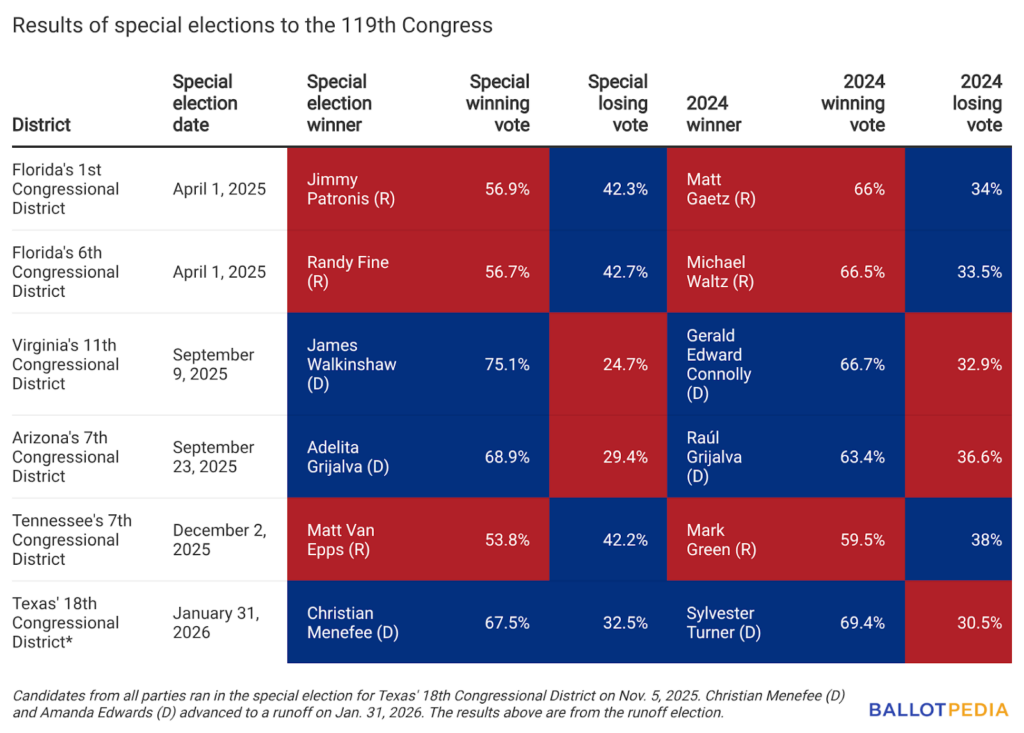
As of Feb. 3, 11 special elections have been called for the 119th Congress. From the 113th Congress to the 118th Congress, 80 special elections were held. For more data on historical congressional special elections, click here.
Click here to read more about the special Democratic primary.