


Welcome to the Friday, Feb. 13, 2026, Brew.
By: Lara Bonatesta
Here’s what’s in store for you as you start your day:
- Twenty-five states weigh legislation on foreign funding in elections
- Closer to home: Local races to watch in early 2026, by Leslie Graves, Ballotpedia Founder and CEO
- Four states have filing deadlines upcoming in the next two weeks
Twenty-five states weigh legislation on foreign funding in elections
Lawmakers in 25 states are considering new state laws or constitutional amendments so far this year related to foreign funding in elections.
Federal law prohibits federal, state, and local candidates from soliciting, directing, or receiving contributions from individuals who are not citizens or permanent residents of the United States. The law also bans contributions from foreign governments, political parties, corporations, organizations, or groups whose principal place of business is in a foreign country.
Federal courts, however, have established that the federal ban does not apply to issue advocacy, such as lobbying or spending in ballot measure campaigns. The Federal Election Commission has affirmed that foreign individuals, corporations, and governments can contribute to ballot measure campaigns.
Beyond federal law, 37 states have enacted their own bans on foreign contributions in some types of elections:
- Twelve states have state-level prohibitions on foreign contributions to candidates.
- Six states prohibit contributions from foreign individuals and groups to ballot measure campaigns.
- Seventeen states prohibit foreign contributions to both candidate and ballot measure campaigns.
- Two states have prohibitions on foreign groups making independent expenditures.
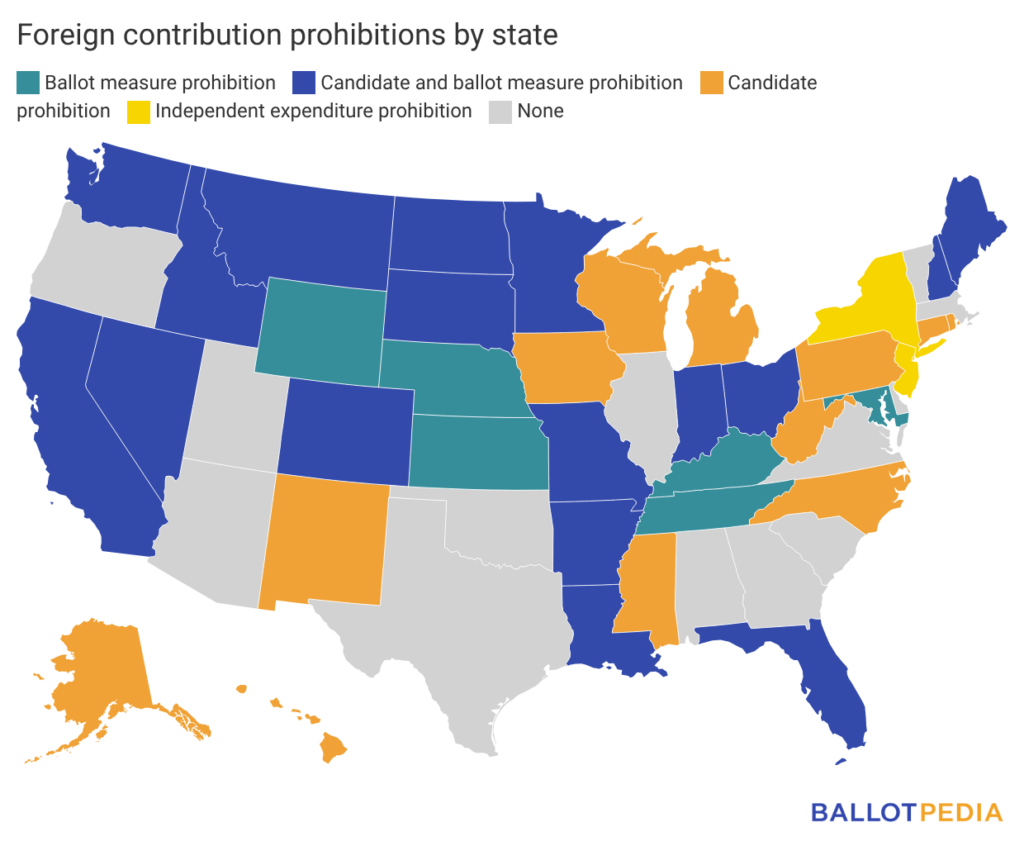
So far this year, legislators in 25 states have introduced or retained from the 2025 session 64 bills that create, modify, or repeal campaign finance regulations related to contributions from foreign individuals or entities.
Twelve of those bills have passed at least one chamber of a state legislature. Lawmakers in Alabama, Michigan, Mississippi, and West Virginia have advanced legislation banning foreign contributions to ballot measure campaigns. In Arizona, Hawaii, New York, and South Dakota, lawmakers have advanced legislation banning at least some foreign entities from giving to both candidates and ballot measure campaigns.
Other states where legislators have introduced foreign funding bans include:
- Florida (ballot measures)
- Georgia (ballot measures and candidates)
- Iowa (ballot measures)
- Massachusetts (ballot measures)
- Nebraska (ballot measures)
- Oklahoma (ballot measures and candidates)
- Tennessee (candidates)
- Wisconsin (ballot measures)
Support for and opposition to bans on foreign contributions in elections does not fall along party lines. Of the 29 states with a ban on foreign contributions to candidates, 14 have Republican trifectas, eight have Democratic trifectas, and seven have divided governments.
Fourteen of the 23 states that ban foreign contributions to ballot measures have Republican trifectas. Five have Democratic trifectas, and four have divided governments.
In 2025, nine states enacted 12 bills related to foreign funding in elections. In 2024, Ohio enacted a law related to foreign funding in elections.
For more information on foreign funding bans at the federal and state levels, click here.
Closer to home: Local races to watch in early 2026

No survey of the early races to watch in 2026 would be complete without a look at a sample of the most compelling local races happening across the country.
From the tens of thousands of local elections to choose from this year, our local elections staff picked four contests that give you a sense of the stakes, the issues, the personalities, and, perhaps most of all, the immediacy of local politics.
Because it’s early in the year, and the lists of candidates for 2026 elections are far from complete (candidate filing deadlines vary by state and localities), our managing editor for local elections, Doug Kronaizl, highlighted for us a sample of elections to watch that are happening between now and March:
Asheville, North Carolina City Council primary
Doug said, “Twenty candidates are running for three city council seats, the largest field since 1999, with all incumbents seeking re-election: Antanette Mosley, Maggie Ullman, and Sheneika Smith.”
“The race includes an ultimately unsuccessful residency challenge against Mosley and is unfolding amid debates over housing affordability and the city’s recovery from Hurricane Helene in September 2024. The top six vote-getters in the March 3 primary will advance to the general election.”
Doug also said that six of the 20 candidates have completed Ballotpedia’s Candidate Connection survey.
Garland County, Arkansas Justice of the Peace District 7
It’s not just city councils or mayors who are on the ballot. This Arkansas race is for an elected office that some voters won’t be familiar with — a justice of the peace.
Doug said that the incumbent, Dayton Myers, “was first elected in 2022 at age 19 and re-elected in 2024 after resigning following his arrest for underage alcohol and fake IDs. He faces Robert Louton in the March 3 Republican primary. There are no Democrats running for this office.”
Doug noted that this race is a “rematch of the 2024 general election, when Myers defeated Louton, who ran as a Libertarian. Myers recently filed a lawsuit against the Garland County Election Commission and County Judge Darryl Mahoney over the decision to designate the Allen Tillery Automobile Dealership as a polling place, as that is Louton's place of employment.”
Doug also noted that Myers completed a Ballotpedia Candidate Connection survey in 2024.
Mitchellville, Iowa City Council special election
Doug said that in Mitchellville, Iowa, there will be a special election to fill three vacant seats on its five-member city council.
“Typically, the council can fill seats by appointment and was set to do so for one seat earlier this year. But then two additional council members resigned in quick succession, depriving the city council of a quorum. This comes on top of various other difficulties the city has been weathering.
“Last August, the council fired its administrator, who had been in dispute with the former mayor, Jessica Trobaugh. They then appointed William Daggett as a temporary administrator. In November, Daggett was investigated by the state auditor for improper pay while working for the City of Baxter. Daggett resigned from his Mitchellville post.
“That November, there was a contested mayoral election, with Tony Jensen defeating incumbent Trobaugh. On Jan. 1, the entire police force also resigned. The city council can't do anything until the Feb. 17 election results are finalized and the council has a quorum again.”
Mayor of Rio Rancho, New Mexico
The last race to watch is for the mayor of one of New Mexico's fastest-growing cities, where all that growth is a key issue among the six candidates vying for the office. Doug noted that the incumbent, Gregg Hull, is running in the Republican primary for governor in June. The candidates include a current member of the Sandoval County Board of Commissioners, an incumbent city councillor, the former chair of the Sandoval County Democratic Party, a local business owner, a former state House candidate who filed a lawsuit challenging city practices last year, and a 28-year-old focused on expanding access to youth programs.
From this list — and remember, this is just four out of the thousands that will occur over the next few months — you can see that local politics is a vibrant, rich, and storied part of our national civic fabric. Helping voters understand who these candidates are, what they stand for, and what they hope to achieve is essential to the health and future of our civic life.
That’s why Ballotpedia is committed to providing you with information on the local elections and candidates in your community — with the goal of covering every election, everywhere in the country by 2034.
Four states have filing deadlines in the next two weeks
As the 2026 general elections draw closer, midterm races are continuing to take shape.
Four states have upcoming candidate filing deadlines in the next two weeks. The map and bulleted list below show which states have candidate filing deadlines scheduled between Feb. 14 and Feb. 28.
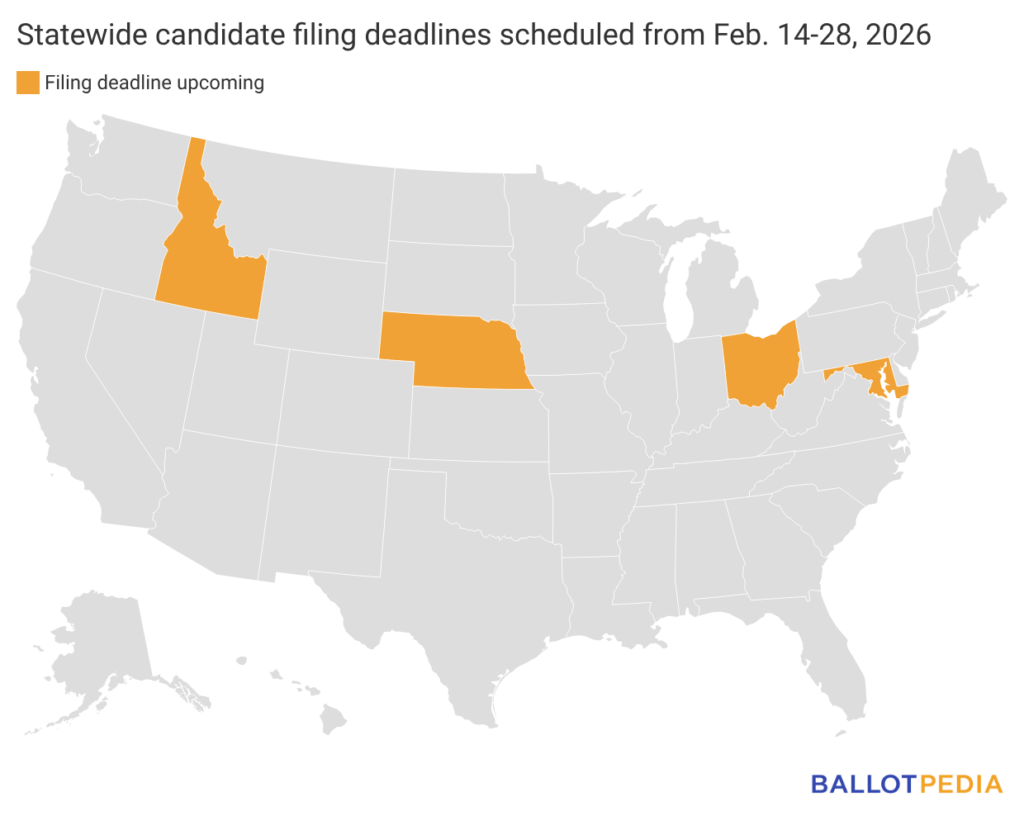
- Nebraska: Feb. 17 (statewide filing deadline for incumbent primary candidates)
- Ohio: Feb. 23 (statewide filing deadline for write-in primary candidates)
- Maryland: Feb. 24 (statewide filing deadline for primary candidates)
- Idaho: Feb. 27 (statewide filing deadline for primary candidates)
Looking back
Six states had a candidate filing deadline in the past two weeks:
- West Virginia: Jan. 31 (statewide filing deadline for primary candidates)
- New Mexico: Feb. 3 (statewide filing deadline for candidates seeking pre-primary designation)
- Ohio: Feb. 4 (statewide filing deadline for primary candidates)
- Indiana: Feb. 6 (statewide filing deadline for primary candidates)
- Louisiana: Feb. 13 (statewide candidate filing deadline)
- Wisconsin: (Spring elections): Feb. 13 (statewide filing deadline for write-in primary candidates)
Candidates must meet various state-specific filing requirements and deadlines to appear on primary and general election ballots. These regulations, known as ballot access laws, determine whether and how candidates can make it onto the ballot. These laws are set at the state level and apply to candidates running for state and federal offices.
Upcoming primaries
Looking ahead, here are the five states with statewide primaries coming up in March, and some dates voters in those states should be aware of.
- Voter registration deadline: Feb. 2
- Early voting start date: Feb. 16
- Primary date: March 3
- Voter registration deadline: Feb. 17 by mail (March 1 online, March 17 in person)
- Early voting start date: Feb. 5
- Primary date: March 17
- Voter registration deadline: Feb. 9
- Mississippi does not permit no-excuse early voting.
- Primary date: March 10
- Voter registration deadline: Feb. 6 by mail or online (Feb. 28 in person)
- Early voting start date: Feb. 12
- Primary date: March 3
- Voter registration deadline: Feb. 2
- Early voting start date: Feb. 17
- Primary date: March 3
To read more about candidate filing deadlines for the upcoming midterm elections, click here. Click here to see a full list of statewide primaries.