


Welcome to the Thursday, Feb. 19, 2026, Brew.
By: Lara Bonatesta
Here’s what’s in store for you as you start your day:
- Voters in two Wisconsin cities to decide on ballot measures related to data center development
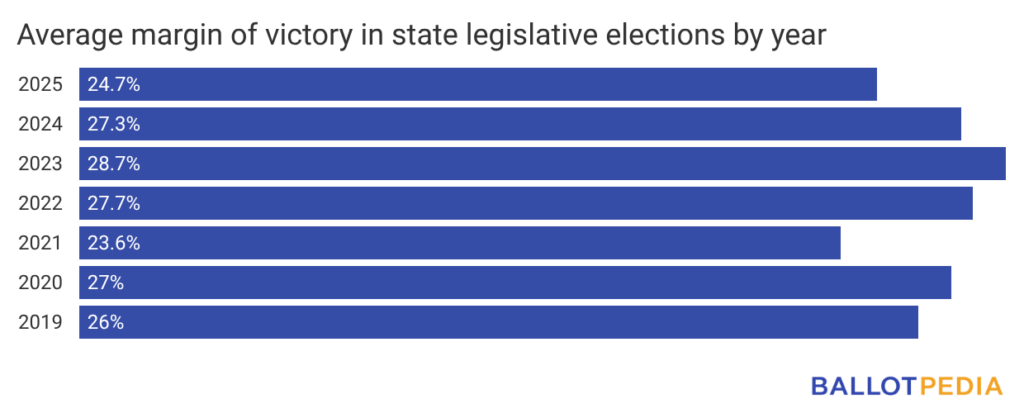
- The average margin of victory across 2025’s state legislative elections was 24.7%, down from 28.7% in 2023
- Twenty-one candidates are running in special general election on March 10 to replace Marjorie Taylor Greene
Voters in two Wisconsin cities to decide on ballot measures related to data center development
The rise of artificial intelligence (AI) has sparked a host of new political debates and questions in recent years. One related topic that has become a growing political issue is the development of the data centers that power AI.
This is the case in two cities in Wisconsin: Janesville and Port Washington. Both will decide on ballot measures related to data center development later this year.
Today, we’re taking a look at both of those proposals.
Port Washington
On April 7, Port Washington voters will decide on a measure that would require voter approval before the city may create, adopt, or approve a Tax Incremental District (TID) if the district has a projected base value of $10 million or more or projected project costs exceeding $10 million.
The group Great Lakes Neighbors United organized the petition drive in response to the Port Washington City Council's approval of a development agreement with Vantage Data Centers Management Company, LLC on Aug. 19, 2025. Petitioners were required to collect 954 signatures, equal to 15% of the 26,082 votes cast in Port Washington in the most recent gubernatorial election. On Nov. 13, 2025, the group reported submitting more than 1,000 verified signatures.
Vantage plans to construct a $15 billion data center campus, to be operated by OpenAI and Oracle, that would span 670 acres across four buildings and require an estimated 3.5 gigawatts of electricity.
The Port Washington City Council voted on Nov. 4, 2025, to create Tax Incremental District (TID) No. 5 for the proposed data center campus. Vantage would spend an estimated $175 million on infrastructure improvements, including water and sewer main extensions, road upgrades, and power infrastructure. Under the TID, increases in property value within the district would generate additional property tax revenue. That revenue would be used to reimburse Vantage for its upfront infrastructure costs. The TID would remain active for up to 20 years, or until the company's infrastructure costs are reimbursed, whichever happens first.
Mayor Ted Neitzke said, "Vantage is putting all the capital up front for all of the infrastructure. We pay them back. If they fail, project stops — we are not obligated to pay that debt back." He also said, "The benefits of welcoming data centers to Port Washington are undeniable. Vantage’s once in a generation investment will create thousands of high-paying jobs—including more than 4,000 union-led construction and operational roles—driving long-term economic ripple effects across the region."
Scott Lone, a resident of Port Washington, said, "This is a global tech company asking Port Washington taxpayers to help fund their expansion. They don’t need our help, and we can’t afford to get it. When we divert property tax revenue into a TID, that money doesn’t go to our schools, our roads, our fire and police departments, or our parks. That’s not economic development. That’s corporate welfare dressed up as progress."
While the measure would not block the approved TID for the Vantage data center campus, it would apply to future proposed TIDs with projected base values or project costs exceeding $10 million. In addition to sponsoring the measure, Great Lakes Neighbors United also filed a lawsuit against the city and its Joint Review Board on Jan. 2, challenging the TID. According to Wisconsin Public Radio, a hearing in that case is scheduled for March 13.
Janesville
On Nov. 3, Janesville voters will decide on a ballot initiative that would require voter approval before a proposed $8 billion data center can be developed.
On Feb. 9, the Janesville City Council voted to include the ballot initiative on the general election ballot. The group No Janesville Data Center organized the petition drive. Petitioners were required to collect 3,915 signatures, equal to 15% of the 26,082 votes cast in Janesville in the most recent gubernatorial election. On Jan. 21, the clerk's office certified 3,927 signatures.
The ballot initiative would require voter approval before the city could approve development on undeveloped portions of city-owned property, known as the GM/JATCO site, if the project’s cost exceeds $450 million. Approval would require a majority vote at a general or special election. If voters reject the proposal, any new development plan or agreement for the site would require a new referendum.
The GM/JATCO site was formerly known as the Janesville Assembly Plant, which General Motors operated from 1919 to 2008.
The Janesville City Council is considering a proposal from Viridian Partners to redevelop the site into an 800-megawatt, 11-building data center campus. The project is estimated to cost $8 billion.
Should the initiative be approved, a project of that cost ($8 billion) would require voter approval. Any future project estimated to cost more than $450 million would require voter approval.
Voters in other states may also decide on ballot measures related to data centers in 2026. On Feb. 10, signatures were submitted for a referendum in Marana, Arizona. Petitions are also circulating in Frederick County, Maryland, and Joplin, Missouri.
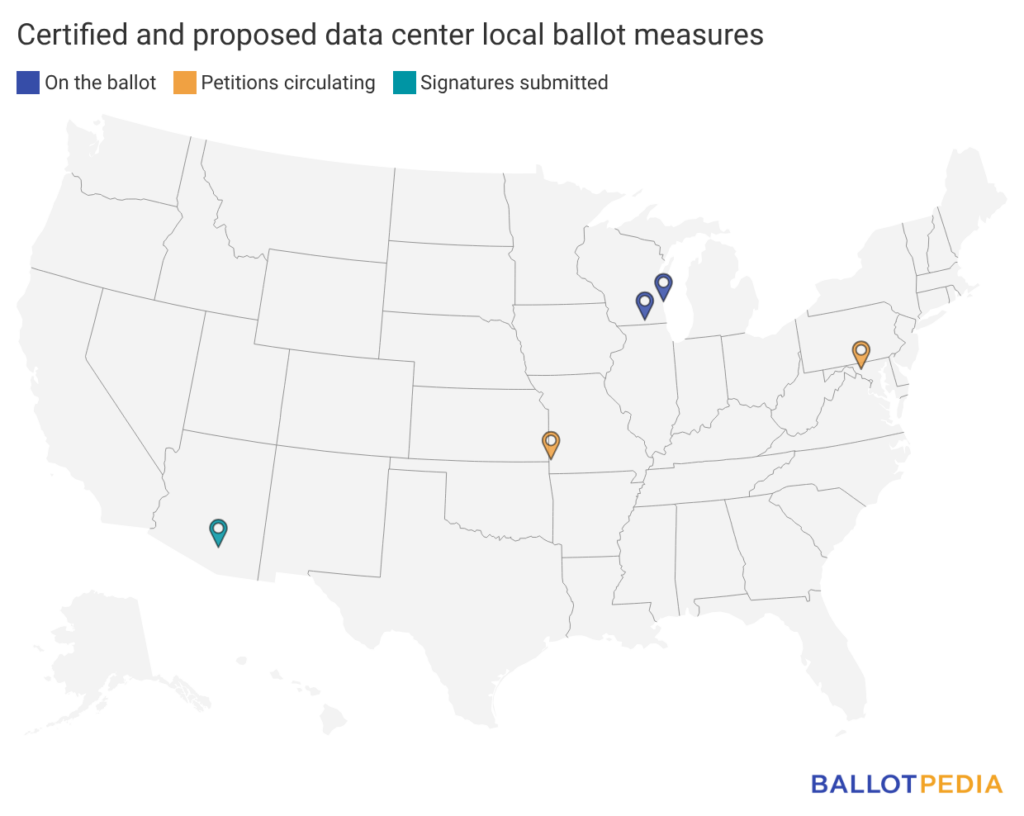
Click here and here to learn more about the measures in Janesville and Port Washington, Wisconsin. You can also click here to learn more about local ballot measures in Wisconsin this year.
The average margin of victory across 2025’s state legislative elections was 24.7%, down from 28.7% in 2023
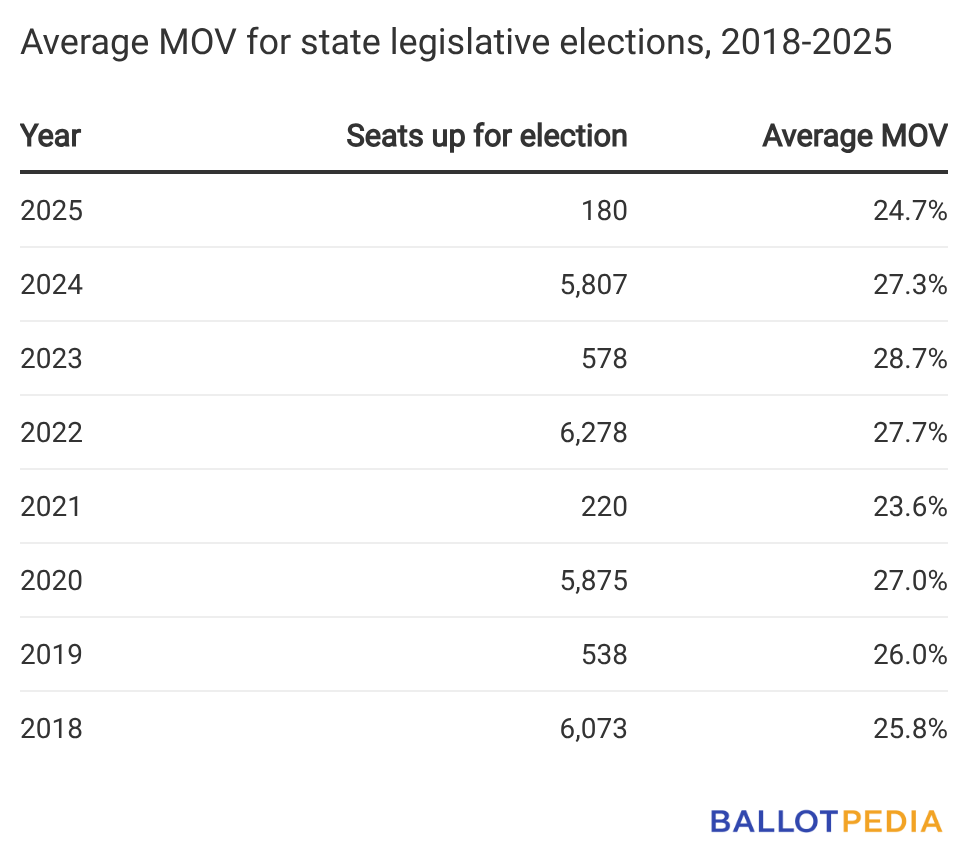
The average margin of victory across 2025’s 180 state legislative elections was 24.7%. This is the second-lowest average margin of victory in odd-year elections since 2019, and down from 28.7% in 2023.
The Nov. 4, 2025, state legislative elections included all 100 seats in the Virginia House of Delegates and all 80 seats in the New Jersey General Assembly. The average margin of victory in the New Jersey General Assembly was 12.5%, and the average margin of victory in the Virginia House was 30.2%.
The table below shows how many seats were up for election in each chamber and how many seats each party won. It also includes a breakdown of how many seats Democrats and Republicans won by 10% or less. It also shows how many candidates ran unopposed in each chamber, as well as the average margin of victory for each party.
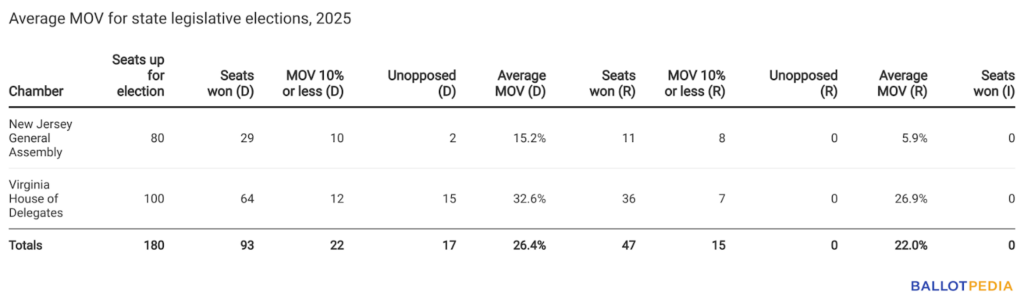
Thirty-seven (20.5%) of the 180 state legislative seats up for election in 2025 were decided by 10 percentage points or fewer. This was the second-highest share of legislative elections to be decided by this margin in an odd year since 2019. The share of seats decided by a margin of victory of 10% or less was 9.7% in 2023, 20.9% in 2021, and 10.6% in 2019.
Of the 37 state legislative races decided by a margin of victory of 10% or less in 2025, Democrats won 22 (59.5%), and Republicans won 15 (40.5%). In 2023, Democrats won 35.7% of races with margins of victory of 10% or less, and Republicans won 64.3%.
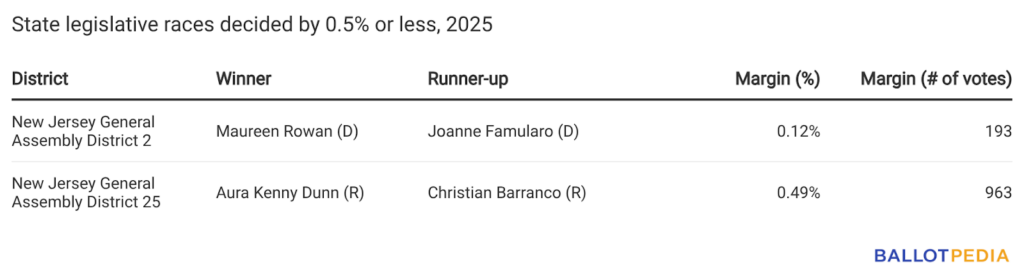
Two races — both in New Jersey — were decided by a margin of 0.5% or less.
The average margin of victory in 2025 (24.7%) was the second-lowest of all state legislative elections since 2018. The lowest percentage was 23.6% in 2021. The highest was 28.7% in 2023.
Click here to see our full margin of victory analysis for the 2025 state legislative elections.
Twenty-one candidates are running in special general election on March 10 to replace Marjorie Taylor Greene
Twenty-one candidates are running in a special general election on March 10 to represent Georgia's 14th Congressional District. Shawn Harris (D), Clayton Fuller (R), Nicky Lama (R), Colton Moore (R), and Brian Stover (R) have received the most media attention. Governor Brian Kemp (R) called the special election after former Rep. Marjorie Taylor Greene (R) resigned on Jan. 5.
According to The Cook Political Report with Amy Walter, the district is the most Republican-leaning in Georgia. BallotWire writes that with 16 Republicans, three Democrats, one Libertarian, and one independent running on the same ballot, "a potentially divided Republican vote, creates at least nominal competition."
All candidates will appear on the same ballot regardless of party. If one candidate wins more than 50% of the vote, they will win the election outright. If no candidate does so, the top two vote-getters will advance to an April 7 runoff election.
Decision Desk HQ's Geoffrey Skelley writes, "Considering Trump carried this seat 68%-31% in 2024, two Republican candidates could attract enough votes to advance to the likely runoff. However, the more likely outcome may be that one Democrat and one Republican move forward. That’s because the larger Republican vote will be spread across a multitude of GOP candidates, while the smaller Democratic vote may mostly line up behind retired Army Brig. Gen. Shawn Harris, who was his party’s nominee versus Greene in the district’s 2024 race."
Harris is a retired U.S. Army brigadier general and cattle producer. Georgia AFL-CIO endorsed Harris.
Fuller is a former district attorney for the Lookout Mountain Judicial Circuit and an officer in the Air National Guard. President Donald Trump (R) endorsed Fuller on Feb. 4.
Lama is a former member of the Dalton City Council and business owner specializing in contracting, real estate development, and farming and ranching. State Reps. Steve Tarvin (R) and Jason Ridley (R) endorsed Lama.
Moore is a former Georgia state senator, an auctioneer, and a dump truck driver. Former U.S. Rep. Matt Gaetz (R-Fla.) endorsed Moore.
Stover is the owner of a trash collection business. Paulding County Sheriff Ashley Henson, Hiram mayor Frank Moran, and Rockmart mayor Sherman Ross endorsed Stover.
Fuller, Lama, and Moore resigned from their elected positions to run in the special election. Georgia is one of five states with a resign-to-run law.
As of Feb. 12, Republicans controlled the U.S. House 218-214 with three vacancies. Eleven special elections have been called for the 119th Congress. From the 113th Congress to the 118th Congress, 80 special elections were held. For more data on historical congressional special elections, click here.To read more about this election and all of the candidates running, click here.