


Welcome to the Thursday, Feb. 26, Brew.
By: Briana Ryan
Here’s what’s in store for you as you start your day:
- What to know about states that don't use primary elections to nominate candidates
- State legislative special elections show shift toward Democrats compared to previous regular elections
- A look at the battleground U.S. House primaries that we’re following in North Carolina on March 3
What to know about states that don't use primary elections to nominate candidates
Arkansas, North Carolina, and Texas have their statewide primaries on March 3, kicking off the 2026 primary season.
Generally, political parties use primary elections to determine their nominees in advance of a general election. In some cases, however, political parties can — or must — nominate candidates for the general election without conducting a primary.
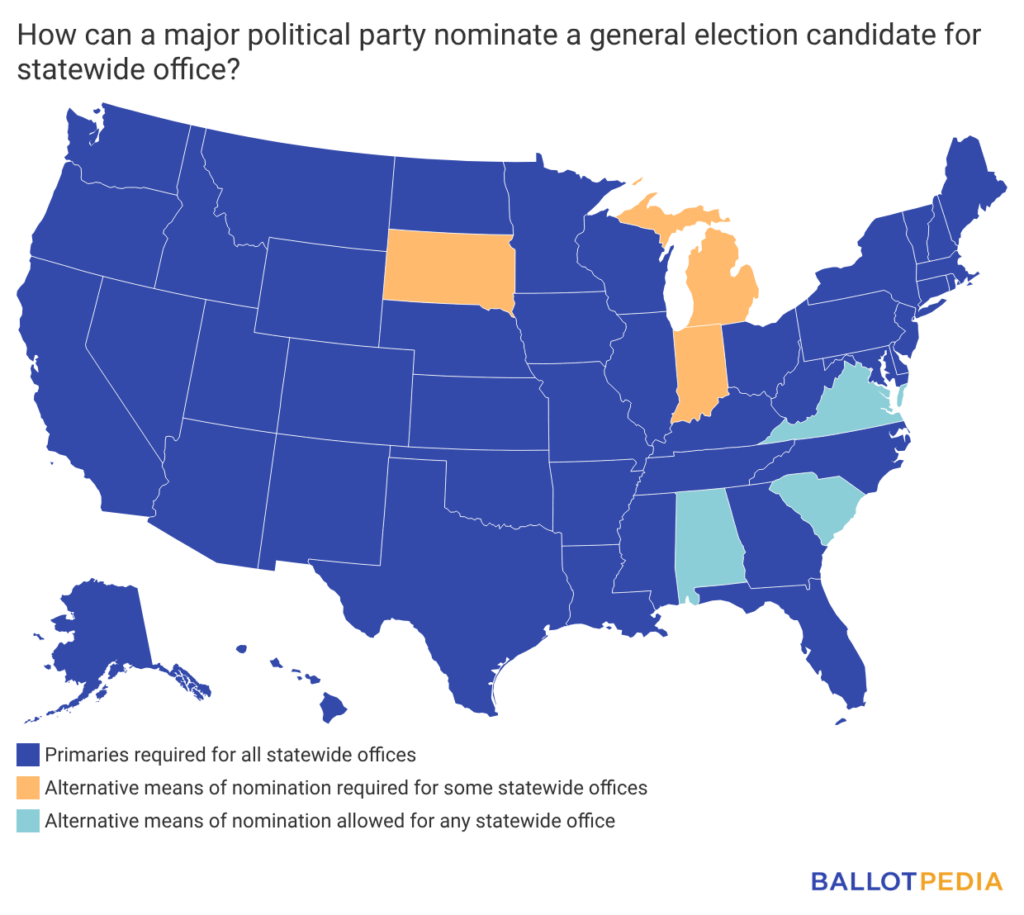
In Indiana, Michigan, and South Dakota, state law requires parties to nominate candidates for certain statewide offices, such as lieutenant governor, secretary of state, and attorney general, at a state party convention.
The following are the state party convention dates in Indiana, Michigan, and South Dakota, as well as the offices up for nomination at each convention:
- Indiana (lieutenant governor, secretary of state, state treasurer, state auditor, and attorney general):
- Democratic convention: June 6, 2026, in Indianapolis
- Republican convention: June 19-20, 2026, in Fort Wayne
- Michigan (lieutenant governor, secretary of state, attorney general, Supreme Court, the boards of Michigan State University, Wayne State University, the University of Michigan, and the state Board of Education):
- Democratic convention: April 19, 2026, in Detroit
- Republican convention: March 28, 2026, in an unknown location
- South Dakota (lieutenant governor, attorney general, secretary of state, state auditor, state treasurer, commissioner of school and public lands, and public utilities commissioner):
- Democratic convention: June 6, 2026 in Sioux Falls
- Republican convention: June 27, 2026, in Rapid City
In Alabama, South Carolina, and Virginia, major political parties may nominate candidates for any statewide office without holding a primary. In Alabama, the party must provide advance notice to the state that it will be foregoing a primary election, while in South Carolina, a party must submit the question of nominating candidates via convention to voters. Neither major party has taken these steps for 2026.
In Virginia, the situation is a bit different. Under state law, party authorities "have the right to determine the method by which a party nomination ... shall be made." Before 2024, some parties nominated candidates for statewide or congressional elections at a caucus or convention.
However, effective January 2024, the law states that a method of nomination "shall not be selected if such method will have the practical effect of excluding participation in the nominating process by qualified voters who are otherwise eligible to participate" but cannot attend meetings due to being active duty military, temporarily living outside of the U.S., being a student, having a disability, or experiencing a contagious disease.
According to Virginia Mercury's Markus Schmidt, "The law effectively forces parties to nominate candidates through state-run primary elections rather than their own party-run contests." The 2024 changes do not apply to special elections.
In 44 states, candidates file paperwork with state or party officials to qualify for the primary election. They also typically must pay a fee, submit a certain number of signatures from eligible voters, or both.
In six states, however, political parties have a process where state or local political parties can directly nominate candidates for the primary ballot. That means the nominee does not need to go through a separate process in order to qualify for the ballot. In all six of those states, candidates can also qualify for the ballot via another means, such as submitting petition signatures.
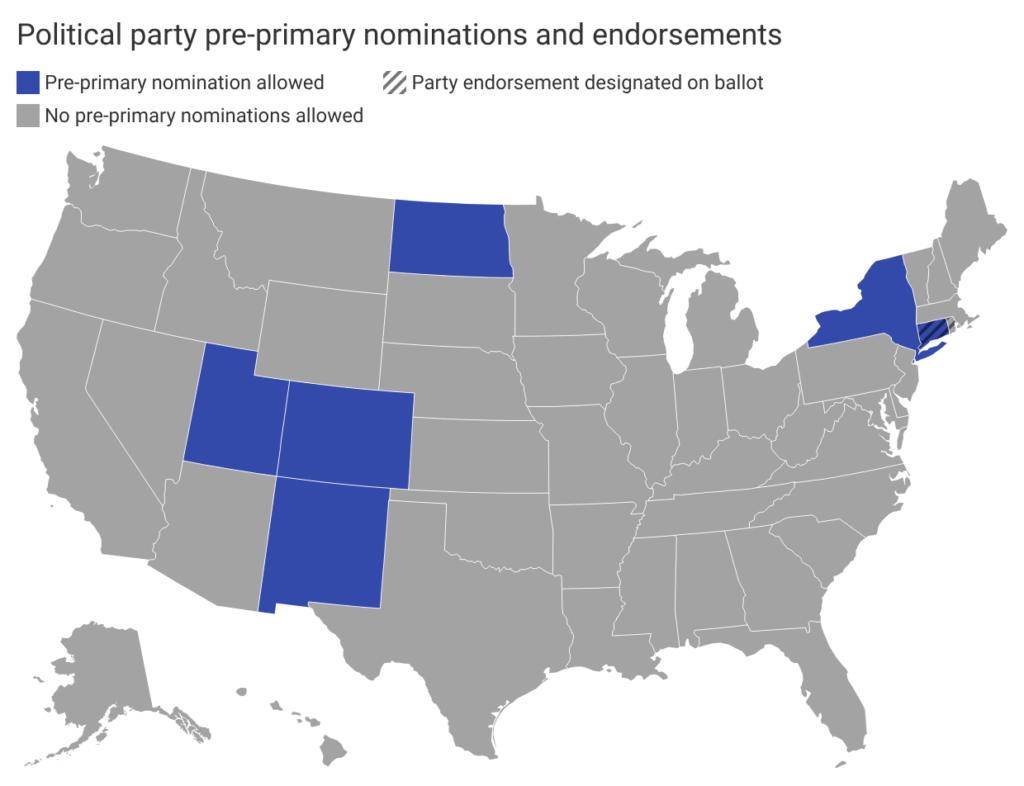
In Colorado, for instance, candidates who receive at least 30% of the vote from state party delegates at a party assembly or who finish in the top two of voting on the second ballot will qualify for the primary election.
Parties in Utah also use conventions to select nominees for statewide office, though candidates can also gather petition signatures to qualify for the ballot. If a candidate receives sufficient support from delegates at the party nominating convention, and there are no candidates who filed via petition, that candidate is declared the nominee and no primary is held. If multiple candidates are seeking a party’s nomination and no candidate receives sufficient support at the convention, the top two vote-getters advance to the primary.
In Connecticut and Rhode Island, parties can endorse candidates before the primary, and that endorsement is designated on the ballot. In Connecticut, party-endorsed candidates qualify automatically for the ballot. Candidates with an endorsement are placed first on the ballot, with an asterisk following their name. In Rhode Island, an endorsement does not automatically mean a candidate will qualify for the primary, but it does mean they are placed first on the ballot.
Read more here about states that allow parties to nominate candidates for the primary.
State legislative special elections show shift toward Democrats compared to previous regular elections
In the state legislative special elections that have happened since January 2025, there was an average shift of 5.6 percentage points towards Democrats. Additionally, Democrats retained 10 percentage points more of their voter turnout from the previous regular election than Republicans.
We found these figures by comparing candidates' special election performance to their performance in the previous regularly scheduled election in each of the 96 state legislative districts where a special general election occurred.
Since January 2025, there have been 117 state legislative special elections nationwide. Ninety-six of those resulted in special general elections. The remainder of the special elections were won outright at the primary stage. Democrats won 67 of the races, and Republicans won 29.
Here’s a closer look at voter turnout retention and margin shifts in the special state legislative elections.
Voter turnout retention
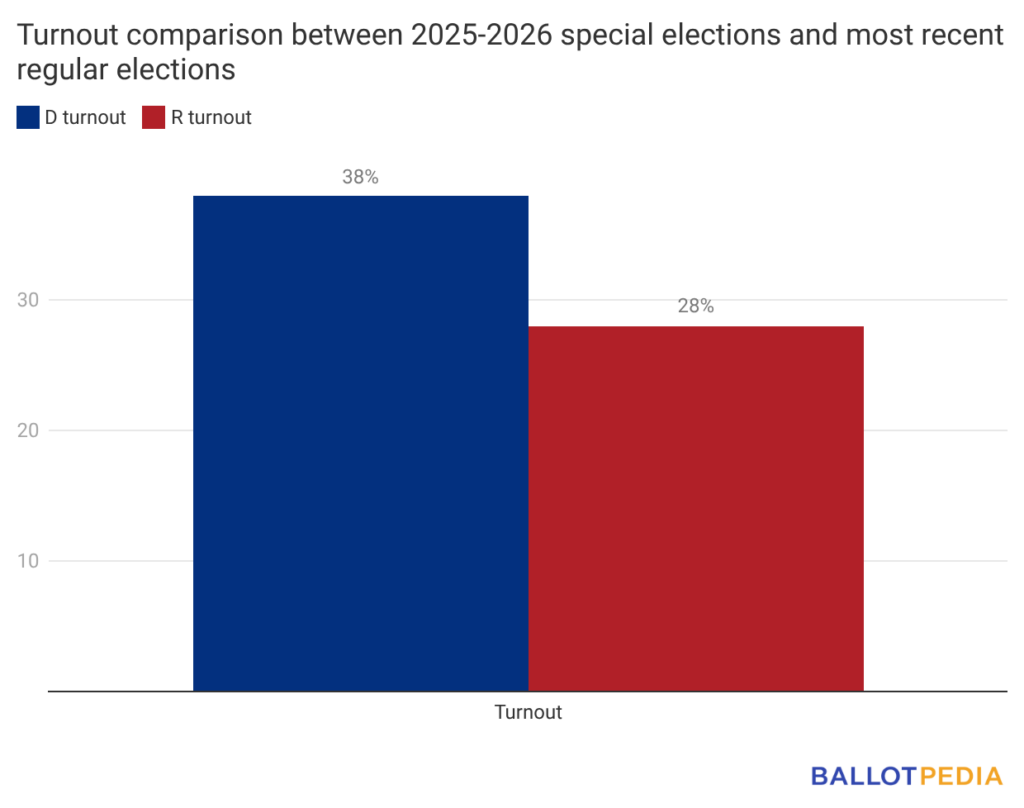
In special state legislative elections, Democrats retained 10 percentage points more of their voter turnout from the previous regular election than Republicans.
There were 76 districts where a Democrat had appeared on the special election ballot and on the previous regular general election ballot. On average in those districts, Democratic voter turnout in the special election was 38% of the party’s turnout in the previous regular general elections.
There were 72 districts where a Republican had appeared on the special election ballot and on the previous regular general election ballot. On average, Republican voter turnout in the special election was 28% of the party’s turnout in the previous regular general election.
By looking at voter turnout retention, we’re able to show each party’s ability to mobilize voters outside regular election cycles.
Margin of victory shifts
There were 50 districts where both the special election and the most recent general election had candidates from both major parties. Democrats won 37 of those special elections, and Republicans won 13. Democrats won 32 of the previous general elections in those districts, and Republicans won 18.
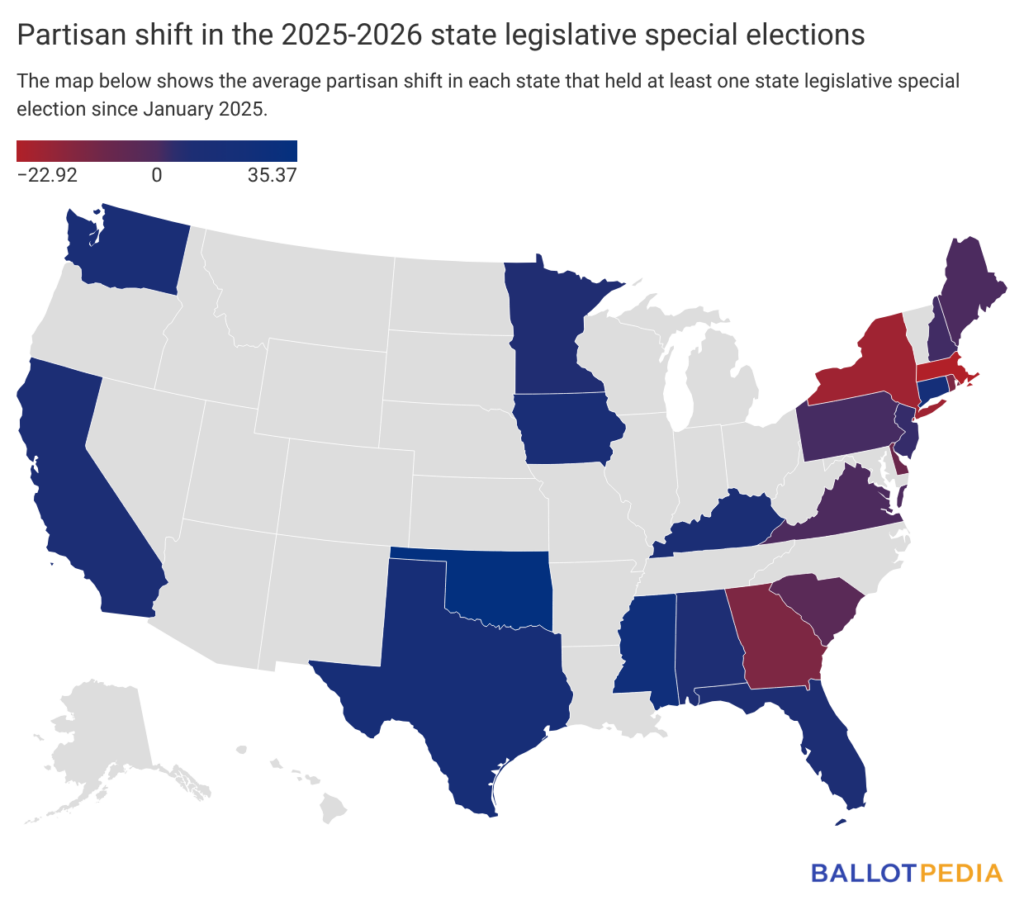
Forty of those districts shifted toward Democrats in the special election compared to the previous election, and 10 shifted toward Republicans. Overall, the average shift across all 50 districts was 5.6 percentage points toward Democrats.
The map below shows the average partisan shift in each state that had at least one state legislative special election since January 2025. The data below include all 96 special general elections.
Click here to read more about 2025 state legislative special elections, and here for 2026 state legislative special elections.
A look at the battleground U.S. House primaries that we’re following in North Carolina on March 3
With primary elections in North Carolina on March 3, we're taking a look at the U.S. House races we're following as battlegrounds — the Democratic primary for the 4th Congressional District and the Republican primary for the 1st Congressional District.
4th Congressional District Democratic primary
Incumbent Valerie Foushee (D), Nida Allam (D), and Mary Patterson (D) are running in the Democratic primary for the District.
Foushee and Allam led in endorsements, fundraising, and media attention. Foushee has represented the District since 2023. Allam has served on the Durham County Board of Commissioners since 2020.
The primary is a rematch between Foushee and Allam, who ran for the then-open seat in 2022. Foushee defeated Allam 46% to 37%. WUNC News’ Colin Campbell wrote that “While both candidates describe themselves as ‘progressive,’ an upset victory for Durham County Commissioner Nida Allam would mean Democratic voters are shifting further to the left – preferring a younger, more outspoken leader to represent them in Washington D.C.”
1st Congressional District Republican primary
Five candidates are running in the Republican primary for the District:
- Asa Buck (R), who has served as Carteret County sheriff since 2006
- Laurie Buckhout (R), who is a former assistant national cyber director for policy in President Donald Trump’s (R) second administration
- Robert Hanig (R), who has represented District 1 in the North Carolina Senate since 2022
- Eric Rouse (R), who has served on the Lenoir County Board of Commissioners since 2010
- Ashley-Nicole Russell (R), who is an attorney operating a family law practice
The election is taking place in the context of redistricting that changed the district's boundaries from those used in 2024. The Assembly's Christa Dutton wrote that the new lines "[made] the 1st District, which now spans the northeast part of the state from the Virginia border to the coast, more conservative." The winner will face incumbent Donald Davis (D), who is unopposed in the Democratic primary, in the general election.
Click here to read more about the Democratic primary in the 4th Congressional District, and here for more about the Republican primary in the 1st Congressional District. Also, if you're a North Carolina voter, check out our Sample Ballot Lookup here to prepare for Election Day.