


Americans for Citizen Voting, the campaign behind an initiative that would amend the Michigan Constitution to require that only U.S. citizens can vote in elections, submitted 750,000 signatures to the Michigan Department of State on March 4, 2026. If enough valid signatures are found, the initiative will appear on the November 2026 ballot.
In Michigan, a citizen initiative to amend the constitution needs 446,198 valid signatures, which is equal to 10% of the votes cast for governor in the last gubernatorial election.
The initiative would require verification of U.S. citizenship for voters through a statewide verification program, or allow them to submit proof of citizenship, such as a passport or birth certificate. It would require the removal of noncitizens from voter rolls after notice and a 45-day response period, and require provisional ballots to be provided for voters whose citizenship has not been verified. The initiative would also require photo identification for absentee voting and eliminate the existing affidavit option for voters without a voter ID.
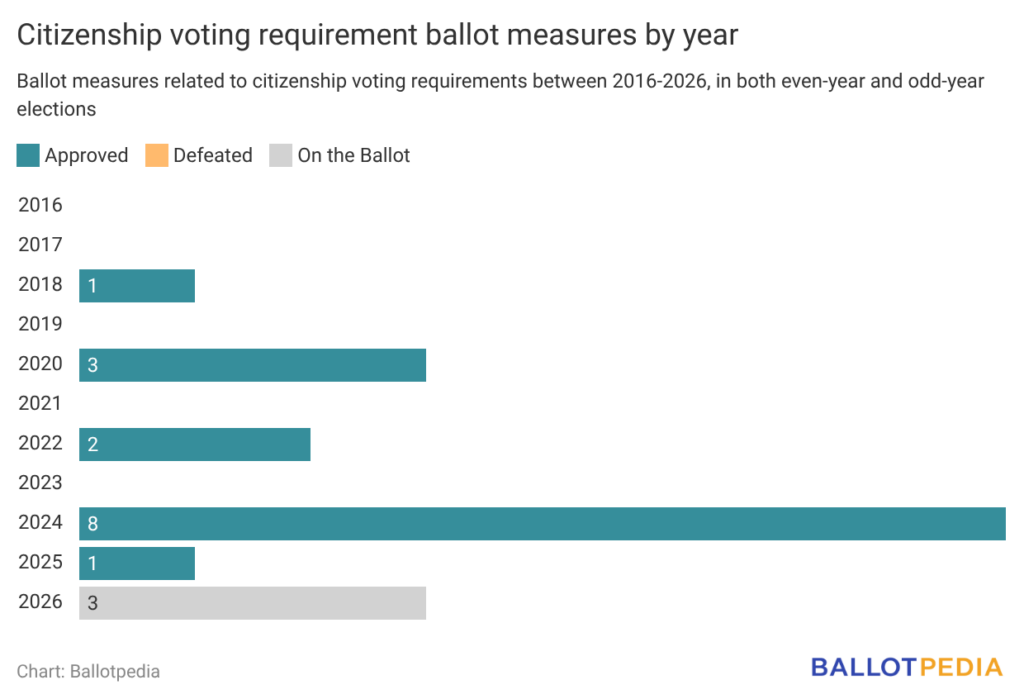
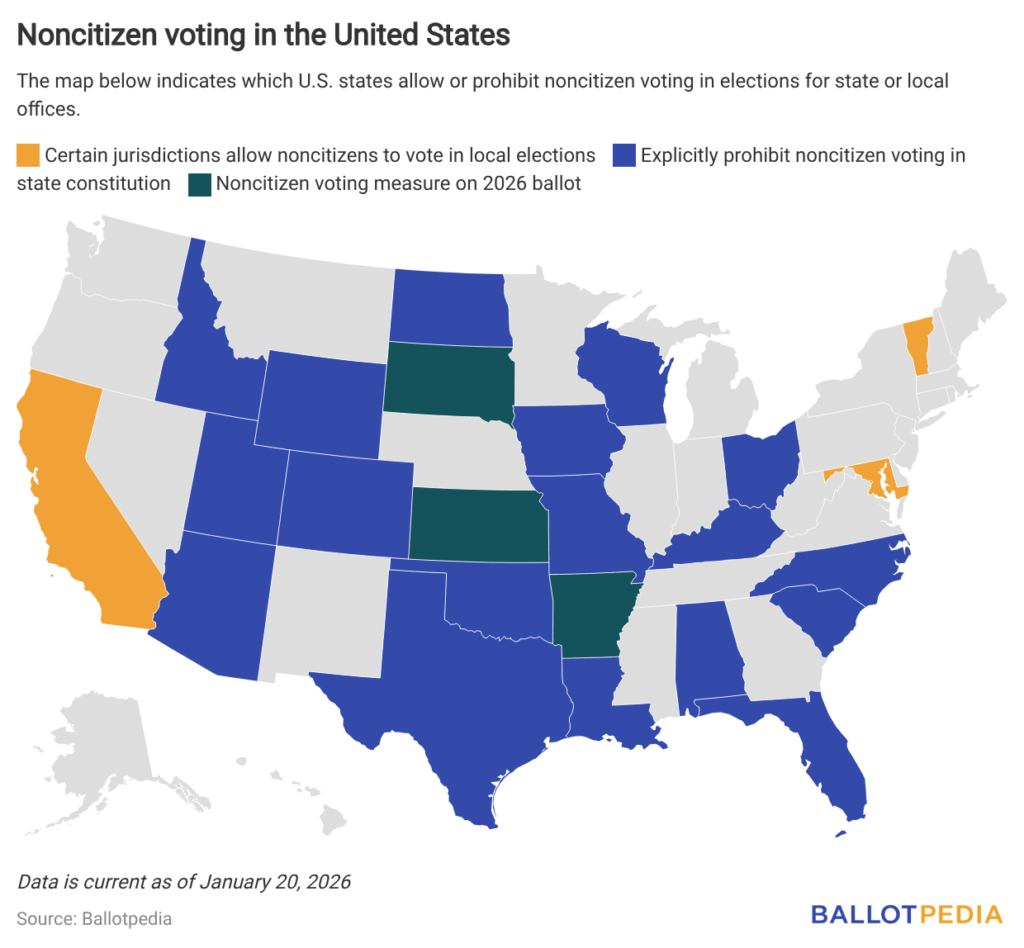
In 2026, voters in at least three states—Arkansas, Kansas, and South Dakota—will decide on constitutional amendments to prohibit noncitizen voting. Meanwhile, an Alaska campaign for a proposed initiative submitted signatures in January.
Ballot measures to prohibit noncitizen voting have become more common in recent years. From 2018 to 2025, voters approved 15 ballot measures adding language about citizenship requirements for voting. In 2024, eight statewide measures to prohibit noncitizen voting were approved by voters—the greatest number of noncitizen-voting-related measures to appear on statewide ballots in any election year.
In 1996, the U.S. Congress passed a law prohibiting noncitizens from voting in federal elections, including those for the U.S. House, the U.S. Senate, and the presidency. This law does not apply to elections for state and local offices. Every state requires voters to attest that they are U.S. citizens when registering to vote.
While no state constitution explicitly allowed noncitizens to vote in state or local elections, some states have jurisdictions that allow noncitizens to vote in some or all local elections. The District of Columbia and certain municipalities in California, Maryland, and Vermont allow noncitizens to vote in some or all local elections. Meanwhile, 18 states include language explicitly prohibiting noncitizen voting in their state constitutions.
Paul Jacob, who is helping lead the American Citizens for Voting campaign, said, “We believe, and this is across the country, state after state has voted on it. In Michigan, the polls show clearly people want only citizens voting in the election, and the opponents seem to think that that can never be determined … Will it disenfranchise people? No, because we’ve put in every possible protection for that. If you need a free ID because you can’t afford it, it is provided there will be a constitutional right to the ID you need to vote.”
Michigan State Rep. Ann Bollin (R), who also supports the measure, said, “This is really to cement and restore the public’s confidence and trust in elections. It is not a high threshold.”
Christy McGillivray, the director for Voters Not Politicians, opposes the measure, saying, “This ballot initiative is part of a wider national power grab by wealthy political elites who are trying to take power away from the people by blocking them from voting. The requirements and stringent implementation timeline in this initiative will force every Michigan voter to re-register to vote with very specific documentation that 700,000 eligible Michigan citizens don’t have easy access to. Blocking 700,000 eligible voters from voting is catastrophic.”
Michael Davis Jr. of Promote the Vote Action, also opposes the initiative, saying, “Michiganders have proven time and time again—and by large margins—that we support modernizing our elections and removing barriers to the ballot box. This initiative will do neither. What it will do is make it more difficult for all of us to register and vote, resulting in the disenfranchisement of tens of thousands of eligible American citizens across the state. It’s voter suppression, pure and simple, and we’re confident Michigan voters will see this effort for what it really is.”
Along with the citizenship voting requirement initiative, Michigan voters may decide three other citizen-led measures in November, and will be deciding a constitutional convention question. The deadline for campaigns to submit signatures is on July 6, 2026.