


Alabama enacted House Bill 214 (HB 214) on March 17, becoming the 24th state to pass a ban on foreign spending in ballot measure elections. HB 214 prohibits foreign nationals from making contributions related to ballot measures, prohibits recipients from accepting those contributions, and makes violations a Class C felony. It passed unanimously in the state House and state Senate and was signed by Gov. Kay Ivey (R) on March 17. It is set to take effect on Oct. 1, 2026.
In the Alabama State Legislature, HB 214 received support from Democrats and Republicans, excluding those who were absent or otherwise did not vote.
State Sen. Dan Roberts (R-15), who was one of the bill’s sponsors, said, “Under current federal law, foreign nationals are banned from donating to political candidates and committees. Loopholes in the law have led to millions of foreign dollars being funneled to influence ballot issue campaigns like constitutional amendment referendums across the United States. Currently, Alabama does not have a matching state law. Therefore, state and local prosecutors do not have the ability to pursue instances of criminal foreign influence on our elections.”
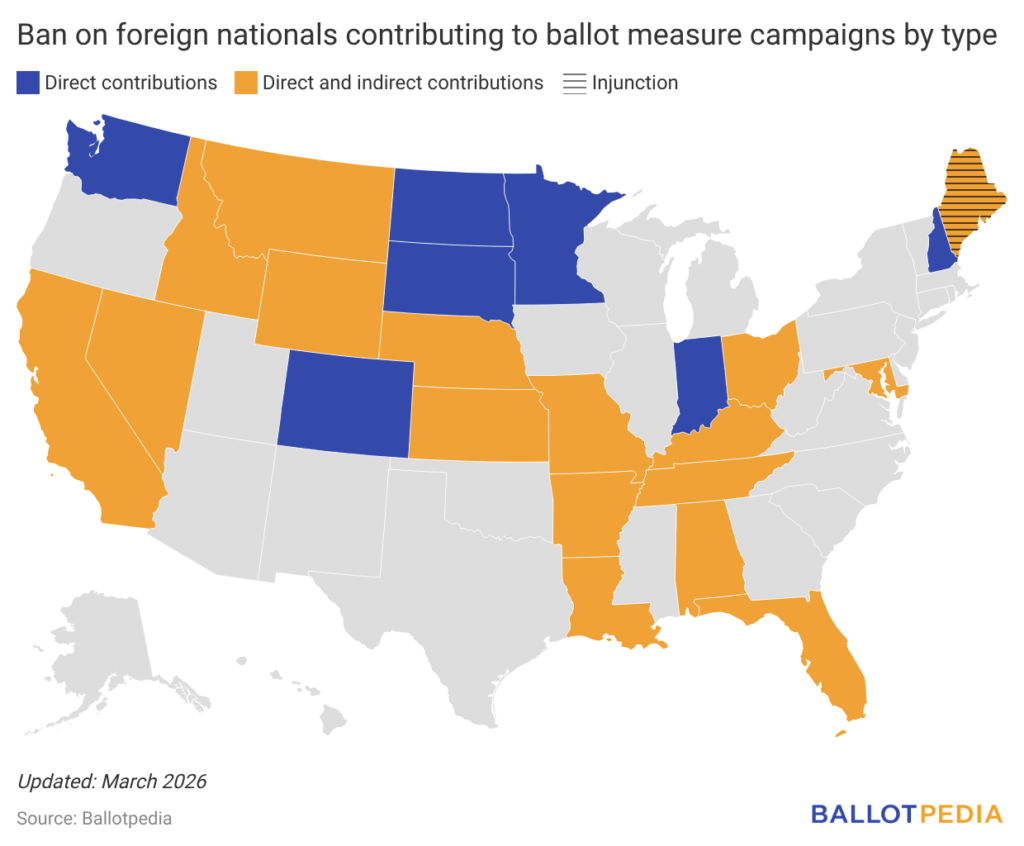
Of the 24 states with bans, seven states have enacted bans on direct contributions, while 17 states have banned direct and indirect contributions from foreign individuals or entities. Bans on direct and indirect contributions include those received directly from the foreign individual or entity, as well as contributions from intermediaries such as independent expenditure committees.
Alabama is the first state to pass such a ban this year. In 2025, nine states — Arkansas, Indiana, Kansas, Kentucky, Louisiana, Missouri, Montana, Tennessee, and Wyoming — enacted bills prohibiting foreign nationals from making contributions or expenditures to support or oppose ballot measures. California made changes to its existing law by adding foreign nationals to the list of banned foreign entities.
Four of the 24 bans were enacted by the approval of a ballot measure. In 2023, Maine voters approved Question 2, an indirect initiated state statute, prohibiting foreign governments, or entities with at least 5% foreign government ownership or control, from spending money to influence ballot measures or candidate elections. The three other bans were citizen-initiated constitutional amendments in Colorado (2002), Missouri (2016), and North Dakota (2018).
Campaign finance rules for ballot measures differ from those for candidate elections. In 1978, the U.S. Supreme Court ruled that spending on ballot measure campaigns is similar to issue advocacy, such as lobbying, in the lawmaking process. In 2012, the Supreme Court affirmed that, under the Federal Election Campaign Act (FECA), foreign nationals were prohibited from making contributions to candidates. However, FECA "does not bar foreign nationals from issue advocacy,” which includes ballot measure campaigns. The Federal Election Commission, following the court's orders, has held that ballot measure campaigns are not regulated under FECA. According to the FEC, since ballot measure campaigns are similar to issue advocacy, foreign individuals, corporations, and governments can contribute to them.
In addition to the federal ban on foreign nationals contributing to candidate elections, 30 states had additional laws governing campaign contributions to candidates from foreign individuals or entities.
Additional reading: