


Welcome to the Thursday, April 16, 2026, Brew.
By: Lara Bonatesta
Here’s what’s in store for you as you start your day:
- A look at competitiveness in the 2026 mayoral elections
- Virginia Gov. Abigail Spanberger signs legislation returning the state to the Electronic Registration Information Center
- U.S. Senator Michael Bennet, Colorado Attorney General Phil Weiser, and four other Democrats are running for Colorado governor
A look at competitiveness in the 2026 mayoral elections
Twenty-two of the nation’s 100 most populous cities are holding mayoral elections this year. Today, we’re taking a look at the structural landscape of these elections, including how many incumbents are contested, how many candidates are running, and how many offices are open, including due to term limits.
Before we dive in, here is an important note on how we conducted this analysis. Cities vary greatly in how they conduct mayoral elections. Some hold partisan primaries, and some hold nonpartisan ones. In other cities, there are no primaries, and all candidates run in the general election. In this analysis, we looked at the first stage, and sometimes the only stage, of each city’s mayoral election.
All incumbents face challenges at the first stage of their re-election bid
So far this year, every incumbent running for re-election in the 100 largest cities has at least one opponent at the first stage of their re-election bid. (For partisan primaries, only major party challengers were included.)
One mayoral election (3.7%) was uncontested in 2025, one (2.9%) was uncontested in 2024, two (6.9%) were uncontested in 2023, and one (3.4%) was uncontested in 2020. There were no uncontested mayoral elections in 2022 or 2021.
Eighty-five candidates, 5.7 per city, are running so far
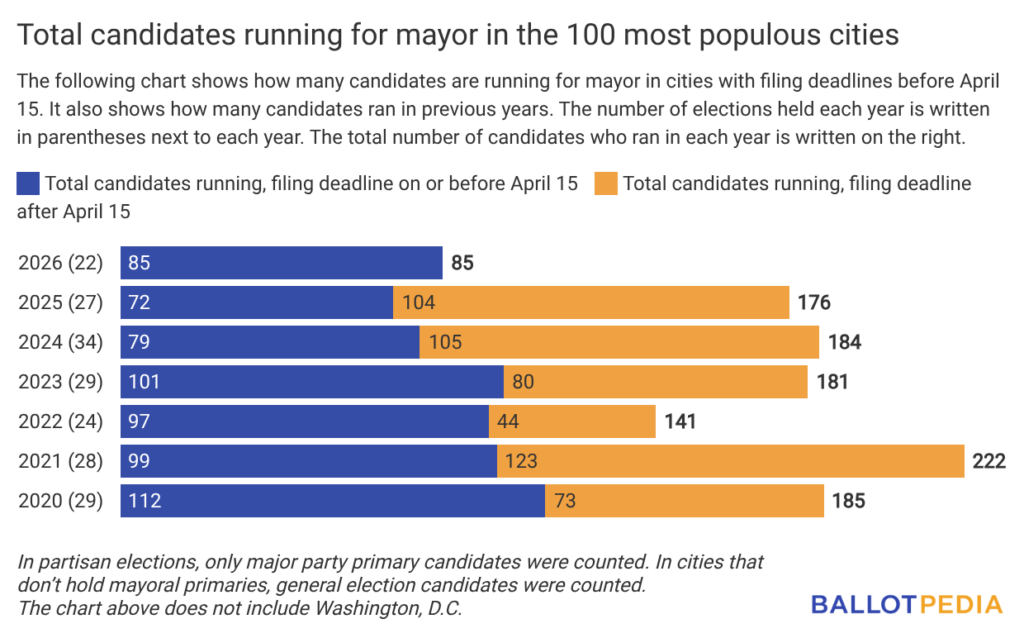
Candidate filing deadlines have passed in 15 cities. In those cities, 85 candidates, or 5.7 per city, are running for mayor. This is the third fewest candidates running per city since 2020.
An average of 6.1 candidates were running at this point in years between 2020 and 2025. Looking at the full year, an average of 6.4 candidates ran per city.
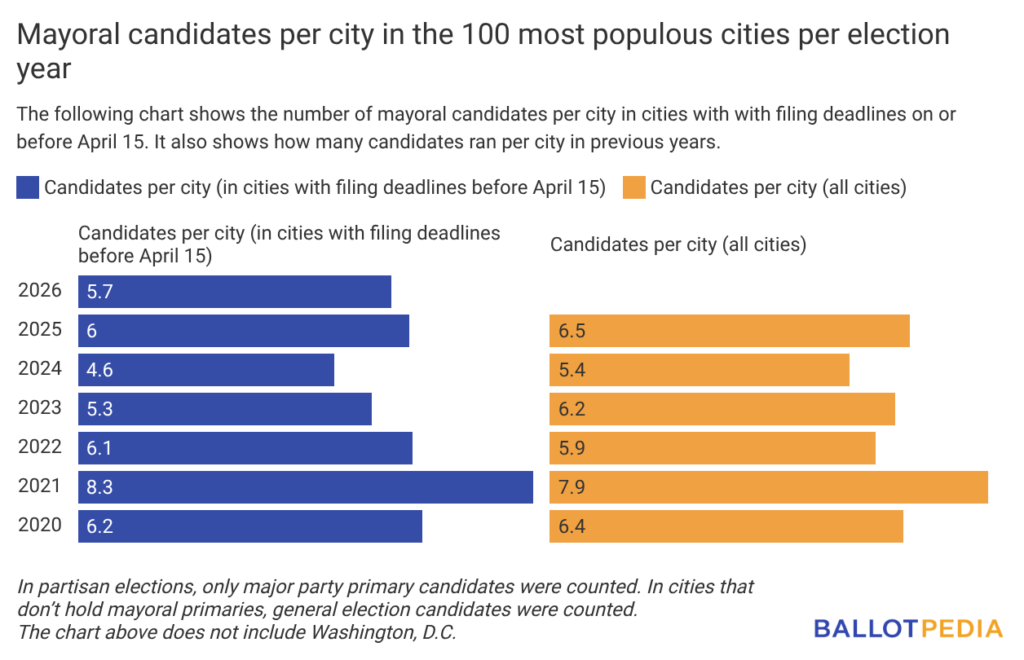
Looking at the total number of candidates, an average of 93.3 candidates were running across all cities at this point in years between 2020 and 2025. An average of 181.5 candidates ran each year nationally.
Open races
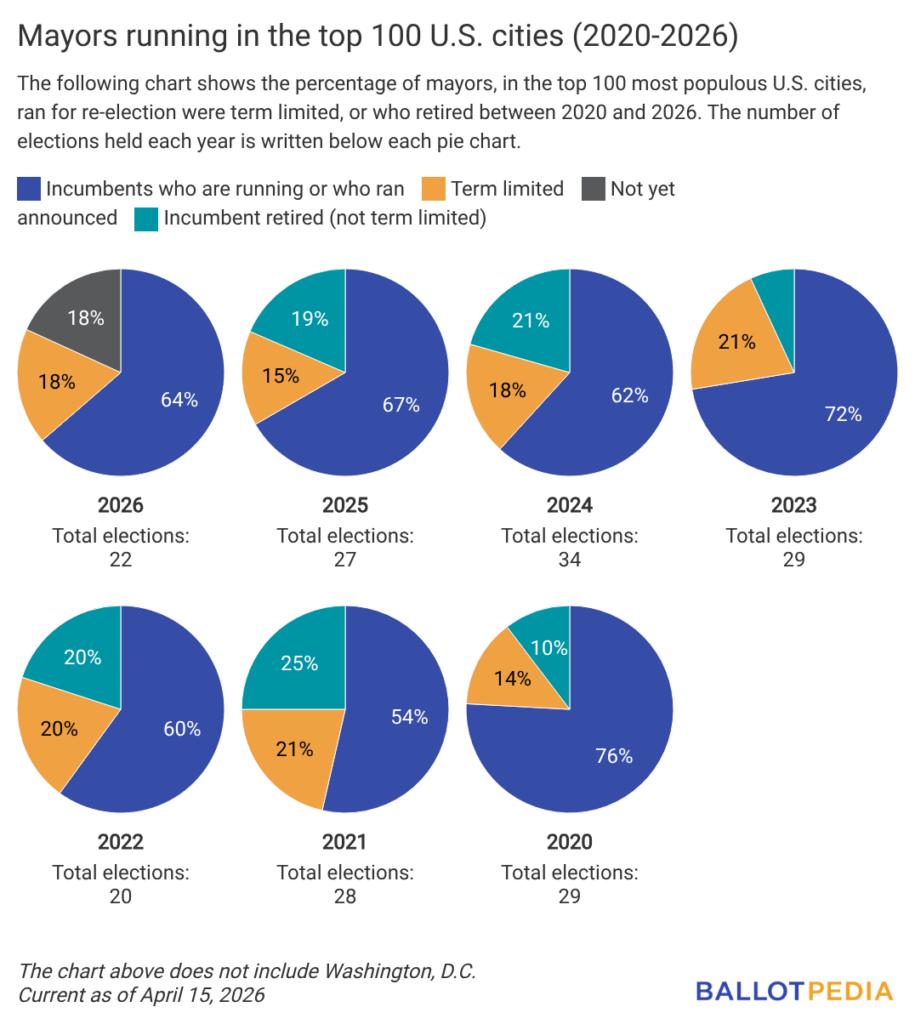
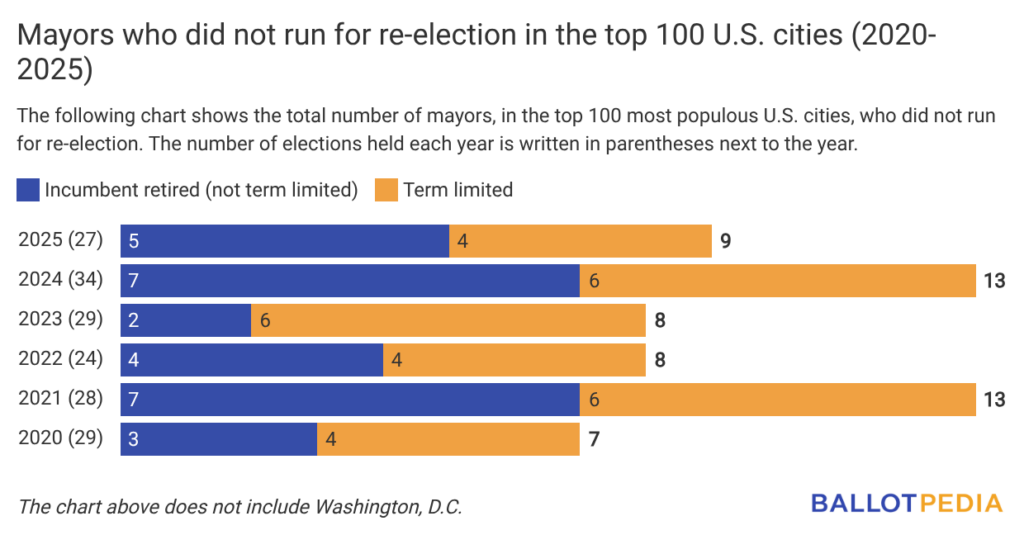
Fourteen (64%) mayors have announced that they are running for re-election. Four mayors (18%) are term-limited, and four mayors (18%) have not yet announced if they will run for re-election. Excluding mayors who are term-limited, no mayors have announced they will not run for re-election this year.
We wrote more about mayoral retirements and term limits in our Dec. 22, 2025, edition of the Daily Brew. Click here to see that coverage.
An average of 63.4% of mayors ran for re-election in the years between 2020 and 2025, and an average of 16.3% of mayors retired (not including term-limited mayors). An average of 17.5% of mayors were term-limited.
Here are some key things to know about this year’s mayoral elections so far.
- Fourteen candidates are running in Los Angeles’ mayoral election. That is the most in any city this year. Los Angeles is the second most populous city in the U.S. Click here to learn more about the June 2 primary.
- Louisville, Kentucky, is holding nonpartisan elections for mayor and metro council for the first time. The city is required to switch to nonpartisan elections under HB288, which the Kentucky General Assembly passed in 2024. Eleven candidates are running in the nonpartisan primary, the second most in any city this year. Twelve major party candidates ran in the primaries in 2022. Seven major party candidates ran in the primaries in 2018.
- Reno, Nevada, is holding its first open race for mayor since 2014. Incumbent Hillary Schieve is term-limited. Nine candidates are running this year, including a former lieutenant governor and two city council members.
- So far this year, one city – Oklahoma City – has held a mayoral election. Incumbent David Holt defeated Matthew Pallares 86.5%-13.5%. This was the second-highest percentage that a mayoral candidate has ever received in the city. The only candidate to receive a larger vote share was Mick Cornett in 2006 (87.6%). Oklahoma City’s mayoral elections are officially nonpartisan. Holt is a former Republican state senator. Holt is the fifth mayor in the city’s history to be elected to a third term.
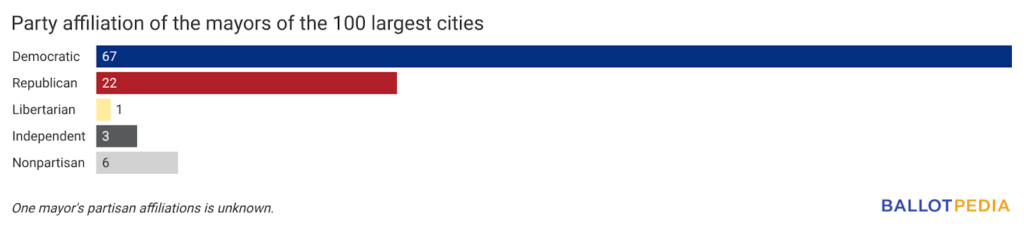
While most mayoral elections in the 100 most populous cities are nonpartisan, Ballotpedia has maintained a list of mayors’ partisan affiliations since 2016.
Currently, there are 67 Democratic mayors, 22 Republican mayors, one Libertarian mayor, three independent mayors, and six nonpartisan mayors. One mayor's partisan affiliation is unknown.
As we mentioned in our April 9 edition of the Daily Brew, that’s the most Democratic mayors since 2016.
Click here to learn more about mayoral elections in 2026, and click here to see our analysis of partisanship in this year's municipal elections.
Virginia Gov. Abigail Spanberger signs legislation returning the state to the Electronic Registration Information Center
On April 13, Virginia Gov. Abigail Spanberger (D) signed legislation requiring the state to rejoin the Electronic Registration Information Center (ERIC). Virginia was previously an ERIC member but withdrew from the organization in 2023, under former Gov. Glenn Youngkin (R).
Senate Bill 57 requires the state commissioner of elections to apply to rejoin ERIC and take all necessary steps to maintain the state’s membership in good standing. The law takes effect on July 1.
On March 24, Spanberger also issued an executive order directing the state to rejoin ERIC.
“Virginia must lead the way by continuing to improve its election security processes to ensure all Virginia voters are able to successfully register to vote and cast their ballots,” Spanberger’s executive order said. “Virginia’s election administrators must have access to the best information. The nonprofit, nonpartisan Electronic Registration Information Center (“ERIC”) is a valuable tool to accurately maintain Virginia’s voter rolls.”
Legislators approved two similar bills requiring the state to rejoin ERIC in 2024, but Youngkin vetoed them.
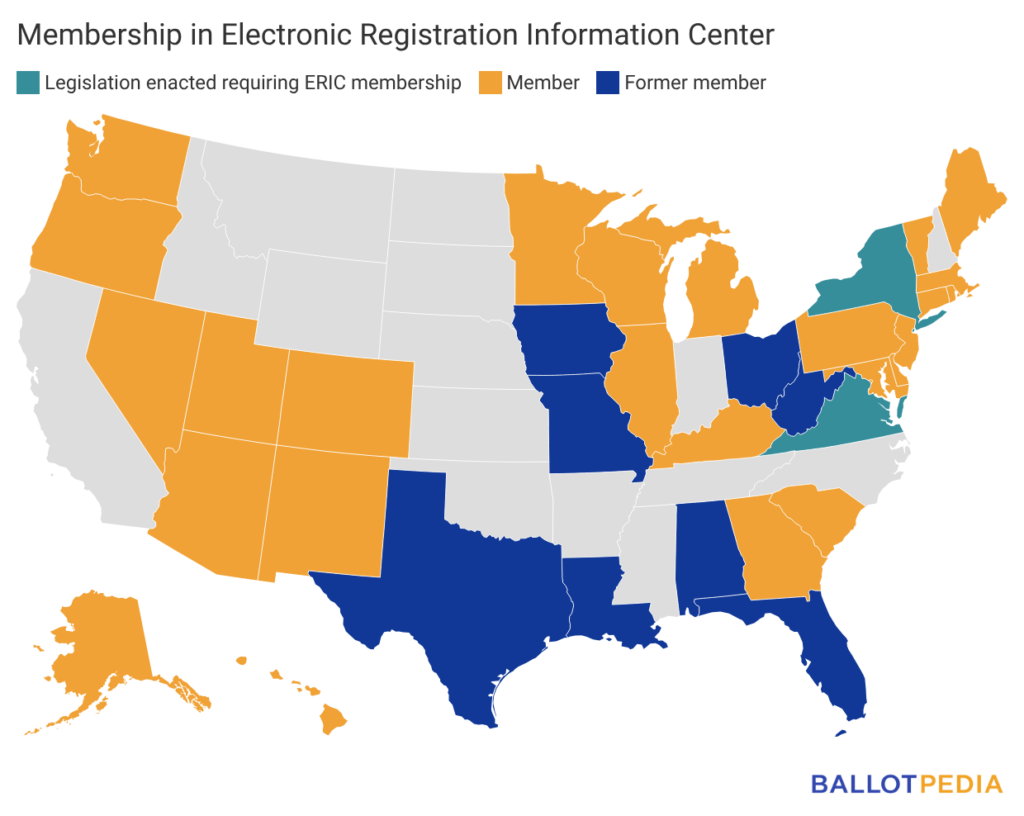
Virginia is the second state in the last year to approve legislation requiring ERIC membership. New York enacted S 1356 in December, requiring the state to join ERIC by July 31.
According to its website, ERIC is a nonprofit organization of member-states that shares information like voter registration and motor vehicle registration records in order to assist in voter list maintenance.
States that join ERIC agree to share their voter registration data and licensing and identification data from motor vehicle departments every 60 days. ERIC then compiles this data and subsequently releases a series of list maintenance reports.
After states receive a list maintenance report, they must act on it and use the information for voter list maintenance purposes. ERIC also releases reports that identify eligible but unregistered voters in each member state.
Currently, 25 states, plus the District of Columbia, are members of ERIC. Virginia and New York will bring the number of ERIC members to 27.
ERIC’s membership was highest in 2022, with 33 participating states. In addition to Virginia, eight other states left ERIC between 2022 and 2023. The states that withdrew from ERIC had either Republican trifectas or divided governments at the time. Currently, all besides Virginia have Republican trifectas, and no other states have rejoined ERIC since leaving. Election officials in states that withdrew from ERIC cited concerns about protecting personal data, partisanship, and strategic disagreements as contributing factors to their respective resignations.
So far in 2026, legislators in 35 states have introduced or carried over 177 bills related to voter list maintenance. Ten of those bills, including Virginia’s SB 57, have been enacted.
U.S. Senator Michael Bennet, Colorado Attorney General Phil Weiser, and four other Democrats are running for Colorado governor
U.S. Sen. Michael Bennet (D), Colorado Attorney General Phil Weiser (D), and four others are running in the June 30 Democratic primary for governor of Colorado. Bennet and Weiser lead in endorsements, polling, and fundraising. Incumbent Jared Polis (D) is term-limited.
According to the Denver Gazette’s Vince Bzdek, Bennet and Weiser diverge “in style more than substance, in the leadership approaches they would take to make Colorado more affordable, the how rather than the what. Weiser has positioned himself as The Fighter, filing more than 40 lawsuits against the federal government challenging various executive actions and funding cuts to protect Colorado’s interests. Bennet is more The Statesman, citing his broad experience serving Colorado, including 17 years in the U.S. Senate, three years as chief of staff to former Mayor John Hickenlooper, and four years as superintendent of Denver Public Schools.”
Bennet was first appointed to the Senate in 2009 to fill the vacancy created when President Barack Obama (D) appointed Ken Salazar (D) as Secretary of the Interior. Before the appointment, Bennet was the superintendent of Denver Public Schools. Bennet is running on his record in the Senate. U.S. Sen. John Hickenlooper (D-Colo.), U.S. Rep. Jason Crow (D-Colo.), U.S. Rep. Brittany Pettersen (D-Colo.), and U.S. Rep. Joe Neguse (D-Colo.) endorsed Bennet. Bennet is one of five U.S. Senators running for governor this year.
Weiser was elected attorney general of Colorado in 2018. Before the election, Weiser was a professor at the University of Colorado Boulder. Weiser is running on his experience in state government. Former Gov. Roy Romer (D), Massachusetts Gov. Maura Healey (D), North Carolina Gov. Josh Stein (D), and Washington Gov. Bob Ferguson (D) endorsed Weiser.
Bennet and Weiser have made opposing President Donald Trump (R) and affordability central to their campaigns. Both have criticized the other’s record in responding to the Trump administration. Weiser criticizes Bennet for supporting some of Trump's cabinet nominees. Bennet said, “There’s literally nothing easier in the world than voting against a Trump nominee on the floor of the U.S. Senate — except for maybe joining someone else’s lawsuit.”
Since 1975, Colorado has had one Republican governor, Bill Owens (1999-2007). The state has had a Democratic trifecta since 2019 and has voted for the Democratic presidential candidate in every election since 2008.
Click here to learn more about Colorado’s Democratic gubernatorial primary.