


Voters in Oklahoma will decide on a constitutional amendment at a special election on Aug. 25, 2026, to require voters to provide identification to vote by any method.
Currently, Oklahoma law requires voters to present identification when voting. The amendment would add this requirement to the state constitution, requiring voters to provide proof of identity in all elections and authorizing the state legislature to define what qualifies as acceptable identification.
Current law provides that valid forms of identification include government-issued photo IDs and county election board voter identification cards.
The amendment, Senate Joint Resolution 47 (SJR 47), was referred to the ballot by the state legislature. State Sen. Lonnie Paxton (R-23) introduced SJR 47. On March 26, the Senate approved the measure 39-8, with all 39 Republicans voting in favor and all eight Democrats voting against. The House approved the amendment on April 15 by a vote of 80-13, with 76 Republicans and four Democrats voting in favor and 13 Democrats voting against.
State Rep. Eric Roberts (R-83) supported the amendment in the House, saying, “It would send a state question to the vote of the people to amend the state constitution, to require voters to present proof of identity when voting … Because down the road it could be changed, currently statutory, it could be changed to remove that proof of identity, so now we’re just putting it in.”
State Rep. Andy Fugate (D-94) questioned the amendment, saying, “If this bill becomes part of the Constitution, will this require photo ID? No. Proof of identity … If it doesn’t change my ability to vote without identification, and it doesn’t require me to have a photo ID, why are we putting what we already have in statute into the constitution?”
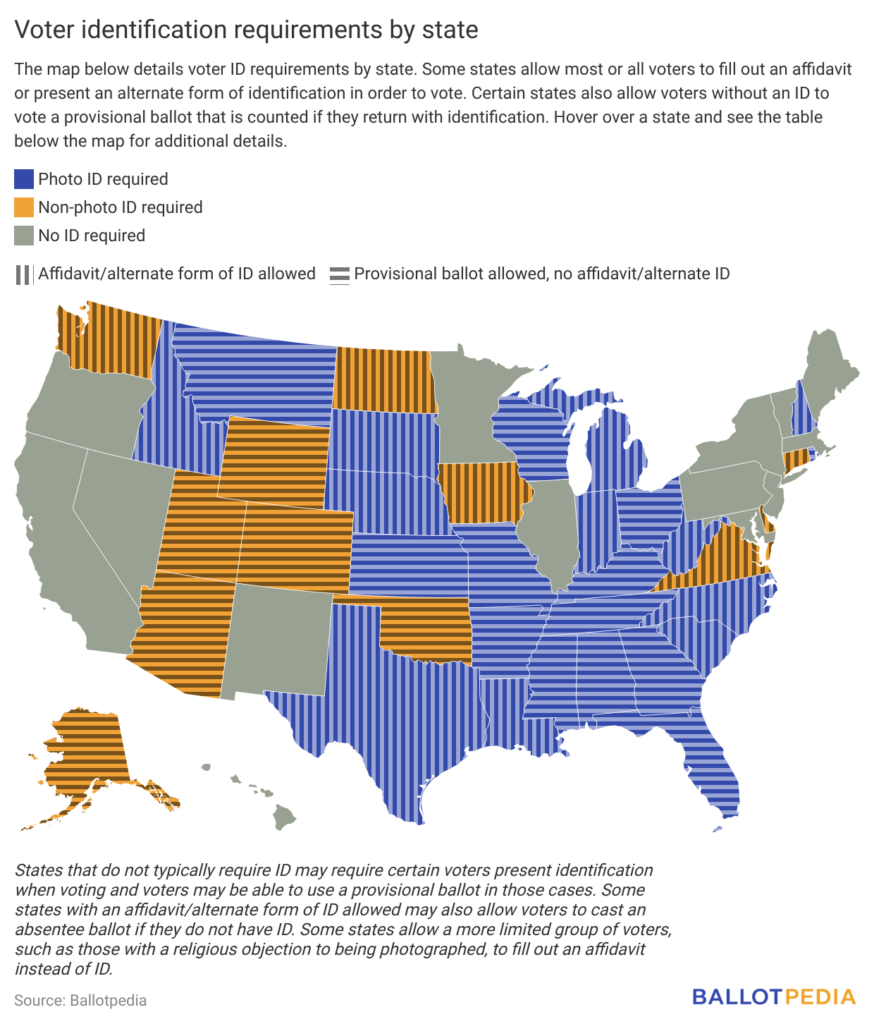
Currently, 36 states require voters to present identification in order to vote. Of these states, 24 require voters to present photo ID, with certain exceptions, and 12 states do not explicitly require photo ID. The remaining 14 states generally do not require voters to present identification to vote at the polls on Election Day.
Between 2004 and 2025, voters in 11 states decided on 12 ballot measures related to voter identification requirements. Voters approved nine of these measures and rejected three. The most recent state to approve a voter identification-related ballot measure was Wisconsin, when voters approved Question 1 in 2025. In 2025, Maine voters rejected Question 1, a ballot measure that would have required photo identification for in-person voting and made changes to absentee voting and ballot drop box rules.
For 2026, two other states—Nevada, North Carolina—will be deciding ballot measures that would require voter ID. Measures related to voter ID may also appear on the ballot in three other states—Arizona, California, and Washington.
Additional reading: