


Welcome to the Wednesday, May 6, 2026, Brew.
By: Lara Bonatesta
Here’s what’s in store for you as you start your day:
- Idaho initiative campaigns submit signatures for measures on abortion and medical marijuana
- Nebraska becomes first state to implement Medicaid work requirements under the OBBBA
- Trump issued five executive orders in April
Idaho initiative campaigns submit signatures for measures on abortion and medical marijuana
On May 1, supporters of two Idaho initiatives that would add a right to reproductive freedom to state law and legalize medical marijuana submitted signatures to Idaho county clerks for placement on the Nov. 3 ballot.
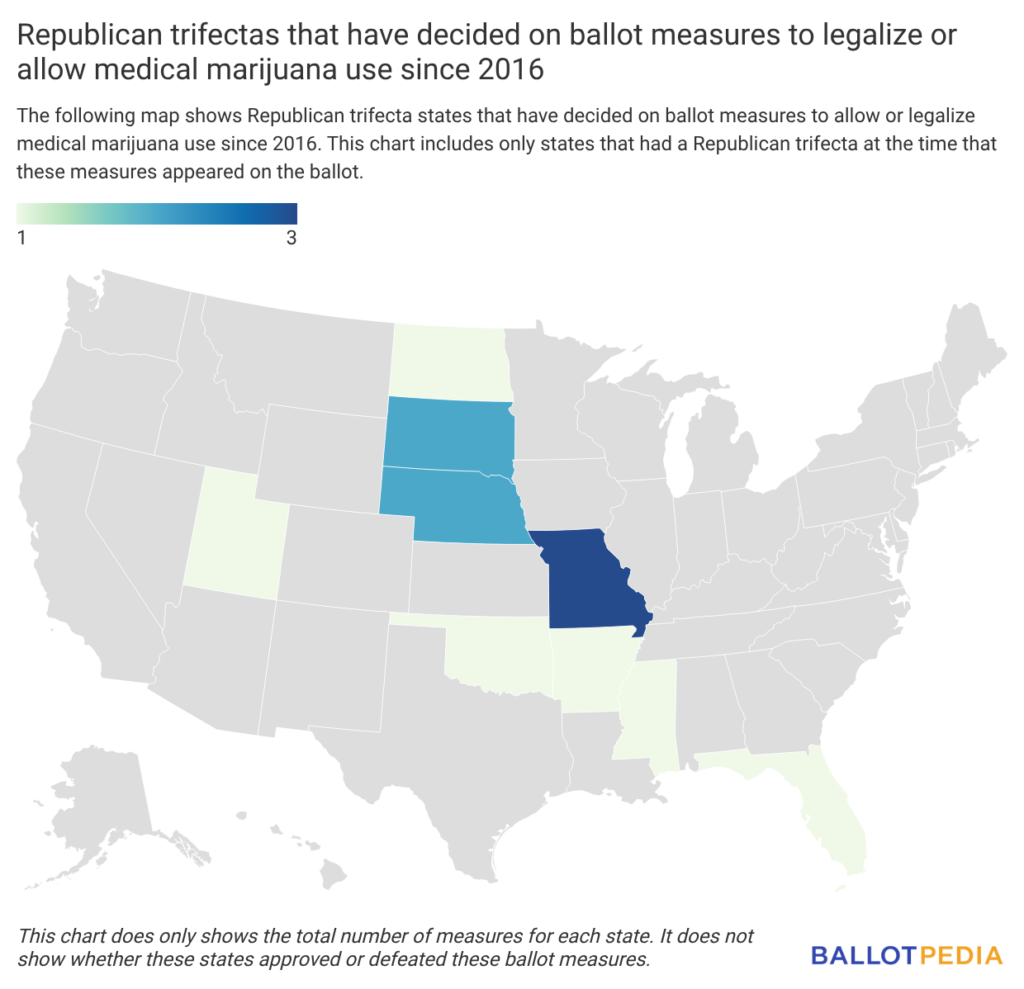
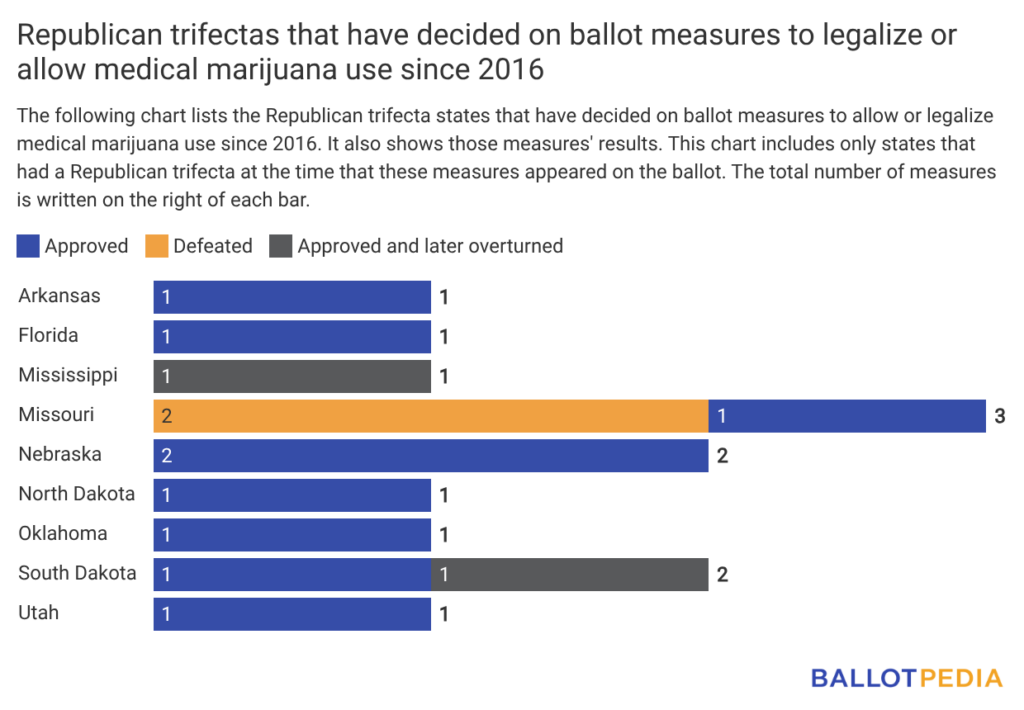
Idaho has a Republican trifecta, meaning Republicans control the governorship and both state legislative chambers. If these measures make the ballot, Idaho will be the sixth state with a Republican trifecta to decide on a pro-choice or pro-reproductive rights ballot measure since 2016 and the tenth state with a Republican trifecta to decide on a medical marijuana legalization measure since 2016.
Supporters of the Reproductive Freedom and Privacy Act Initiative and Medical Marijuana Legalization Initiative reported submitting more than 100,000 signatures for each measure. Both measures are initiated state statutes. Each would need at least 70,725 valid signatures to make the ballot (equal to 6% of the number of registered voters as of the state's last general election.) Idaho has a distribution requirement, requiring signatures to equal at least 6% of registered voters in 18 of the state's 35 state legislative districts (Idaho uses the same map for both its state House and state Senate.) County officials have until June 30 to certify the number of valid signatures and report their findings to the secretary of state.
Abortion measure
The first initiative would add a right to reproductive freedom and privacy to state law. The initiative defines that right as the ability to "make personal decisions about reproductive healthcare that directly impacts the person's own body." The initiative says that right would include decisions about:
- abortion
- childbirth care
- contraception
- fertility treatment
- miscarriage care
- prenatal, pregnancy, and postpartum care
The initiative would permit the state to regulate abortion after the point of fetal viability, except in cases of medical emergencies. The initiative defines fetal viability as “the point in a pregnancy when, on the basis of a physician's good faith medical judgment, based on the facts known at the time, and determined on a case-by-case basis, the fetus has a significant likelihood of sustained survival outside of the uterus without extraordinary medical measures.”
A pregnancy that would result in the loss of the woman's life, place the health of the woman in serious danger, cause the serious impairment of the patient's bodily function, or cause the dysfunction of any organ or part of the patient's body would be considered a medical emergency that could allow for an abortion.
The organization Idahoans United for Women and Families created the group Back to Idaho to lead the campaign for the initiative. The Democratic Party of Idaho also endorsed the initiative. Idaho Chooses Life, Right to Life Idaho, and the Idaho Family Policy Center oppose the initiative.
Three other states will decide ballot measures on abortion this year:
- Missouri Amendment 3 would repeal the state’s constitutional right to reproductive freedom (which voters approved in 2024). Amendment 3 would prohibit abortions except in cases of "medical emergency, fetal anomaly, rape, or incest," and permit abortions in cases of rape or incest only through 12 weeks of gestation. Amendment 3 would also prohibit certain medical procedures for transgender minors.
- Nevada Question 6 would create a state constitutional right to an abortion, while allowing the state to regulate abortion after fetal viability. Voters approved Question 6 in 2024. In Nevada, voters must approve constitutional amendments twice before they are ratified.
- Virginia voters will decide on a constitutional amendment that would establish a right to reproductive freedom, defined as “the right to make and effectuate one's own decisions about all matters related to one's pregnancy.”
Here’s a look at how measures similar to the proposed abortion initiative in Idaho have done in Republican trifecta states over the last ten years.
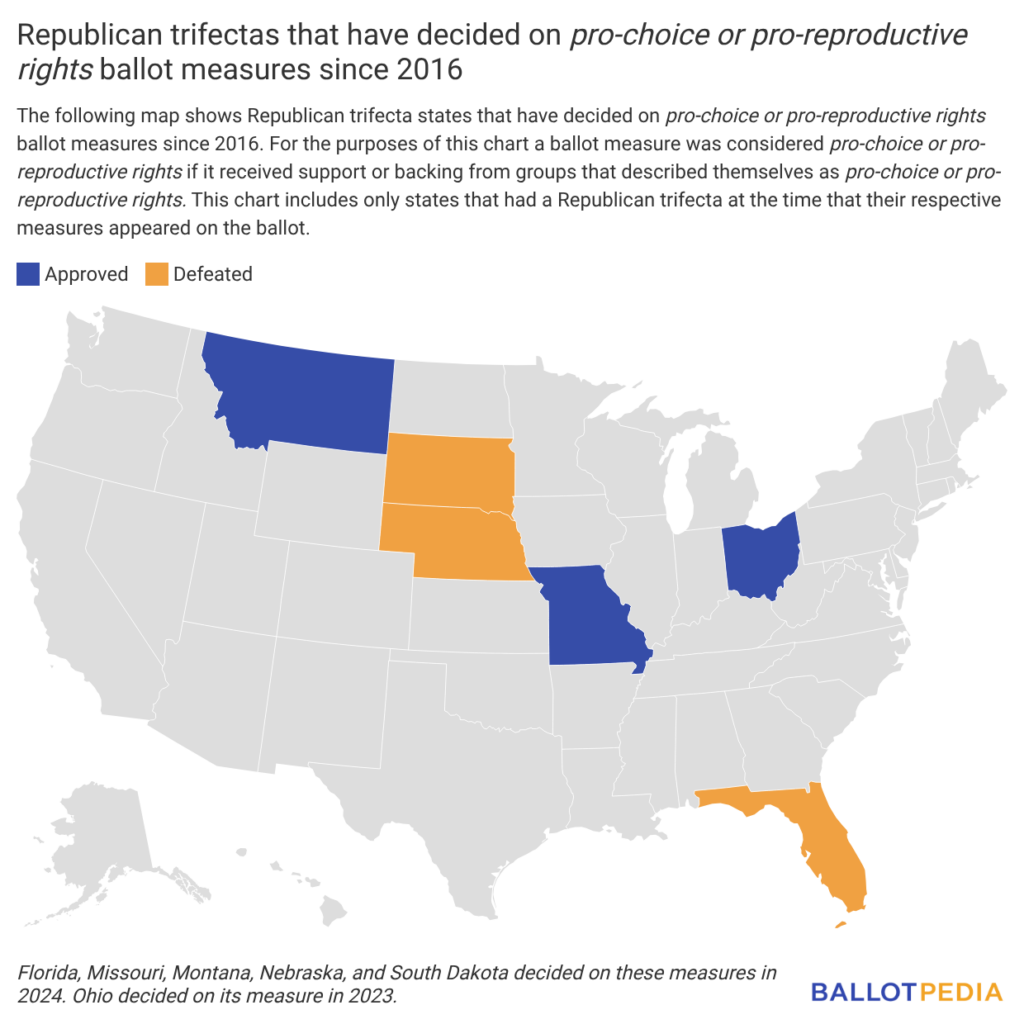
Between 1970 and 2025, there were 65 abortion-related ballot measures. Forty-four of these had the support of organizations that described themselves as pro-life. Voters approved 12 and rejected 32 of these 44 ballot measures. The other 21 abortion-related ballot measures had the support of organizations that described themselves as pro-choice or pro-reproductive rights. Voters approved 15 and rejected six. There were no abortion measures on the ballot in 2025.
Medical marijuana legalization
The second initiative would legalize the use of marijuana for individuals diagnosed with at least one of 16 health conditions listed in the initiative. Voters will also decide on a legislatively-referred constitutional amendment saying that only the Legislature shall have the authority to legalize marijuana, narcotics, or other psychoactive substances. If voters approve the amendment, it would remove citizens' ability to initiate state statutes legalizing these substances. The amendment states that it would be "effective immediately upon adoption by the voters of Idaho." It would not affect any initiatives on the 2026 ballot, including the medical marijuana initiative.
The Medical Marijuana Legalization Initiative would also apply to individuals diagnosed with a terminal illness, a condition for which the patient is granted hospice or palliative care, or a rare condition that is not adequately managed with other treatment attempts. The initiative also allows the state Board of Pharmacy to add to the list of qualifying health conditions.
The measure would also provide for a program for businesses to apply for a medical cannabis production license, and require patients who use medical marijuana to obtain a medical cannabis card.
On April 1, the Legislature approved Senate Concurrent Resolution 127 (SCR 127), which urges, “the citizens of Idaho to reject any effort to bring the Idaho Medical Cannabis Act to the ballot.” The state Senate approved SCR 127 with a voice vote. The state House approved it 58-9 along party lines, with 58 Republicans voting yes, and nine Democrats voting no. Three Republicans did not vote.
As of May 1, no marijuana ballot measures have been certified for the 2026 ballot in other states. Initiatives have been proposed in Arizona, Massachusetts, Missouri, and Nebraska.
History of marijuana policy ballot measures in Idaho
Between 2010 and 2025, there were eight initiatives proposed for the ballot in Idaho concerning marijuana use. None of the initiatives met the signature requirement to qualify for the ballot.
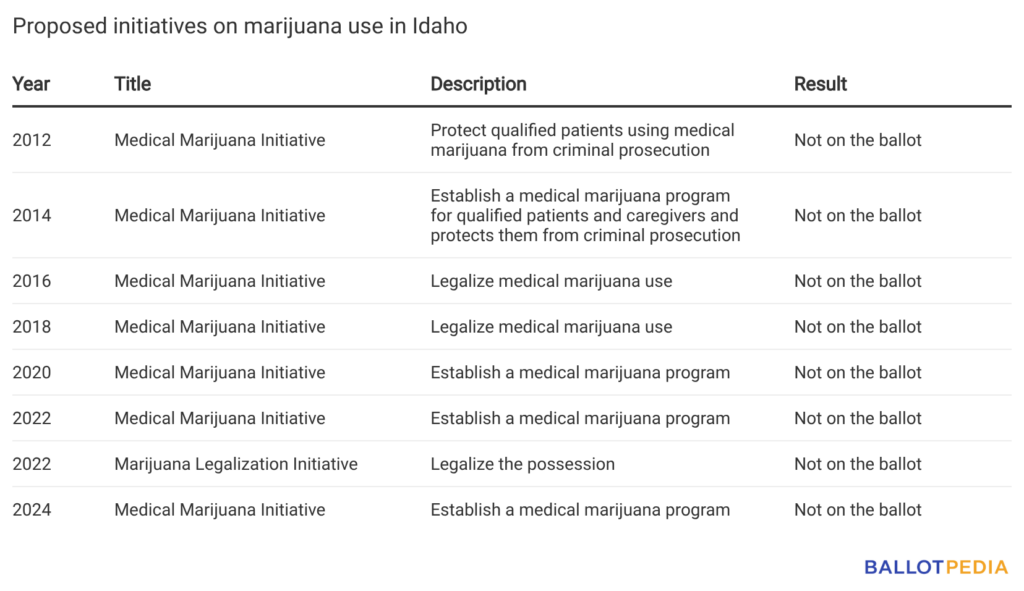
Another marijuana policy initiative was filed for the 2026 ballot. The initiative would have legalized the use of marijuana for recreational purposes. However, Kind Idaho, the organization sponsoring the measure, did not submit signatures by the May 1 deadline. As such, it will not appear on the 2026 ballot.
Here’s a look at marijuana legalization initiatives in Republican trifecta states over the last ten years.
Click here to learn more about Idaho’s 2026 ballot measures.
Nebraska becomes first state to implement Medicaid work requirements under the OBBBA
On May 1, Nebraska became the first state to implement Medicaid work requirements under the One Big Beautiful Bill Act (OBBBA), making it the third state ever to enforce a Medicaid work requirement. The OBBBA directs states to adopt policies requiring able-bodied Medicaid recipients in the Affordable Care Act (ACA) expansion group to work 80 hours per month beginning Jan. 1, 2027.
As of May 1, Medicaid expansion recipients need to work, attend school or an apprenticeship, participate in a work program, or volunteer for 80 hours per month unless they have an exemption.
Work requirements in other states
Nebraska is the third state ever to implement a work requirement, after Arkansas and Georgia.
Arkansas briefly implemented work requirements under a waiver granted during the first Trump administration before it was revoked during the Biden administration. Georgia was similarly granted a waiver to implement work requirements for the program and implemented them after a court case was ruled in the state's favor. Georgia has been the only state with active work requirements since July 1, 2023.
Click here to learn more about Medicaid work requirements.
Trump issued five executive orders in April
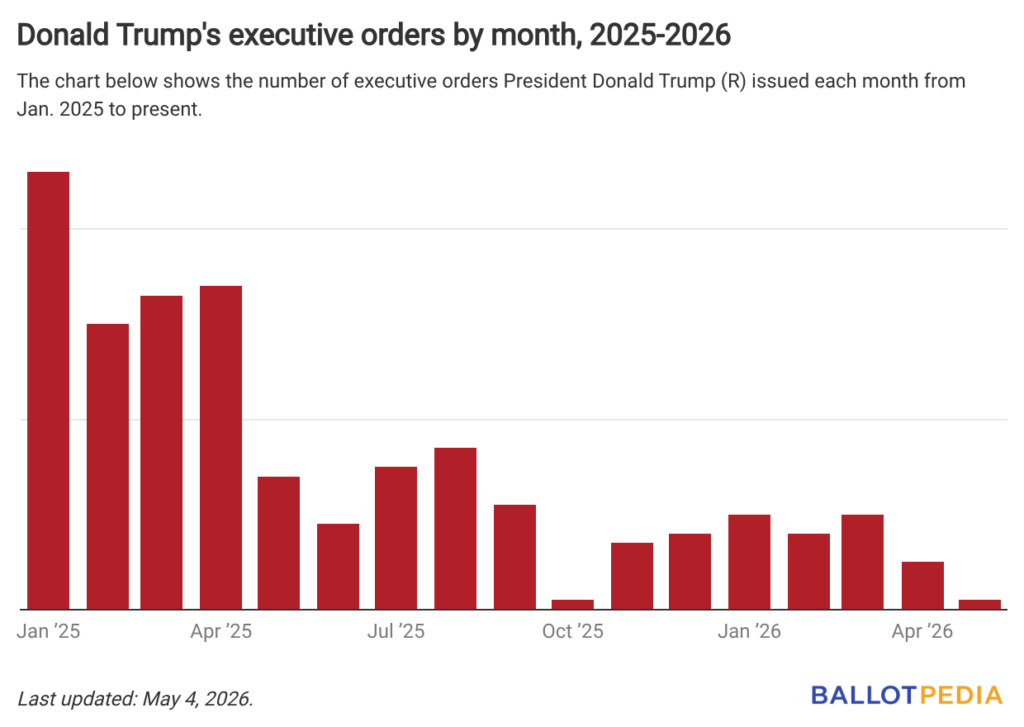
President Donald Trump (R) issued five executive orders last month, the second fewest in a single month so far in his second term.
As of May 1, Trump has issued 259 executive orders in his second term. Trump issued orders on pharmaceuticals, college sports, the administrative state, and retirement savings last month. Click here to read more about each order.
In March, Trump issued 10 executive orders. Trump issued 46 executive orders in January 2025, more than in any other month of his presidency. Trump issued the fewest executive orders of his second term in October 2025, when he issued one.
Among all U.S. presidents, Trump has issued the 10th-most executive orders, with 479 orders across his two terms in office as of May 1. Franklin D. Roosevelt (D) issued the most of all U.S. presidents, with a total of 3,721 executive orders during his time in office. William Henry Harrison (Whig) issued the fewest, having issued none during his one month in office. Three presidents issued only one executive order each: James Madison (Democratic-Republican), James Monroe (Democratic-Republican), and John Adams (Federalist).
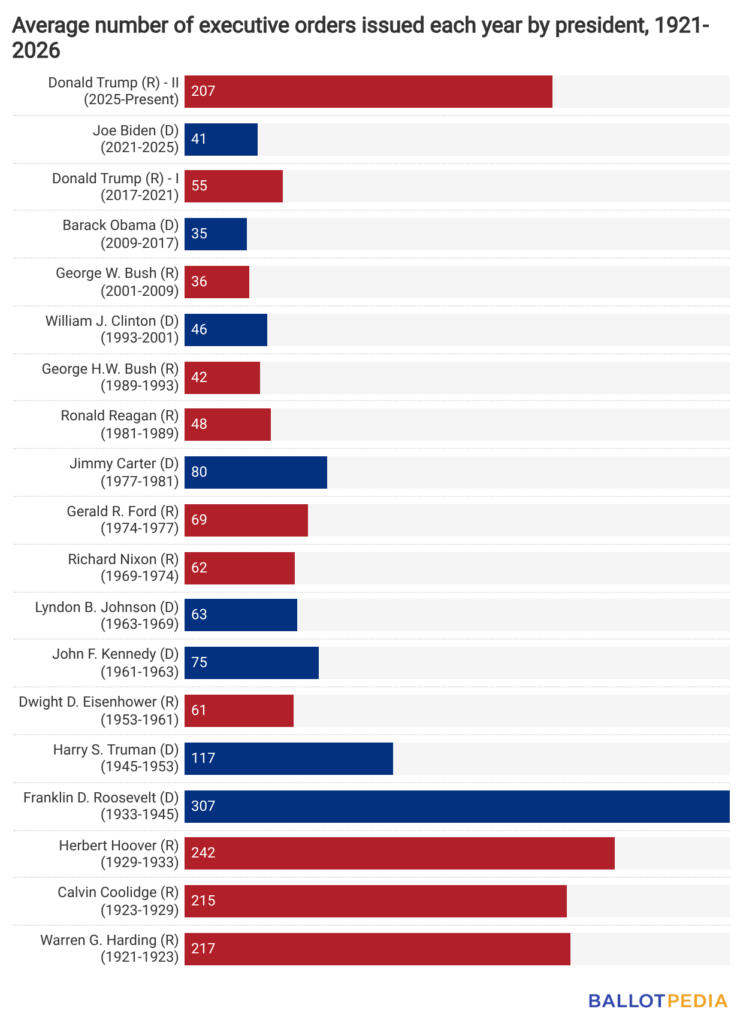
Trump has issued an average of 207 executive orders per year in his second term, the highest average among the seven presidents who have held office since 1981. In his first term, Trump averaged 55 executive orders per year, the second-highest in that time. Joe Biden (D) averaged 41 per year, the third-fewest in that time. Franklin D. Roosevelt issued 307 executive orders per year on average, the most of all U.S. presidents.
Click here to learn more about Trump’s executive orders and actions.
Editor's note: This post originally noted that Nevada was the third state to implement work requirements; it's been corrected to say Nebraska.