


Welcome to the Thursday, May 7, 2026, Brew.
By: Briana Ryan
Here’s what’s in store for you as you start your day:
- Five candidates are running in the May 19 general election for three seats on the Georgia Supreme Court
- Signatures submitted for Missouri initiative requiring voter approval for certain legislative changes to initiative process and voter-approved laws
- Five Indiana Senate incumbents who voted against redistricting lose re-election to Trump-endorsed challengers
Five candidates are running in the May 19 general election for three seats on the Georgia Supreme Court
Three seats on the Georgia Supreme Court are up for general election on May 19, including two Republican appointed and supported justices facing challenges from Democratic-backed candidates.
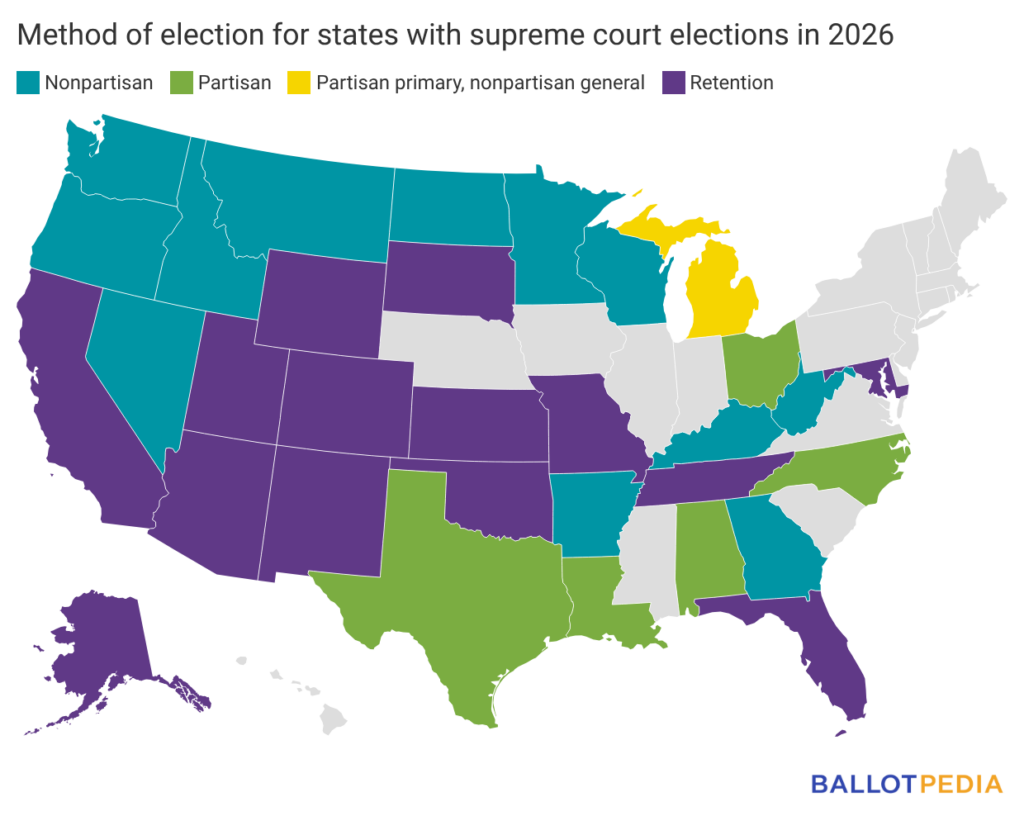
State supreme court elections in Georgia are nonpartisan. Incumbents Charlie Bethel, a former Republican member of the Georgia Senate, and Sarah Hawkins Warren were appointed by Republican governors and endorsed by Gov. Brian Kemp (R). They are facing Miracle Rankin and Jen Jordan, respectively, who have support from Georgia’s Democratic Party. Jordan was the Democratic nominee for Georgia’s Attorney General in 2022. Incumbent Ben Land, appointed by a Republican governor, is running unopposed.
Republican governors have appointed all current justices — except John Ellington — to the Court. Ellington — who a Democratic governor appointed to the Georgia Court of Appeals in 1999 — was initially selected to serve on the Court via a 2018 nonpartisan election. Governor Nathan Deal (R) endorsed him in that election.
If Rankin and Jordan win their respective races, that would bring the number of Democratic-affiliated justices to two. If Bethel and Warren win their respective races, the number of Republican-affiliated justices would remain at eight. In our 2020 analysis of state supreme court justices, Ellington received a confidence score of Indeterminate.
While justices on the Court run in nonpartisan elections for six-year terms, the governor may select a successor from a list of candidates compiled by the Judicial Nominating Commission in the event of a vacancy. According to Atlanta Journal-Constitution‘s Greg Bluestein, this process has historically given candidates the advantage of incumbency in the state's elections. The last time a justice lost re-election in Georgia was 1922.
Across the 13 states where justices are elected via nonpartisan elections, incumbents running for re-election won 94% of the time from 2008 to 2025.
These elections follow the U.S. Supreme Court's 6-3 decision in Louisiana vs. Callais, which will affect how Section 2, which prohibits voting practices and procedures that discriminate on the basis of race, is applied in future disputes over district boundaries. Bolts' Alex Burness wrote that in interviews ahead of the decision, the candidates "were preparing for such a ruling, and that they expected it would hand the Georgia Supreme Court, like its counterparts in the rest of the country, greater responsibility on matters of election law."
Here's a closer look at the candidates running in the contested elections this year:
- Deal appointed Bethel to the Court in 2018. In the 2020 nonpartisan elections, Bethel defeated Beth Beskin 52% to 48%. Bethel served on the Georgia Court of Appeals from 2017 to 2018, in the Georgia Senate from 2011 to 2016, and on the Dalton City Council from 2006 to 2010.
- Deal appointed Warren to the Court in 2018. In the 2020 nonpartisan election, Warren defeated Hal Moroz 79% to 21%. Warren previously served as Georgia's solicitor general and deputy solicitor general and practiced law with Kirkland & Ellis LLP.
- Rankin is an attorney in private practice specializing in personal injury cases.
- Jordan is an attorney in private practice and served in the Georgia Senate from 2017 to 2023. She was also the Democratic nominee for Georgia’s Attorney General in 2022.
Thirty-two states are holding state supreme court elections this year. In total, 65 of the 344 seats on state supreme courts are up for election. Nonpartisan justices hold 46 of these seats, Republican justices hold 13, and Democratic justices hold six.
Click here to read more about this year's Georgia Supreme Court elections.
Signatures submitted for Missouri initiative requiring voter approval for certain legislative changes to initiative process and voter-approved laws
Missouri voters could decide on a citizen initiative on Nov. 3 that would make the state the first in the country to require both a supermajority vote in the legislature and voter approval to amend a citizen-initiated statute.
On May 3, Respect MO Voters, the campaign behind the initiative, reported submitting more than twice the required number of signatures — 367,000 — to refer the Missouri Initiative and Referendum Powers and Legislative Change Requirements Amendment to the ballot. The signatures are pending verification.
The proposed constitutional amendment defines the rights of initiative and referendum as fundamental rights. The amendment would prohibit the Legislature from increasing signature thresholds, shortening signature-gathering periods, restricting subject matter, limiting judicial review of ballot language, creating additional requirements for petitioners, and requiring more than a simple majority vote for approval. Such changes could still be made through a constitutional amendment, which requires voter approval.
The amendment would also prohibit the Legislature from changing a voter-approved initiative unless there’s an 80% vote in each chamber of the Legislature to refer a proposed change to the ballot. Voters would then have to approve the change.
No state requires both a supermajority vote in the legislature and voter approval to amend a citizen-initiated statute. Missouri is one of 21 states that allows citizen-initiated state statutes and one of 11 that currently has no limits on the legislature’s ability to amend or repeal them.
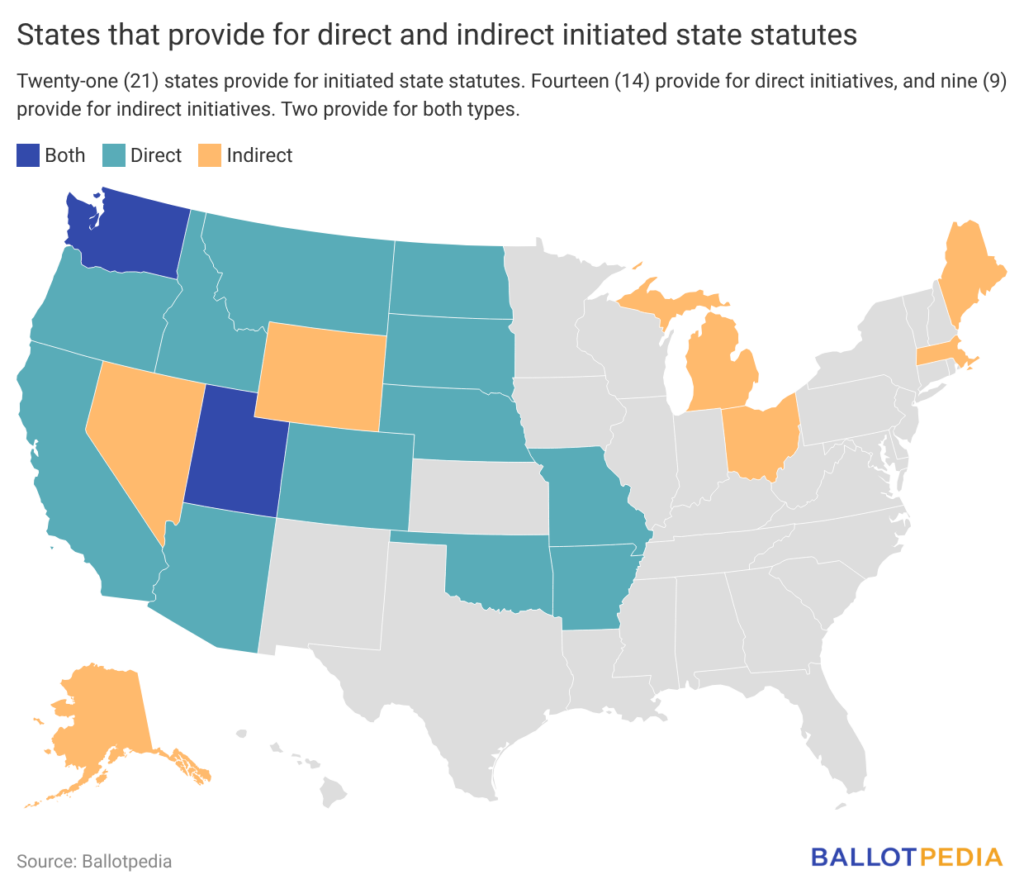
Additionally, no state requires voter approval to change the rules governing the initiative process itself, such as signature thresholds or ballot language rules, which the Missouri amendment would require.
To qualify for the ballot, the campaign must submit 170,215 valid signatures, depending on how they are distributed across the state’s eight congressional districts. That number equals 5% of the gubernatorial vote in at least two-thirds of the state’s eight congressional districts.
Missouri voters have rejected two of three constitutional amendments that would have added restrictions to the initiative process or increased signature requirements. In 1914, voters rejected an initiative to add subject restrictions to initiatives, and in 1924, voters rejected a proposal to increase signature requirements. In 1998, voters approved an amendment changing the initiative signature deadline from four months to six months before the election.
Click here to read more about the Missouri Initiative and Referendum Powers and Legislative Change Requirements Amendment.
Five Indiana Senate incumbents who voted against redistricting lose re-election to Trump-endorsed challengers, and other May 5 election results
On May 5, voters in Indiana, Ohio, and parts of Michigan headed to the polls. Here’s a look at the four elections we were watching closely: the Indiana Senate Republican primaries, the Republican primary for Indiana’s 4th Congressional District, the Republican primary for Ohio Treasurer, and the special general election for Michigan Senate District 35.
Starting with the Indiana Senate Republican primaries. Ten of the 21 Republicans in the state Senate who voted against a Republican-backed mid-decade redistricting bill in December 2025 were up for re-election this year. Two of those 10 Republicans did not run for re-election.
President Donald Trump (R) endorsed primary challengers against seven of the eight Republicans who voted against the effort and ran for re-election. As of May 6 at 3:45 p.m., five of the seven incumbents who voted against redistricting and faced a Trump-endorsed opponent lost. State Sen. Rick Niemeyer (R), who also voted against redistricting, lost against James Starkey (R), who Trump did not endorse, 56% to 44%.
As of May 6, the only incumbent who voted against redistricting and did not lose re-election to a Trump-endorsed candidate was state Sen. Greg Goode (R), who defeated Brenda Wilson (R) 54% to 36%. As of May 6 at 3:45 p.m., the Republican primary for District 23 between state Sen. Spencer Deery (R) and Paula Copenhaver (R) is too close to call.
In total, seven Republican incumbents lost re-election in the primaries. Six of those incumbents voted against redistricting, while state Sen. Nick McKinley (R) was not a member of the chamber at the time of the redistricting vote. In addition to the Republican primary for District 23, the Republican primary for District 15 is too close to call as of May 6 at 3:45 p.m.. Unlike Deery, the incumbent in District 15, state Sen. Liz Brown (R), voted in favor of redistricting.
This year marks the first time since we began tracking state legislative races in 2010 that more than one Republican state senator lost in a primary. No incumbents lost primaries in 2010, 2012, 2020, and 2024. However, one lost primaries in 2014, 2016, 2018, and 2022, respectively.
Staying in Indiana, Rep. Jim Baird (R) defeated Craig Haggard (R) and John Piper (R) in the Republican primary for the 4th Congressional District. Baird won 61% of the vote to second-place finisher Haggard’s 31%. The Indianapolis Star’s Marissa Meador wrote that “After an early campaign launch in August 2025, Haggard had distinguished himself as a ‘new blood’ candidate, tapping into the disillusionment of voters who see dysfunction in Washington, D.C. But Baird, armed with an endorsement from President Donald Trump, pulled through by a wide margin.” Baird will now face Drew Cox (D) in the general election.
In Ohio, Jay Edwards (R) defeated Kristina Daley Roegner (R) in the Republican primary for Treasurer 53% to 47%. Vice President J.D. Vance (R) endorsed Edwards. Gubernatorial candidate Vivek Ramaswamy (R), who ran for president in 2024, endorsed Roegner. Ahead of the primary, Politico's Jacob Wendler wrote, "The otherwise sleepy battle … is one of many divides bubbling up in the Republican Party that is tentatively charting a post-Trump future, with both Ramaswamy and Vance jockeying to put their stamp on the GOP." Edwards will now face Seth Walsh (D) in the general election.
In Michigan, Chedrick Greene (D) defeated Jason Tunney (R) and Ali Sledz (L) in the special general election for state Senate District 35. Greene won 59% of the vote to second-place finisher Tunney’s 39%.
Greene will serve the remainder of Kristen McDonald Rivet’s (D) term, which ends in January 2027, in the chamber. Rivet resigned on Jan. 3, 2025, after being elected to represent Michigan's 8th Congressional District in 2024.
Governor Gretchen Whitmer (D) announced a timeline to fill the vacancy on Aug. 29, 2025. Michigan Public Radio’s Colin Jackson wrote that Whitmer’s “decision to wait months to call a special election has drawn criticism from all sides of the political spectrum, who argued residents of the 35th district were being disenfranchised by not having a voice in the state Senate for most of the year.” According to the Detroit Free Press' Clara Hendrickson, "Whitmer has never publicly explained why she waited so long."
Once Greene is sworn in, the Democratic majority in the Michigan Senate will increase from 19-18 to 20-18.
Click here for more information about the May 5 election results.