


Steve Maviglio, a Democratic political consultant and strategist known for his work on California ballot measure campaigns, filed a ballot initiative on May 8 for the 2028 ballot proposing to repeal the top-two primary system adopted with the approval of Proposition 14 in June 2010.
The top-two system provides that all candidates are listed on the same ballot regardless of party affiliation. The top two vote-getters advance to the general election. Consequently, it is possible that two candidates belonging to the same political party could win in a top-two primary and face off in the general election. Voters approved Proposition 14, a legislatively referred constitutional amendment, by a vote of 53.7% to 46.3%.
The proposed initiative would amend the state constitution to authorize the state legislature to provide for primary elections for partisan congressional and state offices and to allow any political party that holds a primary for a partisan office to advance the top vote-getter from that primary to the general election.
Maviglio published an op-ed in the San Francisco Chronicle upon filing the initiative, arguing the upcoming gubernatorial primary election demonstrates the need for the change. He wrote, “When casting ballots in this fall’s gubernatorial election, however, our state’s electorate could ... be forced to choose between two Republican candidates for governor.” He continues, “There are eight substantial declared Democratic candidates as of last week. None has emerged as a favorite. All have political bona fides. All have a small base from which to start. Collectively, they have the potential to divide the Democratic electorate pie into small slices.”
Sixty-one candidates are running in the top-two primary for governor of California on June 2, 2026. Xavier Becerra (D), Matt Mahan (D), Katie Porter (D), Thomas Steyer (D), Antonio Villaraigosa (D), Chad Bianco (R), and Steve Hilton (R) lead in polling and media attention. Incumbent Gov. Gavin Newsom (D) is term-limited.
To qualify for the ballot, the initiative campaign needs to collect signatures equal to 8% of the votes cast at the 2026 gubernatorial election. State law currently requires ballot initiatives to appear on general election ballots. If adopted in 2028, it would be utilized in the 2030 election cycle.
The 2010 California measure was supported by then-governor Arnold Schwarzenegger (R). In the state voter guide, AARP, the California Alliance for Jobs, and the California Chamber of Commerce endorsed the measure, saying, “Proposition 14 will give independent voters an equal voice in primary elections. Proposition 14 will help elect more practical officeholders who are more open to compromise.”
The California Democratic and Republican parties opposed the measure. The Howard Jarvis Taxpayers Association submitted opposition arguments for the voter guide. The Association said, “Proposition 14 will also decrease voter choice and make elections more expensive. The general election will not allow write-in candidates. ... This means voters may be forced to choose between two candidates from the same political party. Democrats could be forced to choose between two Republicans, or not vote at all. Republicans could be forced to choose between two Democrats, or not vote at all.”
California is one of five states —Alaska, Louisiana, Nebraska, and Washington — that use a top-two style primary for at least some or all congressional and statewide elections. Washington was the first state to adopt a top-two system in 2004 with the approval of Initiative 872. It was first utilized in the 2008 election. In 2020, Alaska voters approved Alaska Ballot Measure 2, establishing a top-four primary, which is a variation of the top-two primary, for state executive, state legislative, and congressional elections. The initiative also established ranked-choice voting for general elections for the aforementioned offices and the presidency.
Louisiana uses a majority vote system for some offices, including state senator and representative. Candidates running appear on the same ballot in either October (in odd-numbered years) or November (in even-numbered years), regardless of their partisan affiliations. If a candidate wins a simple majority of all votes cast for the office (i.e., 50 percent, plus one vote), he or she wins the election outright. If no candidate meets that threshold, the top two finishers, regardless of their partisan affiliations, advance to a second election in November (in odd years) or December (in even years). For Congress, the Justice of the Supreme Court, the State Board of Elementary and Secondary Education, and the Public Service Commission, the state uses a semi-closed primary. Louisiana refers to these as party primary offices.
A ballot initiative in Massachusetts has been filed for the 2026 ballot to adopt a top-two primary system. The campaign is currently collecting a second round of signatures due by July 8 to qualify for the ballot.
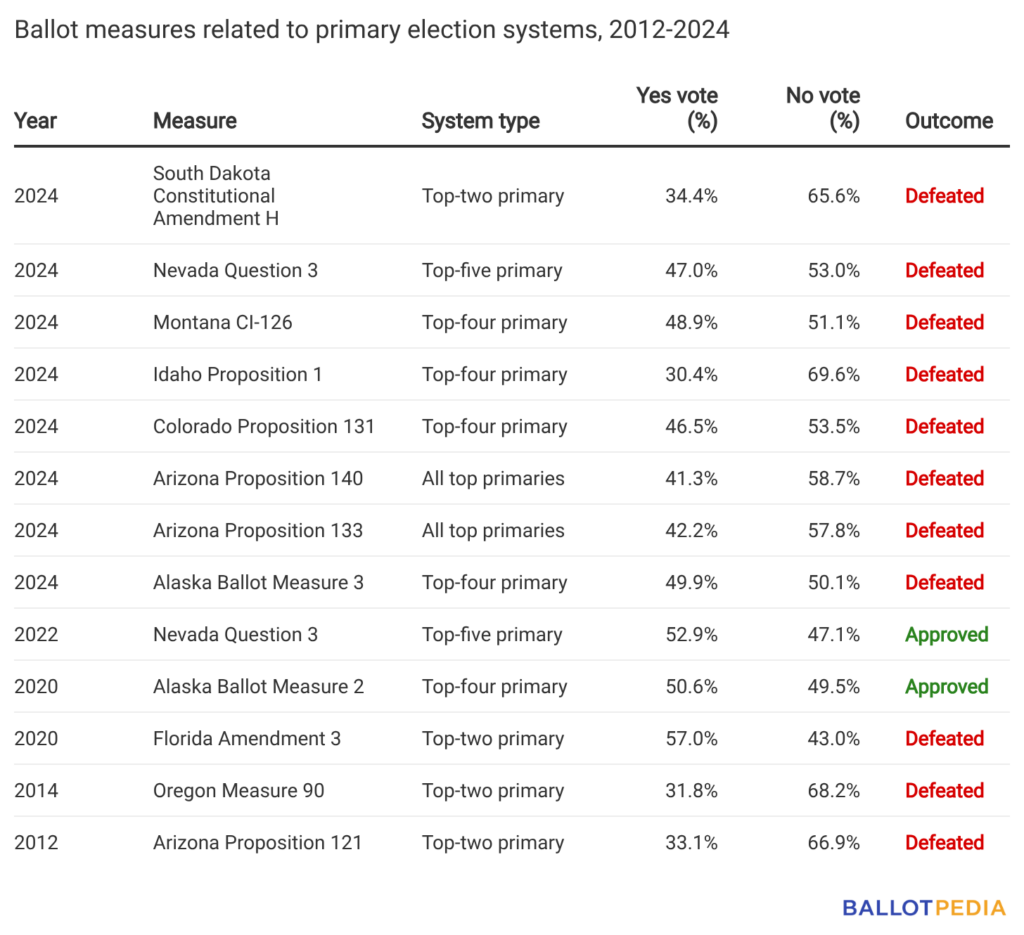
Since 2010, nine states — Arizona, Alaska, Colorado, Florida, Idaho, Montana, Nevada, Oregon, and South Dakota — have decided on 13 ballot measures related to top-two style primary systems. Only Alaska approved the system. In Nevada, proposed amendments must be approved at two consecutive elections. Nevada voters approved an amendment in 2022 to adopt a top-five system, but it was rejected in 2024. The table below lists the measures.
Additional reading: