


Welcome to the Thursday, May 14, 2026, Brew.
By: Lara Bonatesta
Here’s what’s in store for you as you start your day:
- California ballot initiative proposed for 2028 to repeal the top-two primary system
- South Dakota’s 2026 ballot could be the first ballot without a citizen initiative since 1976
- A look at the May 12 election results
California ballot initiative proposed for 2028 to repeal the top-two primary system
On May 8, Steve Maviglio, a Democratic political consultant and strategist known for his work on California ballot measure campaigns, filed an initiative for the 2028 ballot proposing to repeal the state’s top-two primary system. California adopted the system when voters approved Proposition 14, 53.7% to 46.3% in June 2010.
The top-two system requires all candidates to be listed on the same ballot regardless of party affiliation. The top two vote-getters advance to the general election. This makes it possible for two candidates of the same political party to win a top-two primary and face off in the general election.
Maviglio’s proposed constitutional amendment would authorize partisan primaries for congressional and state offices and allow any political party that holds a partisan primary to advance the top vote-getters from that primary to the general election.
In an op-ed in the San Francisco Chronicle, Maviglio wrote, “When casting ballots in this fall’s gubernatorial election, however, our state’s electorate could ... be forced to choose between two Republican candidates for governor.” He continues, “There are eight substantial declared Democratic candidates as of last week. None has emerged as a favorite. All have political bona fides. All have a small base from which to start. Collectively, they have the potential to divide the Democratic electorate pie into small slices.”
Sixty-one candidates are running in the top-two gubernatorial primary on June 2. Incumbent Gov. Gavin Newsom (D) is term-limited. To read our previous Brew coverage of the gubernatorial primary, click here.
To qualify for the ballot, the initiative campaign needs to collect signatures equal to 8% of the votes cast at the 2026 gubernatorial election. State law currently requires ballot initiatives to appear on general election ballots. If adopted in 2028, it would be used in the 2030 primaries.
In 2010, then-governor Arnold Schwarzenegger (R) supported Proposition 14. In the state voter guide, AARP, the California Alliance for Jobs, and the California Chamber of Commerce endorsed the measure.
The California Democratic and Republican parties opposed the measure. The Howard Jarvis Taxpayers Association submitted opposition arguments for the voter guide. Click here to find out more about Proposition 14.
California is one of three states, including Alaska and Washington, that use a top-two style primary, or a variation of one, for all congressional and statewide elections. Louisiana and Nebraska use a top-two or a variation for some offices. The other 45 states use partisan primaries for all statewide and congressional offices.
Washington was the first state to adopt a top-two system in 2004 with the approval of Initiative 872. It was first used in 2008. In 2020, Alaska voters approved Alaska Ballot Measure 2, establishing a top-four primary for state executive, state legislative, and congressional elections. The initiative also established ranked-choice voting for general elections for the offices noted above and the presidency.
Louisiana uses a majority vote system for some offices, including state senator and representative. Candidates running appear on the same ballot in either October (in odd-numbered years) or November (in even-numbered years), regardless of their partisan affiliations. To learn more about Louisiana's majority vote system, click here.
A ballot initiative in Massachusetts has been filed for the 2026 ballot to adopt a top-two primary system. The campaign is currently collecting a second round of signatures due by July 8 to qualify for the ballot.
Since 2010, nine states — Arizona, Alaska, Colorado, Florida, Idaho, Montana, Nevada, Oregon, and South Dakota — have decided on 14 measures related to top-two style primaries. Twelve measures were to implement a top-two system or a variation. One measure in Arizona was to prohibit top-two primaries. One measure in Alaska was to repeal the state’s top-four system.
Only Alaska approved the system. In Nevada, proposed amendments must be approved at two consecutive elections. Nevada voters approved an amendment in 2022 to adopt a top-five system, but it was rejected in 2024. The table below lists the measures.
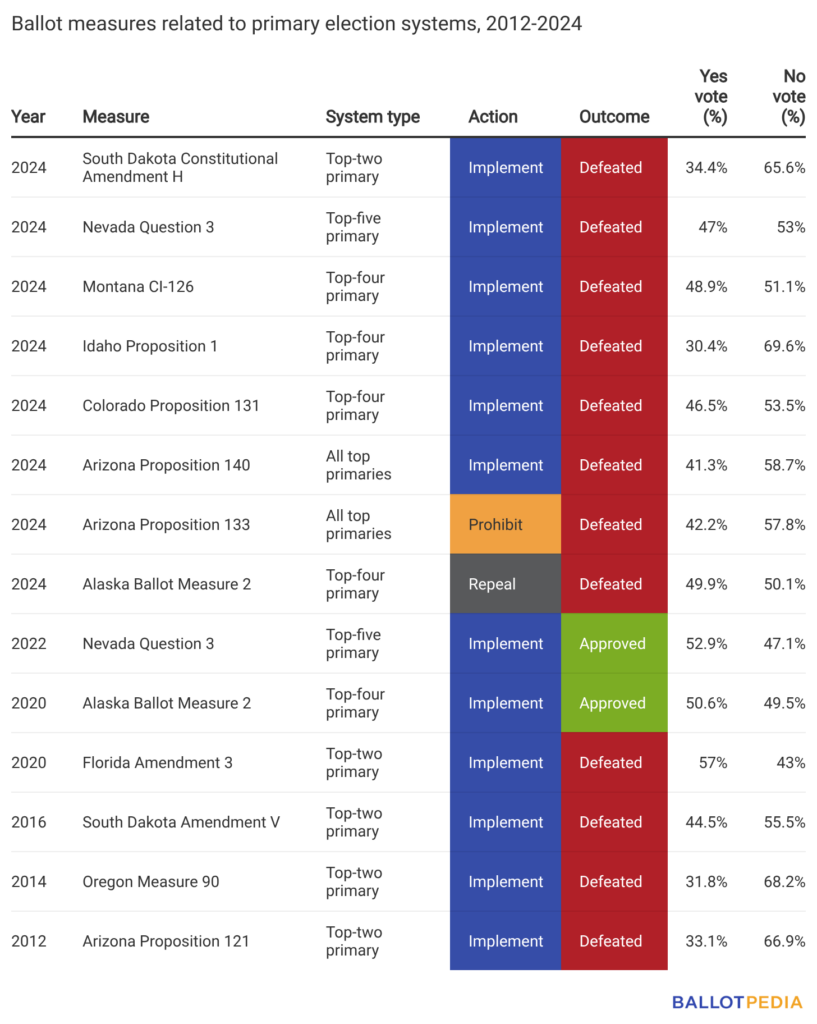
Click here to learn more about the proposed measure in California.
South Dakota’s 2026 ballot could be the first ballot without a citizen initiative since 1976
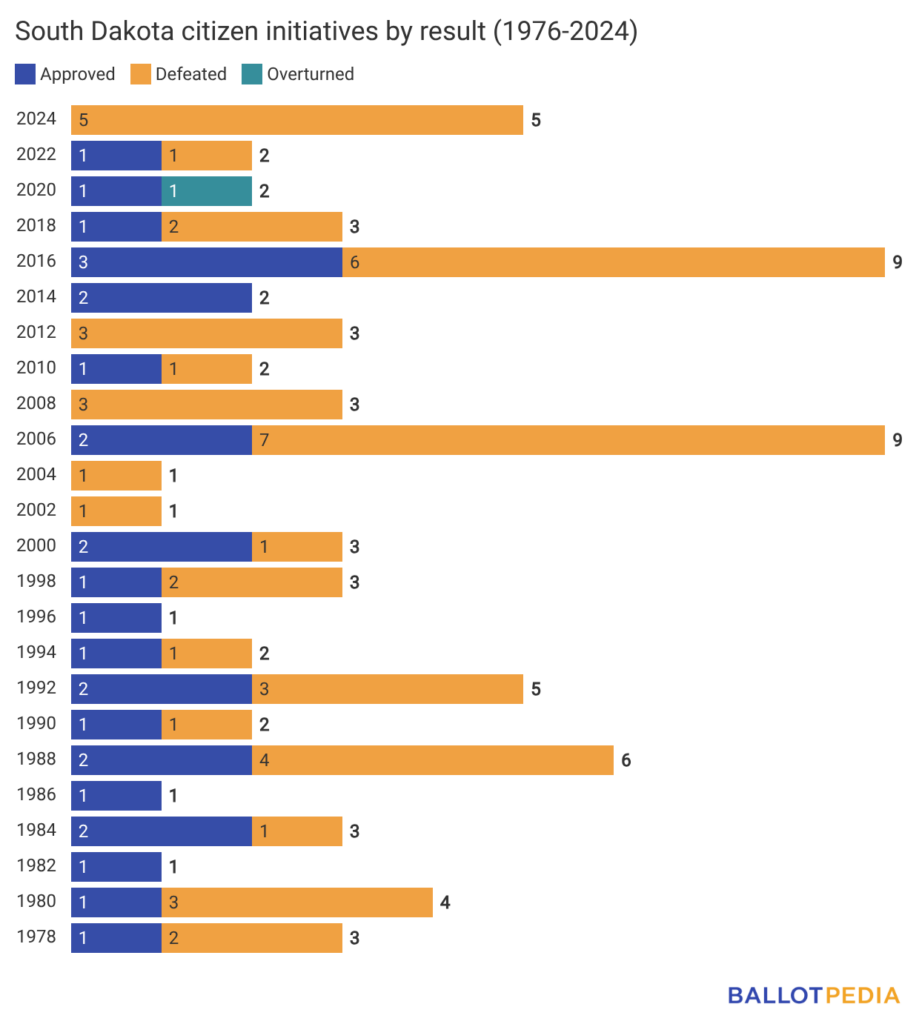
South Dakota’s 2026 ballot could be the first ballot in the state without a citizen initiative since 1976. The deadline for citizen initiative sponsors to submit signatures for the Nov. 3 ballot was May 5. Three measures were approved for circulation, but sponsors did not file signatures for any of them. According to the Secretary of State, petitions postmarked by May 5 may still arrive by mail.
Between 1976 and 2024, an average of roughly three citizen initiatives appeared on the ballot in South Dakota each year.
One initiative could still make the ballot: a veto referendum on Senate Bill 245. That bill created a state fund to reduce property taxes on owner-occupied single-family homes, funded by the equivalent of 0.3 percentage points of certain existing state taxes. Signatures are due June 28.
The South Dakota Legislature put four constitutional amendments on the ballot:
- Constitutional Amendment I would condition the state's Medicaid expansion on the federal government funding at least 90% of the program's cost. If federal support drops below that threshold, the Legislature could end expansion.
- Constitutional Amendment J would disqualify noncitizens from voting in any South Dakota election. Kansas, Arkansas, and West Virginia will also decide on citizenship voting amendments this year. Legislatures put all four measures on the ballot. South Dakota has never voted on a citizenship voting requirement measure. Fifteen states have decided on similar amendments since 2018. All 15 were approved.
- Constitutional Amendment K would establish a trust fund for unclaimed property, requiring the state treasurer to deposit those funds into the trust after covering claims and expenses, with interest distributions flowing to the general fund starting in July 2027.
- Constitutional Amendment L would raise the voter approval threshold for all state constitutional amendments from a simple majority to 60%. North Dakota will decide on a similar amendment this year. This is the third attempt at a supermajority requirement in South Dakota in eight years. In 2018, voters defeated an amendment proposing a 55% threshold for constitutional amendments, 54.7% to 45.7%. In 2022, they defeated an amendment proposing a 60% threshold for ballot measures that increased taxes or appropriated more than $10 million, 67.4% to 32.6.
Since becoming a state in 1889, South Dakota voters have decided on 131 citizen initiatives. They approved 40 and defeated 91, a 31% approval rate. South Dakota voters have decided on 233 legislatively referred ballot measures. They approved 118 and defeated 115, a 50.6% approval rate.
Of the 48 veto referendums in South Dakota's history, 35 resulted in the law being repealed and 13 were upheld — a repeal rate of roughly 73%.
South Dakota has had a Republican trifecta since 1995, and all four certified 2026 measures have backing from the majority party.
Since 2018, the South Dakota Legislature has passed more than two dozen laws governing the initiative process, including:
- SB 1256 (2025) changed the signature threshold from a percentage of votes cast for governor to a percentage of total qualified electors.
- HB 1184 (2025) shortened the signature collection window from 24 months to 21 months, moving the deadline from the first Tuesday in May to the first Tuesday in February. The May 5 deadline for 2026 was a court-ordered modification of that timeline.
- SB 106 (2025) restricted petition sponsorship to registered South Dakota voters.
- SB 92 (2025) requires both the Legislative Research Council and the Secretary of State to verify compliance with the state’s single subject rule before a petition is approved for circulation. The single-subject rule has applied to initiated state statutes since 2018 and to all constitutional amendments since voters approved Amendment Z (also in 2018).
Ballotpedia's full rundown of the certified measures is here: South Dakota 2026 ballot measures. For a comprehensive look at the history of ballot measures in South Dakota, click here.
A look at the May 12 election results
Ballotpedia covered elections in four states on Tuesday, May 12. Nebraska and West Virginia both held statewide primaries. There were local elections for city council and mayor in Newark, New Jersey, and Georgia held a special election to fill a vacancy in its state House of Representatives.
Here’s an overview of the results, including some of the most interesting elections as well as what happened in the top-ballot races.
Notable results
Among the most notable results of the night were those for Nebraska’s Secretary of State and the West Virginia’s Supreme Court of Appeals
In Nebraska, Omaha businessman Scott Petersen defeated incumbent Secretary of State Bob Evnen (R) 54.7% to 45.3% in the Republican primary. Sarah Slattery defeated Lee Cimfel 91.2% to 8.8% in the Democratic primary.
According to the Nebraska Examiner’s Erin Bamer, “Throughout his campaign, Petersen largely criticized Evnen’s handling of the state’s elections systems, particularly in vote counting. He has questioned whether the ballot-counting machines the state uses can access the internet and be hacked, has argued that voting by mail should be restricted to only special circumstances and promised to conduct full hand counts of races.” Bamer wrote the Evnen ran on his record, ”defending his office’s work and acknowledging the election security concerns of some GOP primary voters.”
In West Virginia, two incumbent Supreme Court of Appeals justices were defeated. This marks the first time a West Virginia justice has lost re-election since 2016.
Governor Patrick Morrisey (R) appointed justices Tom Ewing and Gerald M. Titus III in 2025 to complete the terms of justices Beth Walker and Tim Armstead, respectively. Both incumbents lost in the nonpartisan elections. The last time this happened, in 2016, Walker defeated incumbent justice Brent Benjamin. These three elections are the only time a justice lost re-election since the state's judicial elections became nonpartisan in 2015.
Bolts Magazine's Daniel Nichanian wrote, "The elections are ostensibly nonpartisan, but most candidates on the ballot have ties to GOP politics." Mountain State Spotlight’s Henry Culvyhouse wrote, “How the new judges will steer the state’s high court remains to be seen. Flanigan … has broken ranks with his party before … Kirkpatrick said he would fit in with the current makeup of the state Supreme Court.”
State Delegate Bill Flanigan (R) defeated Ewing 58% to 42%. Both described themselves as conservatives, with Ewing's campaign website calling him "The Common Sense, Conservative Choice" and Flanigan's campaign website calling him a "Constitutional Conservative." Flanigan’s term ends in 2028, when he will be up for election for a full 12-year term.
H.L. Kirkpatrick defeated Titus and three other candidates, receiving 31% to Titus’ 26%. In his response to Ballotpedia's Candidate Connection survey, Kirkpatrick said he "has focused on applying the law as written, without regard to public pressure, politics, or the parties involved." Titus said of his judicial philosophy: "I believe in the rule of law, judicial restraint, and upholding the Constitutions of the United States and West Virginia. The role of a Justice is not to make law or policy, but to apply the law as written—fairly, independently, and without bias." Kirkpatrick’s term ends in 2032, when he will be up for election for a full 12-year term.
In addition to the Supreme Court Justices, several incumbent West Virginia state legislators also lost their re-election bids. These included House of Delegates members Vernon Criss (R-12) (who is also the House Finance Committee chair), Scot Heckert (R-13), Stanley Adkins (R-49), Marshall Clay (R-51), Jeffrey Stephens (R-6), and Betsy Kelly (R-9). As of this writing, 16 races featuring incumbents were still uncalled, including 15 in the House of Delegates and one in the state Senate.
According to West Virginia Watch’s Amelia Ferrell Knisely, Morrisey campaigned against Criss after the two “openly feuded over state budget matters since just a few weeks into the governor’s term.” Knisely also reported that Political Action Committees (PACs) connected to Morrisey and those that support school choice policies spent more than $600,000 to oppose Sen. Tom Takubo (R) and Sen. Vince Deeds (R). Takubo and Deeds both won their respective primaries.
Congressional elections
Nebraska and West Virginia both held U.S. Senate primaries.
- Nebraska: Incumbent Pete Ricketts (R) earned 80.3% of the vote, defeating four other candidates in the GOP primary. Cindy Burbank (D) defeated William Forbes (D) 90%-10% in the Democratic primary.
- West Virginia: Incumbent Shelley Moore Capito (R) earned 66.5% of the vote, defeating five other candidates in the GOP primary. Rachel Fetty Anderson (D) defeated four other candidates in the Democratic primary.
Nebraska has three U.S. House seats, and West Virginia has two. No incumbents were defeated in the primaries. One district, Nebraska’s 2nd District, is open this year. Republican Brinker Harding was uncontested in that GOP primary. As of this writing, the Democratic primary was still uncalled. Denise Powell and John Cavanaugh had the most votes with 39% and 37%, respectively.
Other state-level elections
Nebraska also held primaries for 12 state executive offices, including governor, attorney general, auditor of public accounts, treasurer, Public Service Commission, State Board of Education, and University of Nebraska Board of Regents.
In the Nebraska Senate, 24 out of 49 seats are up for election this year. Fifty-seven candidates ran in the top-two primaries, including twelve incumbents. All 12 incumbents advanced to the general elections on Nov. 3. Nebraska is the only state with an officially nonpartisan Legislature, though almost all members are affiliated with the state affiliate of either the Democratic or the Republican Party.
Nebraska is also the only state with a unicameral Legislature. The Nebraska Senate is its only chamber. Currently, Republicans have a 33-14-2 supermajority. According to Flatwater Free Press, Republicans would need to retain all 33 seats in November to keep their supermajority. Democrats and nonpartisans would need to win one more seat to break the supermajority.
Local and special elections
In Newark, New Jersey, incumbent Ras Baraka earned 70.3% of the vote in the city’s mayoral election, defeating seven other candidates. Mayoral elections are nonpartisan in Newark. Baraka is a Democrat.
All nine seats on the Newark City Council were also up for election.
Georgia held a special election for its House of Representatives District 177. Five candidates ran. According to DDHQ, Democrats Alvin Payton Jr. and Eric Howard had the most votes as of this writing with 35.8% and 19.8%, respectively. If no candidate receives a majority, a runoff will be held on June 9.
Click here to see all of the races we covered on May 12.