



On May 7, 2026, New York Governor Kathy Hochul (D) said that she plans to opt the state into the federal education tax credit scholarship program, also known as the Education Freedom Tax Credit (EFTC). New York is the third state with a Democratic trifecta to indicate participation in the program, following Virginia and Colorado. Twenty-three states with a Republican trifecta, and four with a divided government have opted in.
Hochul said she will wait for the Internal Revenue Service (IRS) to issue regulations to implement the program before opting in. A representative for Hochul, Emma Wallner, said, "Governor Hochul is supportive of the federal tax credit scholarship and its potential to help New York students and schools… Our office awaits information from the federal government on the program and will thoroughly review the details of the policy for poison pills that could harm New York’s education system.”
The IRS had not issued regulations to implement the program as of May 13.
About the program
The U.S. school choice tax credit scholarship is a nonrefundable tax credit, allowing individuals to receive federal tax credits for donations up to $1,700 to authorized scholarship-granting organizations (SGOs). It is a dollar-for-dollar nonrefundable tax credit, meaning individuals can lower their federal tax liability by $1 for every $1 donated to accredited SGOs; if a taxpayer donates more than $1,700, they will not receive a tax refund for the amount over $1,700. The total amount of credits the program can offer is not capped.
SGOs distribute the donated scholarship funds to eligible families, which can be used on a variety of private or public educational expenses, including private school tuition, tutoring services, textbooks, and more. In order to qualify for scholarships, students had to live in households earning no more than 300% of the area's median gross income and be eligible to enroll in K-12 schools. The program will take effect January 1, 2027.
States that elect to participate must submit a list of SGOs that taxpayers can donate to to receive the federal tax credit. Students in states that do not opt in cannot receive scholarships funded under the program, but donors in those states can still receive a federal tax credit by donating to SGOs in participating states. As enacted, the program will not affect state budgets.
What other states have taken action to participate?
As of May 15, 30 states had indicated intent to participate in the program or had formally opted in. Three states said they would not participate, and legislation requiring the state to participate in the program failed in three states.
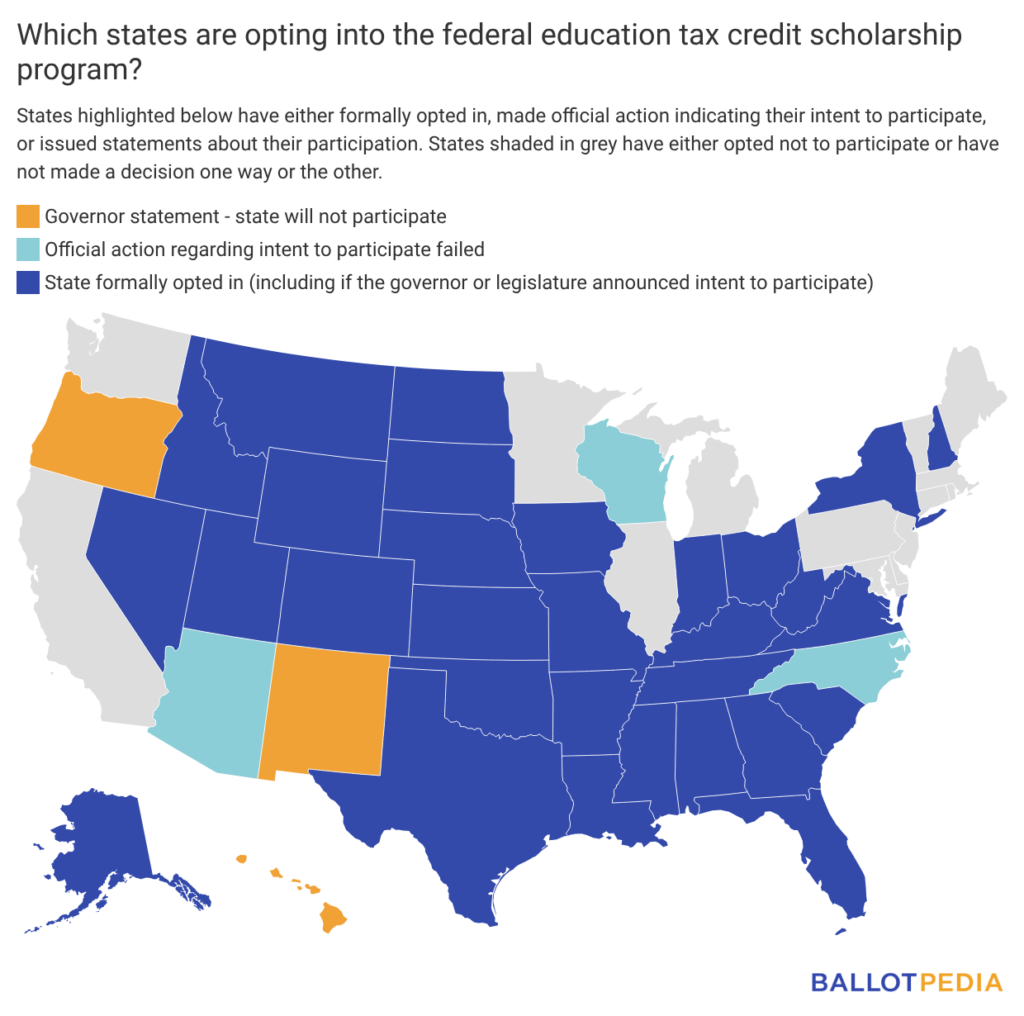
- Six have Democratic trifectas. Three states — Virginia, Colorado, and New York — have indicated participation in the program, while three states — Hawaii, New Mexico, and Oregon — have said they would not participate, though all three governors of those states are reconsidering participation, according to EducationWeek.
- Twenty-three have Republican trifectas. All twenty-three states — Alabama, Arkansas, Florida, Georgia, Idaho, Indiana, Iowa, Louisiana, Mississippi, Missouri, Montana, Nebraska, New Hampshire, Ohio, Oklahoma, South Carolina, South Dakota, Tennessee, Texas, Utah, West Virginia, and Wyoming — said they would participate in the program.
- Seven have divided governments. The Kentucky Legislature overrode Gov. Andy Beshear's (D) veto of a bill requiring the state to opt into the program, and the Kansas Legislature overrode Gov. Laura Kelly's (D) veto of a bill requiring the same. In North Carolina, Arizona, and Wisconsin, legislation to indicate participation failed. Alaska and Nevada formally opted into the program.
The Indiana, Idaho, Oklahoma, and Tennessee Legislatures passed bills requiring the state to opt into the program, though the respective governors had already done so for Fiscal Year 2027. The Idaho and Oklahoma bills require the state to opt into the program every year.
To learn more about state participation in the program, click here.