


Welcome to the Wednesday, May 20, 2026, Brew.
By: Lara Bonatesta
Here’s what’s in store for you as you start your day:
- A closer look at state-level voting rights acts
- Louisiana becomes fourth state to put a bail-related constitutional amendment on the 2026 ballot
- Sixty-eight members of Congress have announced they will not seek re-election in 2026
A closer look at state-level voting rights acts
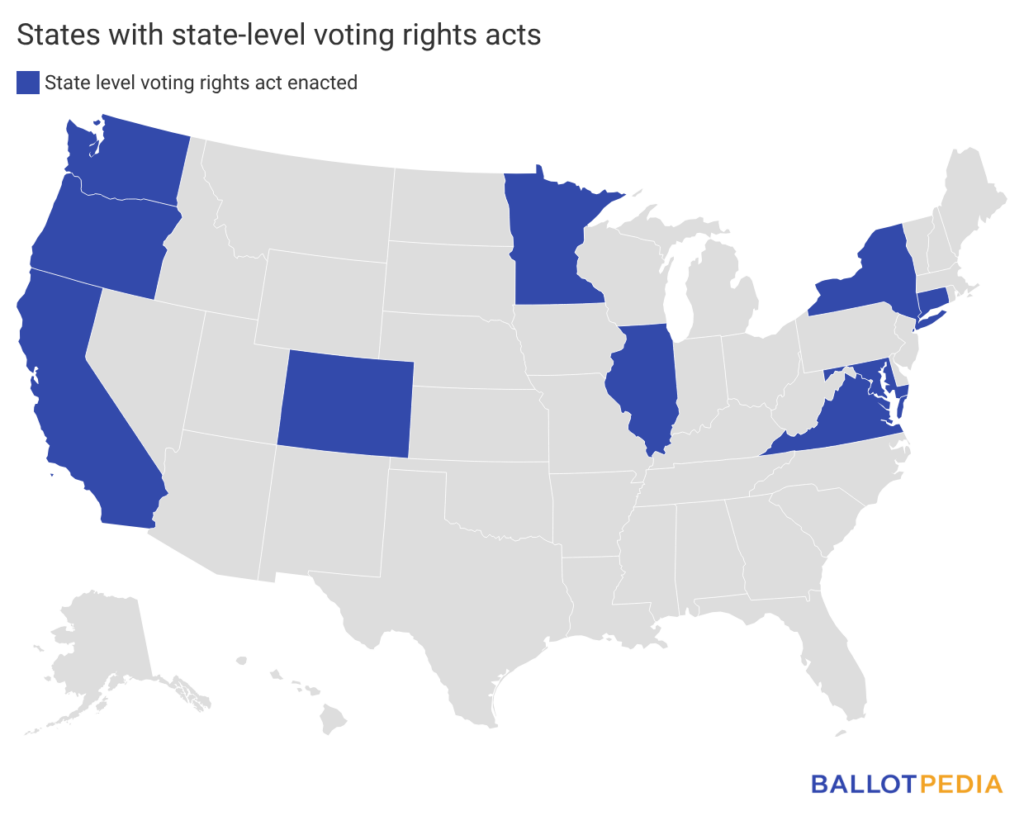
Since Congress passed the 1965 Voting Rights Act (VRA), prohibiting racial discrimination in voting nationwide, 10 states have passed state-level voting rights acts. The provisions of these laws vary, but they generally include policies that mirror or expand on the federal VRA.
Since it was established, the VRA has been the subject of ongoing political debates, redistricting conflicts, and state and federal court cases. One notable example of this is the U.S. Supreme Court’s recent decision in Louisiana v. Callais. In that case, the court ruled that Louisiana’s congressional map that added a second majority-Black district was an unconstitutional racial gerrymander. Following the ruling, several other states — including Tennessee, Alabama, South Carolina, and Mississippi — have redrawn or considered redrawing their congressional maps.
In light of the Callais decision and ongoing redistricting conflicts across the country, today we’re taking a look at state VRAs — which states have them, and what they contain.
All states with VRAs had a Democratic trifecta when those laws were approved. California was the first state to enact its own VRA, doing so in 2002. Maryland became the most recent state to pass a VRA on April 28, 2026.
Overlapping provisions in these states’ VRAs include:
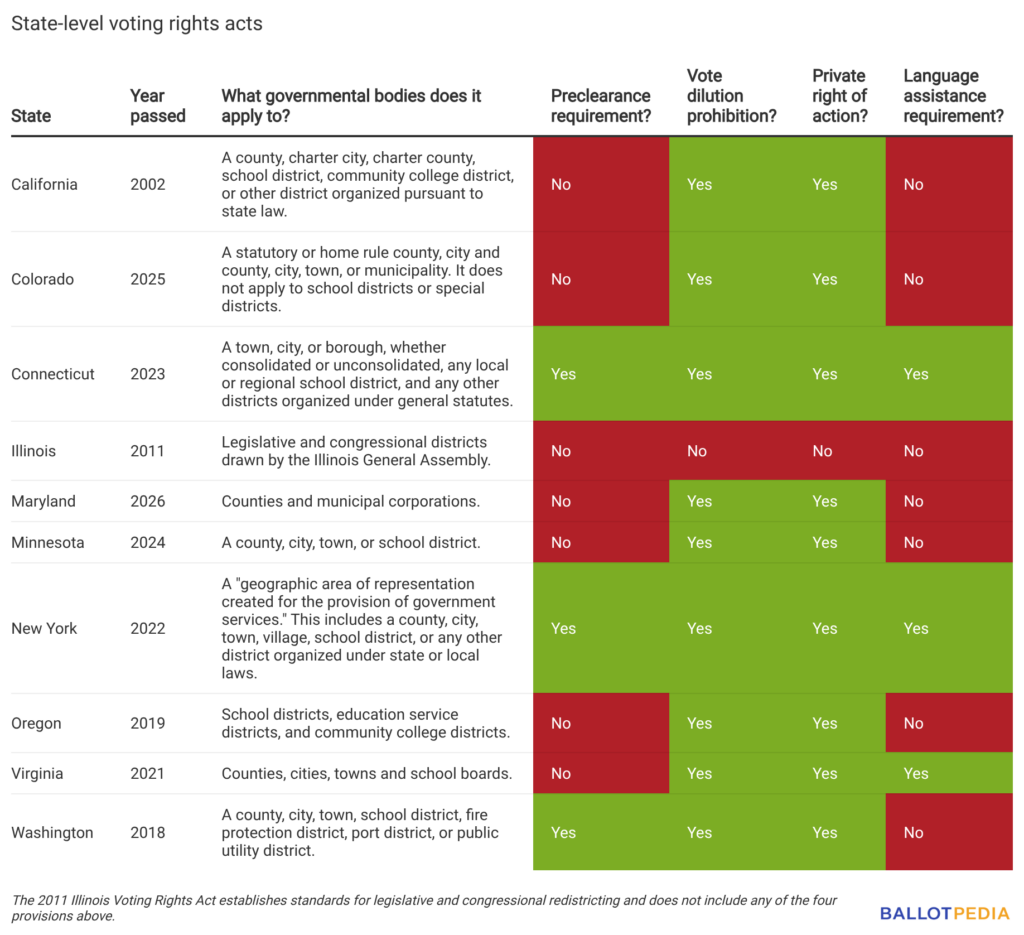
- Pre-clearance: Some states require local governments that meet certain criteria to receive approval from the state attorney general or another agency before changing voting ordinances, electoral systems, polling locations, or other election-related policies. Local governments that may be required to pre-clear their policies include those of a certain size or those found to have violated the federal Voting Rights Act or the U.S. Constitution in recent years. Virginia, a state that has its own version of the VRA, does not mandate pre-clearance, but it’s an option for localities that wish to avoid a state-mandated waiting period before implementing a new election policy.
- Vote dilution prohibition: Some states prohibit policies that dilute the votes of covered communities and groups. This can include prohibiting at-large districts, in which local governing body members are elected across a city or county rather than from a set district.
- Private cause of action: Some states allow private citizens or groups to challenge a local governing body's election policies if they believe the policies are discriminatory or violate the VRA. In some cases, the laws spell out which factors courts may consider when evaluating whether a challenged policy is unlawful. Plaintiffs may sometimes be required to notify a locality of a forthcoming lawsuit and give the locality an opportunity to change its policies before the suit is filed.
- Language assistance requirement: Some states require municipalities with a certain number of non-English language speakers to provide voting materials, such as ballots, voter registration forms, or voting guides, in another language.
The table below displays which of these provisions are included in each state’s VRA.
Proponents of state-level voting rights acts say that they are necessary in light of federal court rulings they believe have weakened the federal VRA. Opponents say state-level laws are unnecessary and can burden local governments.
Twelve states have introduced 20 state voting rights act bills this year. Click here to see a list of bills.
Click here to learn more about state-level voting rights acts.
Louisiana becomes fourth state to put a bail-related constitutional amendment on the 2026 ballot
On May 13, the Louisiana Legislature approved a constitutional amendment on post-conviction bail for defendants who are convicted of an aggravated offense against minors. The amendment will appear on the Nov. 3 ballot.
In Louisiana, a two-thirds vote is required in each chamber during a single session to place a constitutional amendment on the ballot. That translates to a minimum of 70 votes in the Louisiana House of Representatives and 26 votes in the Louisiana Senate, assuming there are no vacancies.
House Bill 51
Introduced as House Bill 51 (HB 51) on Jan. 30, the constitutional amendment would prohibit bail for individuals convicted of an aggravated offense against a minor.
Currently, Article I, Section 18 of the Louisiana Constitution provides for the right to bail after conviction but before sentencing if the maximum sentence is five years or less. Judges may grant bail if the maximum sentence is more than five years.
The state House passed the amendment 92-0 on April 20, with five Republicans and eight Democrats not voting. On May 13, the state Senate approved it 31-1, with 25 Republicans and six Democrats supporting the amendment, while one Democrat voted against it. Three Republicans and four Democrats did not vote.
Since 2023, voters in Colorado, Texas, and Wisconsin have approved constitutional amendments adding conditions or exceptions to the right to bail for criminal defendants. In 2026, voters in Alabama, Indiana, and Tennessee, along with Louisiana, will also decide on bail-related amendments.
In Alabama, Amendment 1 would expand the list of crimes for which bail can be denied to include shooting or discharging a firearm, explosive device, or other weapon into an occupied dwelling and solicitation to commit murder.
In Indiana, Question 1 would deny bail to individuals charged with crimes when the proof of the charge is evident, or the presumption is strong, and the accused poses a substantial risk to any other person or the community.
In Tennessee, Amendment 1 would remove the right to bail in cases where the presumption of guilt is great, and the defendant is accused of terrorism, second-degree murder, aggravated rape of a child, grave torture, and any other offense for which a convicted individual could not be released before the expiration of at least 85% of their sentence.
Voters in Louisiana will decide on three other ballot measures on Nov. 3, regarding homestead tax exemptions for the surviving spouses of deceased veterans, property tax rate limits, and the income limit to qualify for property tax special assessments.
In the May 16 primary election, Louisiana voters decided on five constitutional amendments that the Legislature put on the ballot, and rejected all five. For more information about those amendments and the election returns, click here.
Click here to learn more about the bail amendment.
Sixty-eight members of Congress have announced they will not seek re-election in 2026
Sixty-eight members of the U.S. Congress — 57 U.S. representatives and 11 U.S. senators — have announced they will not seek re-election in 2026.
Since our April 23 update, two U.S. representatives announced they will not seek re-election. Here’s a list of how independent election forecasters have rated the 2026 general election for each district and state these incumbents currently represent.
- Rep. Daniel Webster (R-Fla.) announced on April 28 that he is retiring from public office. Election forecasters have rated the election for the district as either Solid or Safe Republican.
- Rep. Steve Cohen (D-Tenn.) announced on May 15 that he is retiring from public office. On May 7, the Tennessee Legislature redrew the boundaries of Cohen’s old district. Election forecasters have rated the election for the new district as either Solid or Safe Republican. Under the old map, Harris defeated Trump 70.8% to 27.4% in the 2024 presidential election. In the new district, Trump would have defeated Harris 59.9%-38.8%.
U.S. House of Representatives
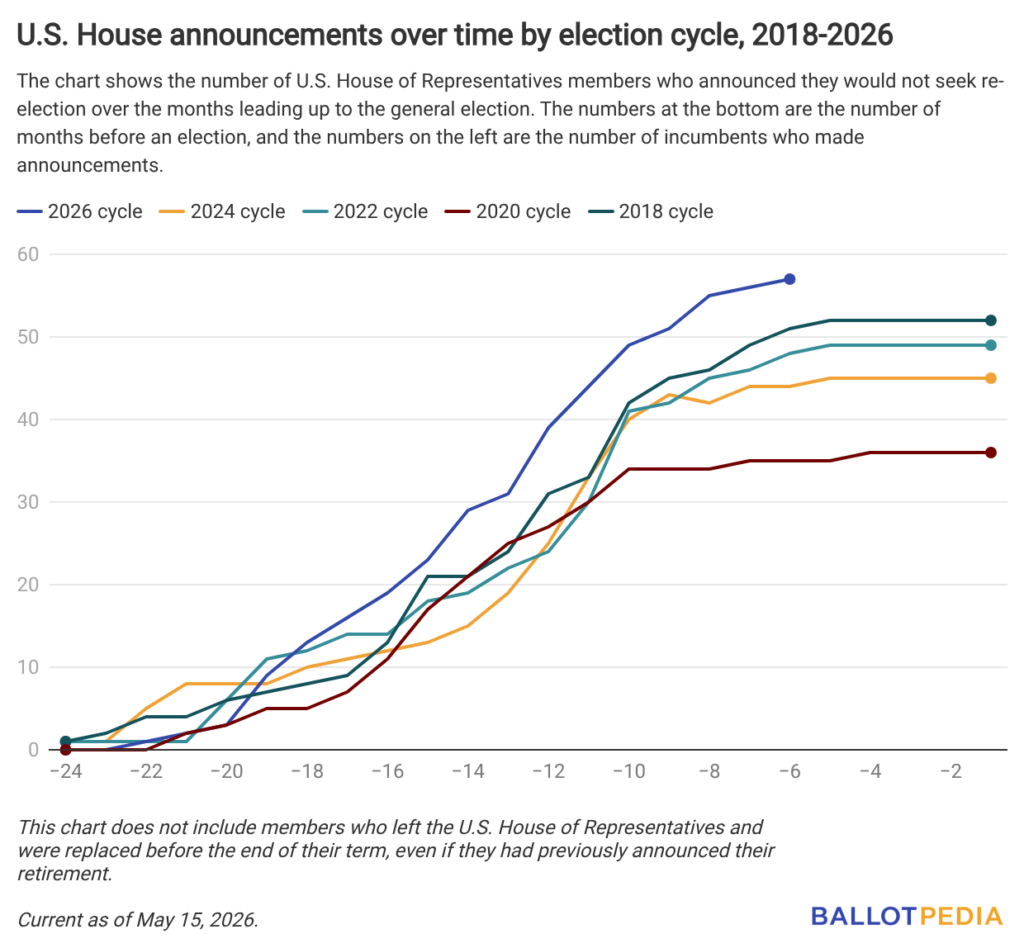
Fifty-seven U.S. representatives — 21 Democrats and 36 Republicans — will not seek re-election in 2026. Of the 57 members not seeking re-election:
- Thirty — 14 Democrats and 16 Republicans — are retiring from public office.
- Sixteen — seven Democrats and nine Republicans — are running for the U.S. Senate.
- Ten — all Republicans — are running for governor.
- One Republican is running for state attorney general.
At this point in each of the last four election cycles, there were 44 retirement announcements in2024, 48 in2022, 35 in2020, and 51 in 2018.
Seven of the 57 retiring U.S. representatives — two Democrats and five Republicans — won by 10 percentage points or less in 2024. Three U.S. representatives — Jared Golden (D-Maine), Don Bacon (R-Neb.), and David Schweikert (R-Ariz.) — won by fewer than five percentage points.
U.S. Senate
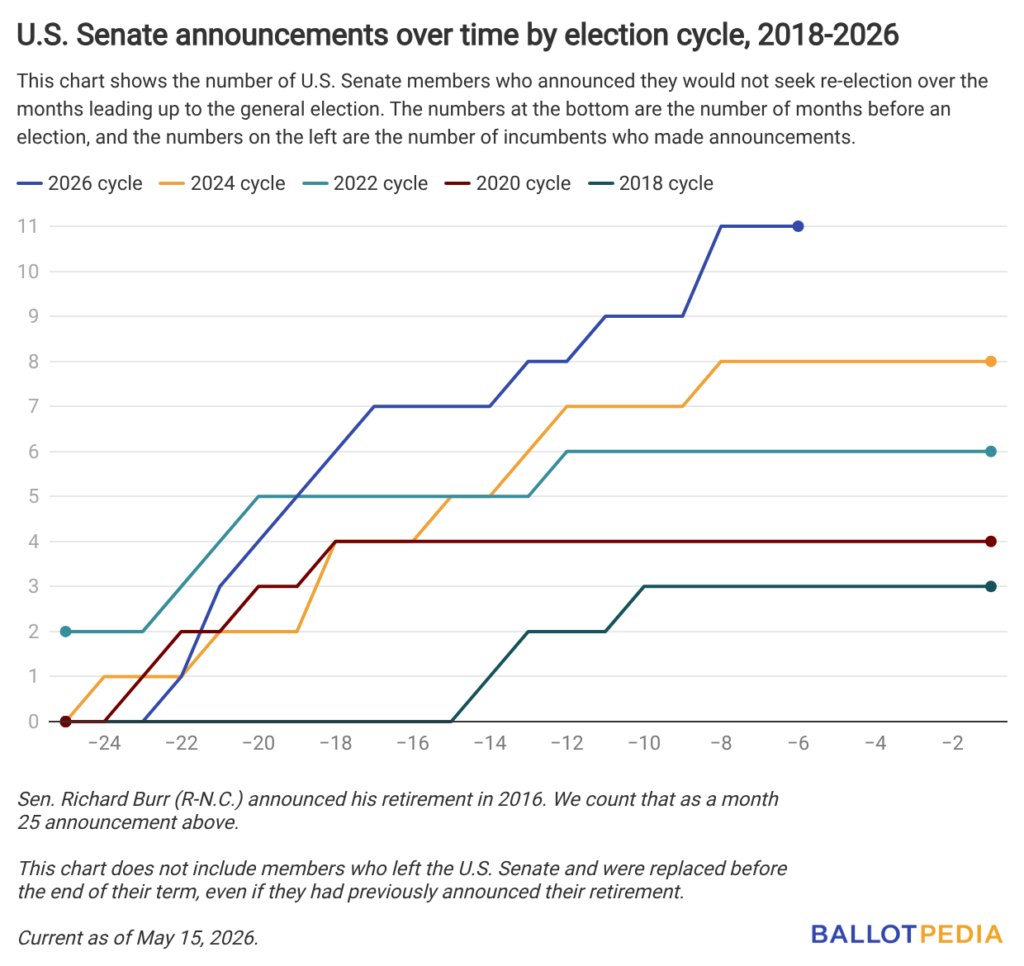
Eleven senators — four Democrats and seven Republicans — announced they will not seek re-election in 2026. Senators Alan Armstrong (R-Okla.), Steve Daines (R-Mont.), Cynthia Lummis (R-Wyo.), Joni Ernst (R-Iowa), Thom Tillis (R-N.C.), Dick Durbin (D-Ill.), Jeanne Shaheen (D-N.H.), Mitch McConnell (R-Ky.), Tina Smith (D-Minn.), and Gary Peters (D-Mich.) are retiring from public office. Sen. Tommy Tuberville (R-Ala.) is running for governor of Alabama.
At this point in each of the last four election cycles, there were eight retirement announcements in 2024, six in 2022, four in 2020, and three in 2018.
Excluding Armstrong, who Oklahoma Gov. Kevin Stitt (R) appointed in 2026, the last time the other 10 U.S. senators ran was in 2020. In the 2020 elections, five of this year’s retiring Senators — two Democrats and three Republicans — won by 10 percentage points or less. Tillis and Peters won by less than five percentage points.
Between January 2011 and May 2026, 414 U.S. Senate and House incumbents announced they would not seek re-election. By month, the most retirement announcements during that time period occurred in January (74), and the fewest occurred in June (16).
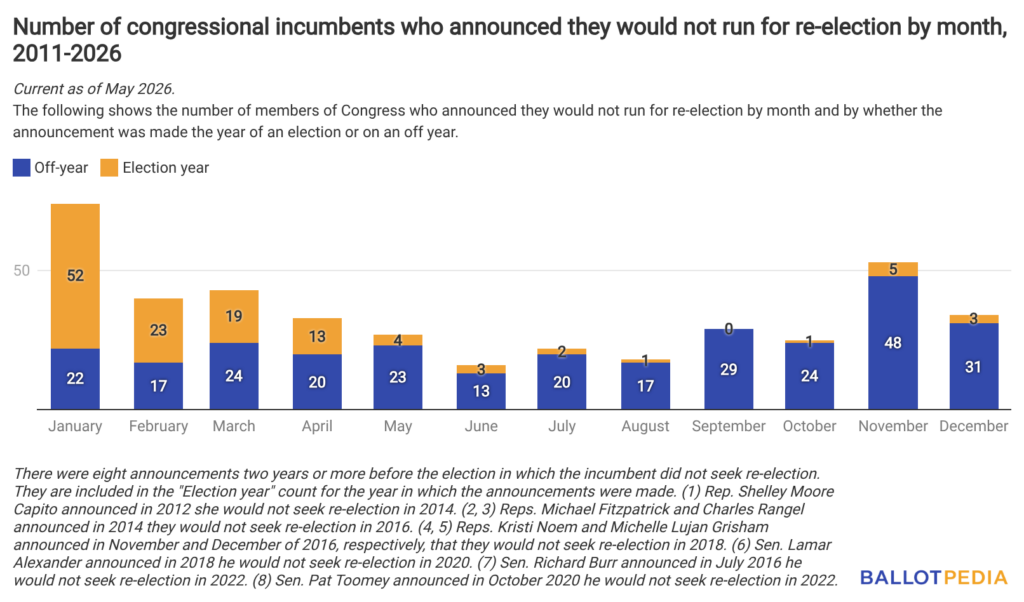
Click here to see a full list of congressional incumbents who are not running for re-election.