



The Louisiana State Legislature referred 10 ballot measures to the ballot for voter approval on Nov. 3, 2026. Of these measures — all of which are constitutional amendments — nine were certified in May 2026, and one was certified in June 2025.
All 10 measures are slated to appear on the Nov. 3, 2026, general election ballot. The state legislature adjourned on June 1, 2026.
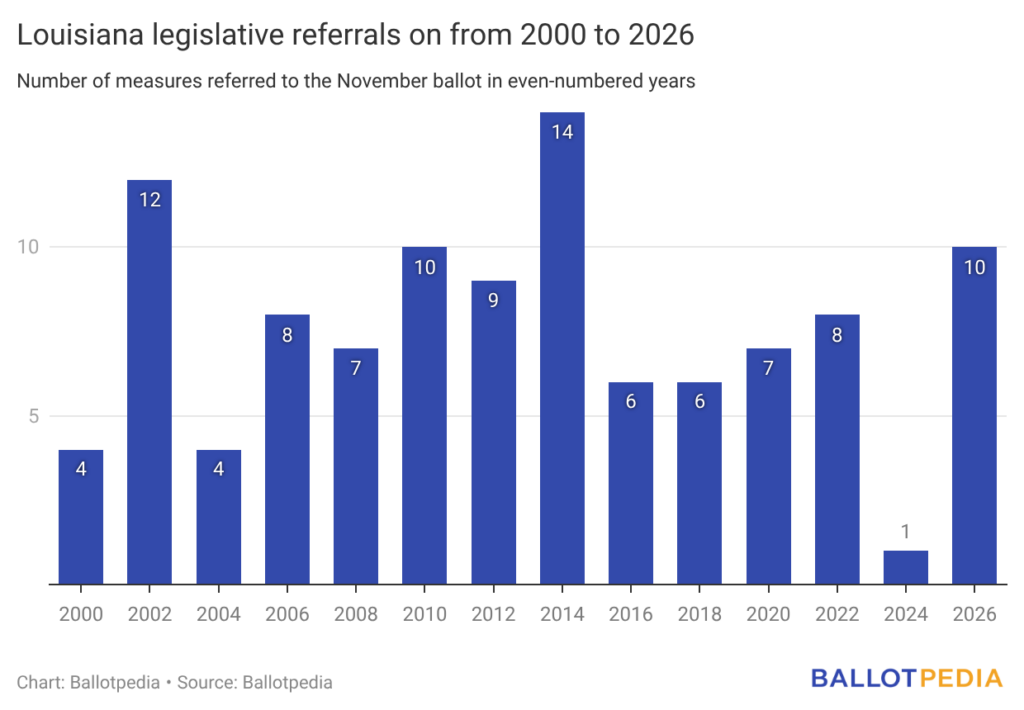
From 2016 to 2024, the state legislature has certified an average of approximately six measures for the general election ballot during even-numbered years. In 2024, the state legislature certified one measure for the general election ballot. In 2022, eight measures were certified. In 2020, seven measures were certified. In 2018 and 2016, six measures were certified.
House Bill 225
House Bill 225 (HB 225) would establish a lifetime term limit for the governor, with a maximum of two terms.
As of 2026, Article IV, Section 3(B) of the Louisiana state constitution prohibits governors from serving more than two consecutive terms — meaning they can serve two terms, leave office for one term, and then be eligible for another two terms.
HB 225 was first approved by the State House on May 5, 2026, by a 73-25 vote. The state Senate approved HB 225 on May 26, 2026, by a 28-10 vote.
Senate Bill 180
Senate Bill 180 (SB 180) would allow the surviving spouse of a disabled veteran to undergo a one-time transfer of a homestead tax exemption to another property. The exemption would be limited in value, being equal to the amount of the exemption claimed on the prior homestead.
As of 2026, Article VII, Section 21(K)(1) of the Louisiana State Constitution grants the surviving spouse of a deceased veteran the exemption if they occupy and remain the owner of the property, but does not provide for the ability to transfer the exemption to another property.
SB 180 was first approved by the state Senate on March 24, 2026, by a vote of 38-0. However, the state House approved an amended version of SB 180 on May 6, 2026, by a vote of 92-0, thereby sending it back to the state Senate. On May 11, 2026, the state Senate concurred with the amended version.
House Bill 51
House Bill 51 (HB 51) would prohibit bail for individuals convicted of an aggravated offense, as defined by state law, against a minor.
As of 2026, Article I, Section 18 of the Louisiana Constitution provides for the right to bail after conviction but before sentencing if the maximum sentence is five years or less; judges may grant bail if the maximum sentence is more than five years.
HB 51 was first approved by the state House on April 20, 2026, by a 92-0 vote. The state Senate approved HB 51 on May 13, 2026, by a 31-1 vote.
House Bill 192
House Bill 192 (HB 192) would prohibit the expropriation of property by foreign adversaries or agents of a foreign adversary — both of which are defined by law.
As of 2026, Article I, Section 4 of the Louisiana state constitution prohibits property from being taken or damaged by private entities, except for a public and necessary purpose, in addition to the property owner being compensated.
Additionally, Louisiana state law defines foreign adversary as "a foreign nongovernment person or foreign government identified as a foreign adversary pursuant to 15 CFR 7.4 including the People's Republic of China and the Hong Kong Special Administrative Region, Republic of Cuba, Islamic Republic of Iran, Democratic People's Republic of Korea, Russian Federation, and Venezuela under the leadership of Nicolas Maduro."
HB 192 was first approved by the state House on April 21, 2026, by a 100-0 vote. The state Senate approved HB 192 on May 21, 2026, by a 36-0 vote.
House Bill 514
House Bill 514 (HB 514) would authorize a property tax exemption of up to $30,000 in assessed value, increasing with age, for individuals at least 65 who already qualify for the income-based assessment freeze under the state constitution.
As of 2026, Article VII, Section 21 of the Louisiana state constitution does not provide property tax exemptions for seniors.
HB 514 was first approved by the state House on April 20, 2026, by a 93-0 vote. The state Senate approved HB 514 on May 20, 2026, by a 34-0 vote.
House Bill 521
House Bill 521 (HB 521) would authorize taxing authorities to levy millage rates above the rate established by the previous year's appraisal but below the maximum authorized rate in the state constitution, as approved by voters.
As of 2026, Article VII, Section 23(C) prevents taxing authorities from raising millage rates above the prior year's maximum rate. Additionally, Article VII, Section 23(B) requires that millage rates be fixed for their duration, unless altered by Section 23(C) — which HB 521 would do.
HB 521 was first approved by the state House on April 13, 2026, by a 95-0 vote. The state Senate approved HB 521 on May 11, 2026, by a 36-0 vote.
House Bill 300
House Bill 300 (HB 300) would raise the income limit to qualify for theproperty tax special assessment level — a provision that freezes the assessed value of a home for eligible homeowners so that their property taxes do not increase due to rising property values — from $100,000 to $150,000.
As of 2026, the special assessment level applies to:
- individuals 65 years or older;
- veterans with a service-connected disability rating of 50% or more as determined by the U.S. Department of Veterans Affairs;
- members of the military or Louisiana National Guard who last owned the property and were killed in action, missing in action, or taken as prisoners of war for at least 90 days; and
- individuals permanently totally disabled as determined by a non-appealable court judgment or government agency.
Individuals who do not qualify for a special assessment level are subject to property value reassessments that could increase the amount of property taxes owed.
HB 300 was first approved by the state House on May 27, 2025, by a 91-2 vote. The state Senate approved HB 300 on June 9, 2025, by a 35-2 vote.
House Bill 27
House Bill 27 (HB 27) would remove the requirement that a state retirement system receiving nonrecurring state funds must apply those funds to its oldest outstanding unfunded accrued liabilities (UALs) first.
HB 27 was first approved by the state House on April 20, 2026, by an 87-0 vote. The state Senate approved HB 27 on May 28, 2026, by a 34-0 vote.
House Bill 214
House Bill 214 (HB 214) would authorize a tax exemption for derelict or blighted property, as defined by the state legislature, that has been rehabilitated.
As of 2026, Louisiana state law defines blighted property as "any vacant or occupied immovable property that has been declared certified as blighted or a public nuisance by a court of competent jurisdiction or by an administrative hearing officer acting pursuant to R.S. 13:2575 or 2576, or any other applicable law."
HB 214 was first approved by the state House on April 20, 2026, by an 80-12 vote. The state Senate approved HB 214 on May 19, 2026, by a 33-2 vote.
Senate Bill 228
Senate Bill 228 (SB 228) would authorize the use of public funds to identify, inventory, remove, or replace drinking water utility service lines affected by hazardous materials, as specified by the U.S. Environmental Protection Agency's Lead and Copper Rule Improvements.
As of 2026, Article VII, Section 14 of the Louisiana state constitution prohibits funds from being "loaned, pledged, or donated to or for any person, association, or corporation, public or private." Additionally, the section provides for exceptions in which public funds may be used. SB 228 would include water utility lines impacted by certain hazardous materials in the list of exceptions.
The state Senate first approved SB 228 on May 6, 2026, by a 28-9 vote. The state House approved an amended version of SB 228 — which included the EPA specifications — by an 80-12 vote, thereby sending it back to the state Senate for a final vote. The state Senate approved the amended version of SB 228 on May 31, 2026, by a 32-4 vote.
From 2000 to 2026, the state legislature has certified an average of eight measures for the November general election ballot in even-numbered years. The number of referrals to appear on the November ballot in 2026 is the third highest, with 2002 being second highest at 12 measures and 2014 being the highest at 14 measures.
Within the last decade, the number of measures referred to the November ballot by the state legislature in even-numbered years has been below 10. In 2024, the state legislature certified one measure for the general election ballot. In 2022, eight measures were certified. In 2020, seven measures were certified. In 2018 and 2016, six measures were certified.
Additional reading: