


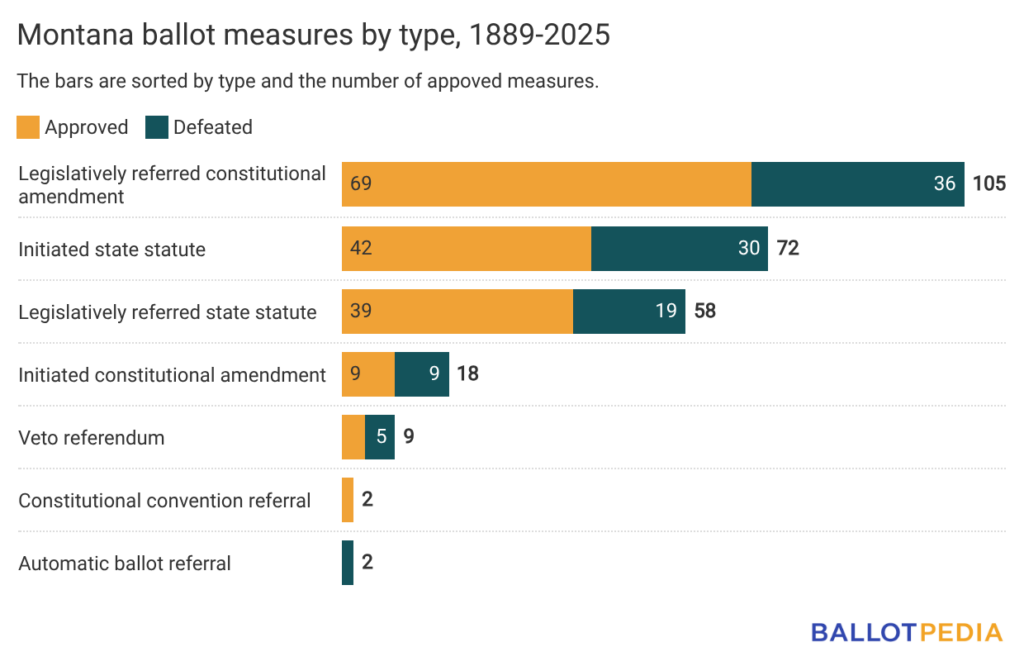
Between 1889, when Montana became a state, and 2025, Montana voters decided on 266 ballot measures. Of those, 165 (62%) were approved, and 101 (38%) were defeated. The Montana State Legislature voted to refer 163 ballot measures to the state ballot between 1889 and 2025, while 99 citizen initiatives were on the statewide ballot. Additionally, two measures were automatic constitutional convention questions, and two measures were referred to the ballot by the state's constitutional convention.
Voters authorized the initiative and referendum power by approving a constitutional amendment in 1906. Montana was the fifth state to adopt a ballot initiative process. Referred measures, including those placed on the ballot by a constitutional convention, saw better success at the ballot box than citizen-initiated measures. Referred measures were approved 66% of the time, while 56% of initiated measures were approved.
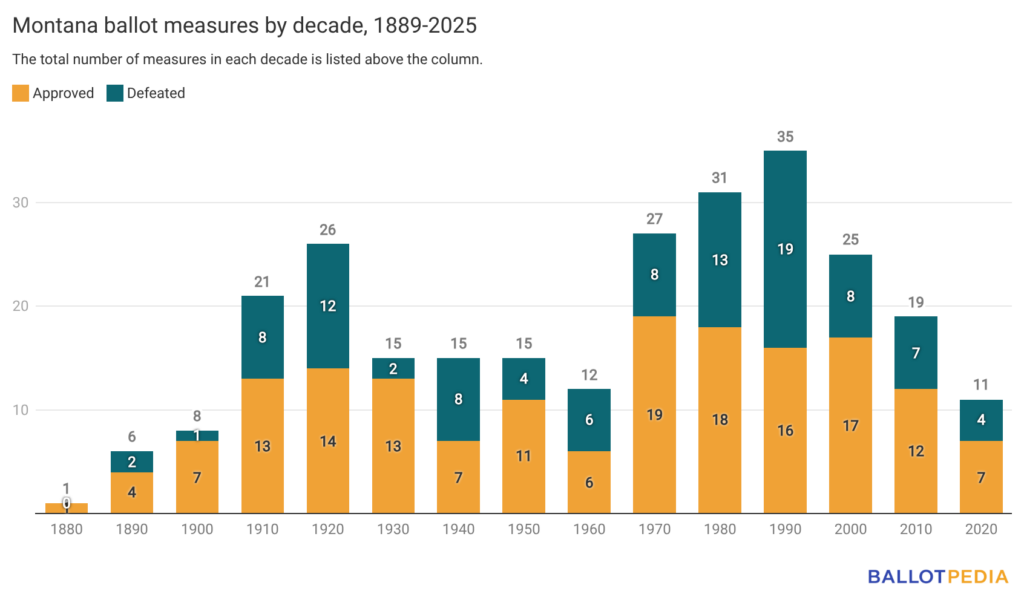
Between 1889 and 2025, the average number of measures per decade ranged from 17 to 18. The decade with the most ballot measures was the 1990s, with 35. Sixteen measures (46%) were approved, and 19 (54%) were defeated. The decade with more than one measure that had the highest approval rate was the 1900s, which featured eight measures — all but one was approved. The decade with the lowest approval rating was the 1990s.
Montana ballot measures have addressed 118 unique topics, with some measures addressing multiple topics.
State constitution and capital
Montana voters have ratified two state constitutions. The first constitution was approved in 1889, shortly before statehood, by a margin of 92% to 8%. The current constitution was approved in 1972 by a margin of about one percentage point. Voters called the convention that produced the 1972 constitution by approving Referendum 67 in 1970. Montana is also one of 14 states that provides for an automatic constitutional convention question every 20 years. Voters rejected automatic convention questions in 1990 and 2010.
Voters decided the location of the state capital across two elections. An 1892 question proposed seven cities — Anaconda, Boulder, Bozeman, Butte, Deer Lodge, Great Falls, and Helena. The cities were placed on the ballot after signatures were collected from the respective residents. Helena (31%) and Anaconda (22%) received the most votes, but neither received a majority. Voters decided between the two cities in an 1894 runoff, selecting Helena as the capital.
Mining and business regulations
In 1904, voters approved an eight-hour workday in mills, smelters, and mines and a measure to prohibit the employment of children under 16 in underground mines. The measures were among the widest margins in state history, at +77% and +85%, respectively. Voters extended the eight-hour day to all industries with the approval of an amendment in 1936.
In 1976, voters approved a constitutional trust fund for a portion of the coal severance tax. In 1982, voters approved a measure to direct a quarter of future deposits toward in-state investment. Voters approved I-137 in 1998, requiring public notice and additional environmental disclosure for mining permits, but defeated measures that would have restricted new metal-mine and cyanide-leach permits in 1999; allowed cyanide-leach processing at open-pit gold and silver mines in 2004; and added water-quality requirements for new hard-rock mines in 2018.
Taxes
In 1934, voters approved an amendment to levy graduated and progressive income taxes to replace property taxes. The revenue was distributed between public schools and state government.
Montana has no general sales tax, and voters have repeatedly rejected statewide ballot measures to create one. They rejected a 2% sales and use tax in 1971 and a 4% sales tax in 1993, then approved an amendment in 1994, limiting any future statewide sales or use tax to 4%.
Elections and campaign finance
Montana voters repeatedly decided on several campaign finance-related measures. In 1996, voters approved a prohibition on corporate contributions to ballot-measure campaigns. The state legislature expanded the prohibition to prohibit contributions or expenditures in ballot issue campaigns by corporations, partnerships, associations, and tax-exempt organizations except through separate political funds funded by voluntary contributions with the passage of House Bill 575 in 1997. The law was challenged by a veto referendum in 1998, which voters upheld, but the law was later struck down in court. In 2012, Montana voters approved an initiative to ban corporate contributions and expenditures in elections. However, the measure was overturned in 2013.
In 1992, voters approved CI-64, setting term limits for statewide executives, legislators, and members of Congress; in 2004, voters rejected a legislatively referred constitutional amendment that would have increased term limits for state legislators from eight years in a 16-year period to 12 years in a 24-year period.
In 2024, voters rejected two measures to change how elections are conducted: CI-126, which would have established top-four primaries, and CI-127, which would have required a majority rather than a plurality to win certain offices, including governor, lieutenant governor, secretary of state, auditor, attorney general, superintendent of public instruction, state legislature, and Congress. CI-126 was defeated with 51% opposed, and CI-127 was defeated with 60% opposed.
Social issues
In 2004, voters approved CI-96, defining marriage as between one man and one woman. It was one of 31 states to approve such amendments. The amendments were later overturned with the Obergefell ruling in 2015.
Montana voters have decided on three abortion-related measures. Voters approved parental notification for minors in 2012, with 71% of voters supporting it. In 2022, voters rejected LR-131, which would have stated that infants born alive at any stage of development are legal persons and require medical care to be provided to infants born alive after an induced labor, cesarean section, attempted abortion, or another method. The margin was 47% in favor to 53% opposed. In 2024, voters approved CI-128, establishing a state constitutional right to abortion before fetal viability. The margin was 58% to 42%.
The inventory of Montana statewide ballot measures is part of Ballotpedia's Historical Ballot Measure Factbooks, which document nearly 200 years of direct democracy in the United States. This ongoing research effort will provide an unparalleled resource for researchers, reporters, and voters on how ballot measures have evolved, the issues they've covered, and the role they have played in our civic life.