



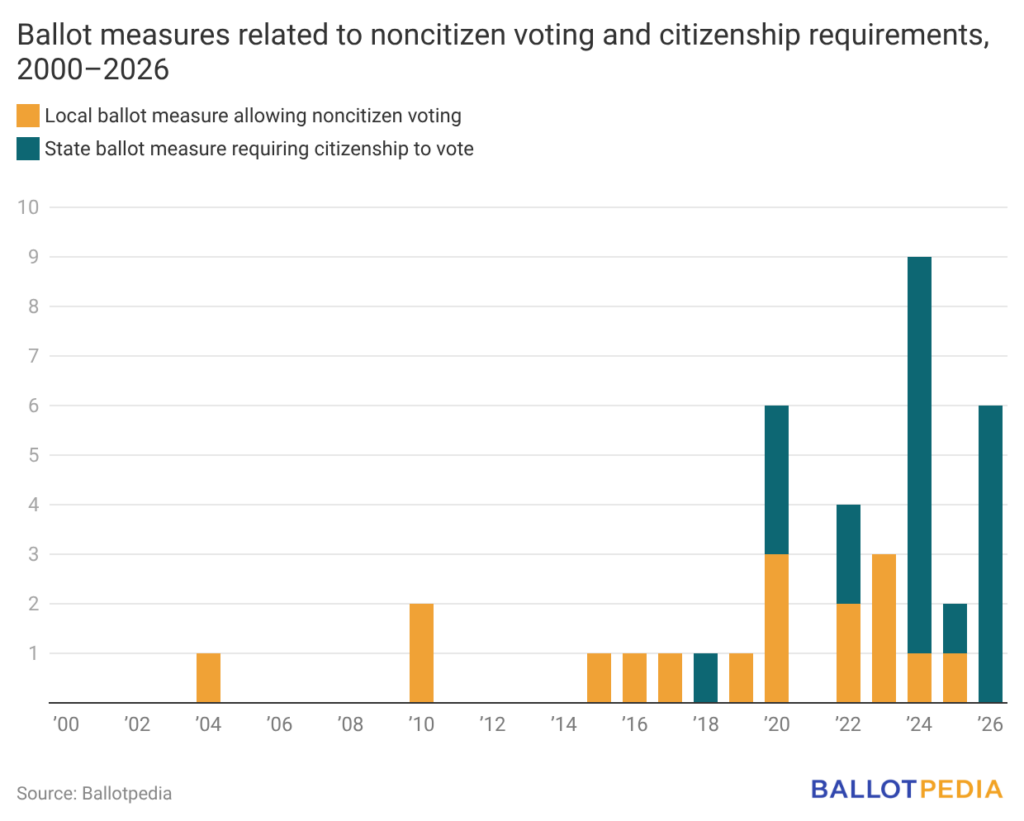
In 2026, voters in six states will decide ballot measures related to citizenship requirements for voting, continuing a multi-year trend that started in 2018. Each measure would provide that only U.S. citizens may vote in state and local elections. Five are legislative constitutional amendments, and one — in Alaska — is a citizen-initiated state statute.
Measures in Alaska, Arkansas, Kansas, South Dakota, and West Virginia would define who is eligible, or ineligible, to vote based on citizenship.
In Arizona, the constitutional amendment would provide that “only citizens may register and vote in Arizona elections.” Unlike the constitutions of the other five states, however, the Arizona Constitution already expressly limits voting to U.S. citizens, stating that “no person shall be entitled to vote ... unless such person be a citizen of the United States.” The constitutional amendment is also broader than the other measures, addressing citizenship, voter identification, campaign finance, and election administration.
Voters in Alaska will decide the first statewide ballot measure on this topic proposed as a statute rather than a constitutional amendment.
Federal law has prohibited noncitizens from voting in elections for president, the U.S. House, and the U.S. Senate since 1996. State constitutions and state and local laws govern eligibility for other elections.
The 2026 measures continue a recent trend
The six measures on the ballot in 2026 are part of the second of two historical waves of statewide ballot measures concerning citizenship and voting eligibility.
From 2018 through 2025, voters decided 15 constitutional amendments that added or strengthened citizenship requirements for voting. Voters approved all 15, with an average of 73% voting in favor. Eight of the amendments appeared on the ballot in 2024.
These measures generally did not repeal an existing authorization for noncitizen voting; instead, they changed language such as “every citizen may vote” to “only a citizen may vote” or added an express prohibition on noncitizen voting.
The amendments also preempted state or local governments from later allowing noncitizens to vote. In most states, they did not override an existing law because no locality had already authorized noncitizen voting. The exception was Ohio, where Yellow Springs voters amended the village charter in 2020 to allow noncitizen residents to vote in local elections. However, that charter amendment was not implemented following a directive from Secretary of State Frank LaRose.
Statewide measures have occurred in two historical waves
From 1894 through 2025, voters considered 35 statewide ballot measures related to citizenship requirements for voting and noncitizen voting. The measures occurred in two distinct periods separated by 91 years.
Between 1894 and 1926, voters decided 20 measures that repealed or restricted constitutional provisions allowing certain foreign-born noncitizens to vote. Voters approved 17 of the measures, or 85%.
Between 2018 and 2025, voters decided 15 measures that added constitutional citizenship requirements for voting. All 15 were approved.
No statewide ballot measures added or changed citizenship requirements for voting between 1926 and 2018.
Across both historical waves, statewide ballot measures moved in the same general direction—toward limiting voting to U.S. citizens. No statewide ballot measure proposed granting or expanding voting for noncitizens.
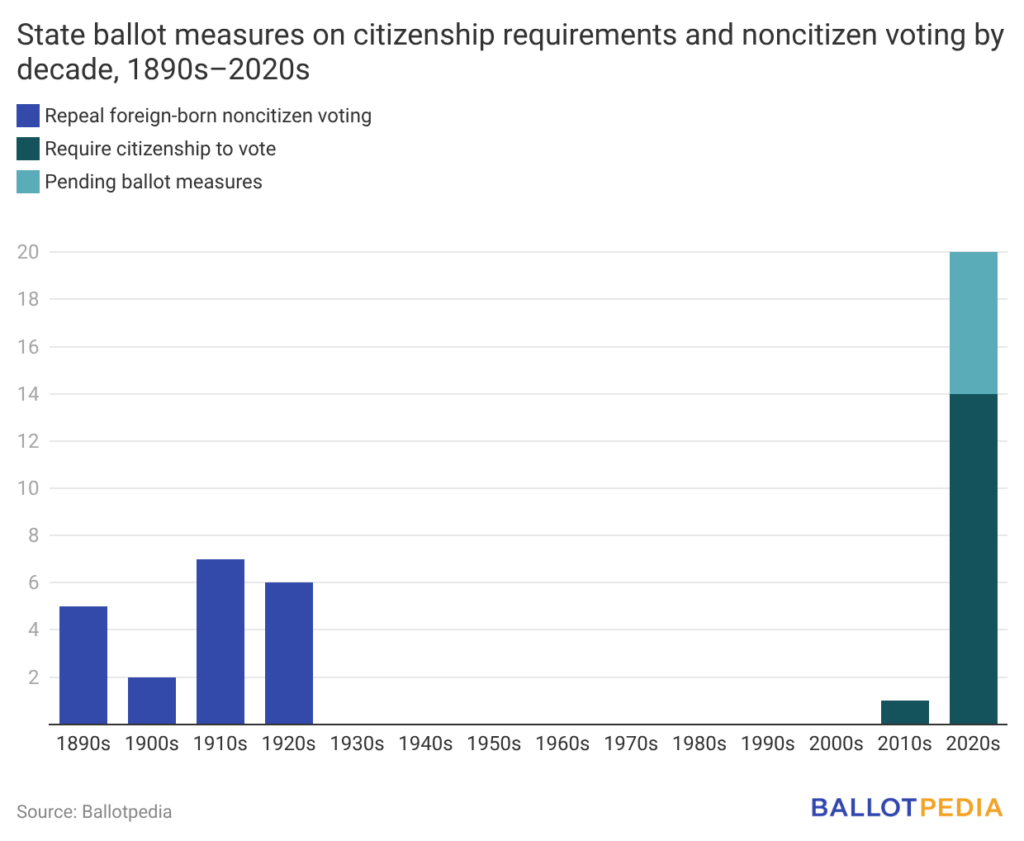
The first wave ended declarant-noncitizen voting
During the first wave, from 1894 through 1926, voters considered measures that removed or restricted state constitutional provisions allowing certain foreign-born noncitizens to vote. The people affected were noncitizens who had formally declared their intention to become U.S. citizens but had not completed the naturalization process.
In “Voters in a Foreign Land: Alien Suffrage in the United States, 1704–1926,” Alan Kennedy described noncitizen voting as widespread in early U.S. elections. He wrote that “all thirteen original states offered noncitizens some form of suffrage by 1800” and that, by that year, “voting by landed, white, male noncitizens was legal in many states.” He noted that state constitutions often used terms such as inhabitant or freeman rather than citizen when describing suffrage. According to Kennedy, “frontier territories with statehood inclinations lured immigrants with promises of state citizenship and voting rights.” These jurisdictions generally required immigrants to declare their intention to become citizens before voting. By 1880, “more than one-third of the states” allowed white male declarant noncitizens to vote.
The practice declined after 1890 and ended in the last state in 1926. Between 1894 and 1926, voters considered 20 statewide measures to repeal or restrict it. Seventeen were approved, and three were defeated. In each state where voters initially rejected a measure — Missouri, Nebraska, and Texas — voters approved a similar proposal within the following several years. Three measures during this period combined the elimination of noncitizen voting with provisions granting women the right to vote.
The final statewide authorization for noncitizen voting, in Arkansas, ended in 1926. In 1931, political scientist Leon E. Aylsworth wrote that “for the first time in over a hundred years, a national election was held in 1928 in which no alien in any state had the right to cast a vote for a candidate for any office—national, state, or local.”
Local measures have moved in the opposite direction
While statewide measures have moved toward limiting voting to U.S. citizens, contemporary local ballot measures moved in the opposite direction by proposing to authorize or expand noncitizen voting.
From 1991 through 2025, voters decided 18 local measures proposing to authorize or expand noncitizen voting in municipal, county, or school elections. Nine were approved, and nine were defeated.
As of July 8, 2026, no local noncitizen-voting measures are certified for the ballot in 2026.
Additional reading: