


On July 11, 2026, Sen. Lindsey Graham (R-S.C.) died, leaving a vacancy in the U.S. Senate.
The vacancy now brings the Republican majority in the U.S. Senate to 52 to 45, with one vacancy. Additionally, Sens. Angus King (I-Maine) and Bernie Sanders (I-Vt.) are independents who caucus with Democrats.
Graham is the fourth member of the U.S. Senate since 2013 to have died while in office:
- Sen. Dianne Feinstein (D-Calif) died on Sept. 29, 2023, during the 118th Congress. Following her death, the seat was vacant for four days.
- Sen. John McCain (R-Ariz.) died on Aug. 25, 2018, during the 115th Congress. Following his death, the seat was vacant for 11 days.
- Sen. Frank Lautenberg (D-N.J.) died on June 3, 2013, during the 113th Congress. Following his death, the seat was vacant for seven days.
Graham is also the sixth member of the U.S. Congress to have died while serving in the 119th Congress:
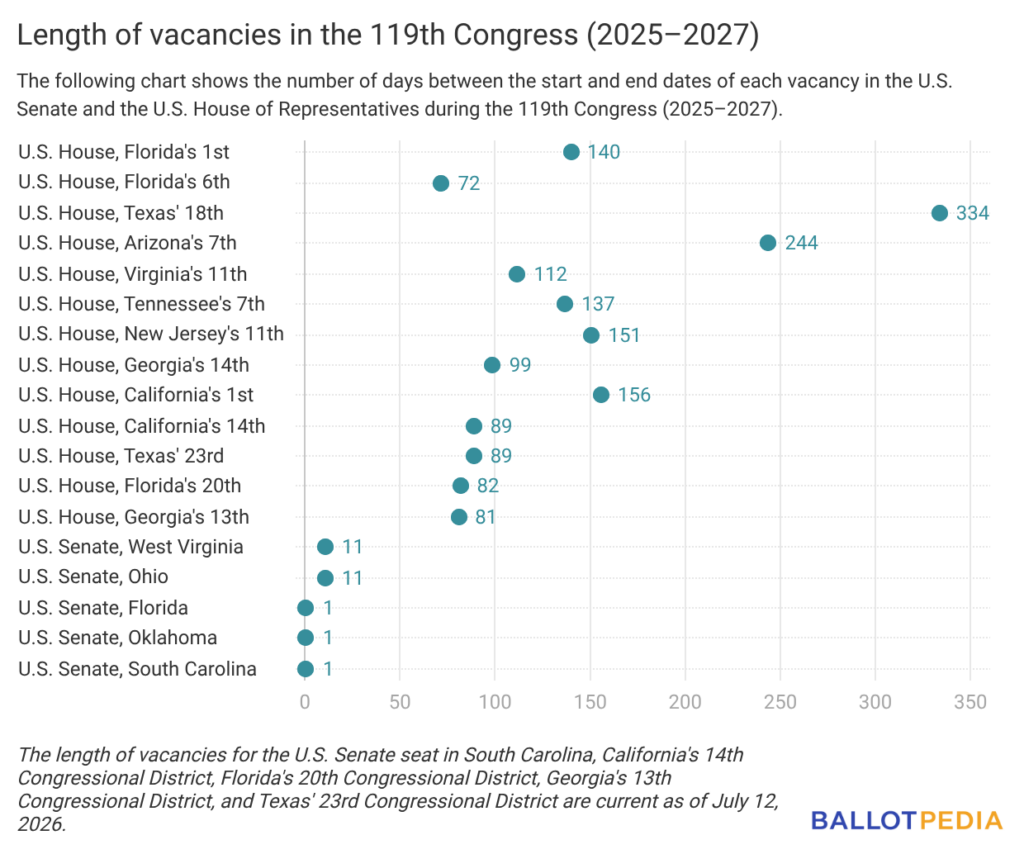
- Rep. David Scott (D-Ga.) died on April 22, 2026. As of July 12, 2026, Georgia's 13th Congressional District has been vacant for 81 days.
- Rep. Doug LaMalfa (R-Calif.) died on Jan. 5, 2026. Following his death, California's 1st Congressional District was vacant for 156 days.
- Rep. Gerald Connolly (D-Va.) died on May 21, 2025. Following his death, Virginia's 11th Congressional District was vacant for 112 days.
- Rep. Raúl Grijalva (D-Ariz.) died on March 13, 2025. Following his death, Arizona's 7th Congressional District was vacant for 244 days.
- Rep. Sylvester Turner (D-Texas) died on March 5, 2025. Following his death, Texas' 18th Congressional District was vacant for 334 days.
Graham's electoral history in the U.S. Senate
In 2002, Graham ran for his first term representing South Carolina in the U.S. Senate. In the general election, he defeated Alex Sanders (D) 54.4% to 44.2%. Graham won re-election in 2008 by 15.4 percentage points, in 2014 by 17.7 percentage points, and in 2020 by 10.2 percentage points.
Vacancies in the 119th Congress
So far in the 119th Congress, there have been 13 vacancies in the U.S. House of Representatives and five in the U.S. Senate. Of those vacancies:
- Three in the U.S. Senate were filled via appointment.
- One in the U.S. Senate was filled when Sen. Jim Justice (R-W.Va.) was sworn into office 11 days after the start of the 119th Congress. Justice delayed his swearing-in in order to fulfill the remainder of his term as governor of West Virginia.
- Nine in the U.S. House were filled after special election winners were sworn in.
As of July 12, 2026, the vacancies in California's 14th Congressional District, Florida's 20th Congressional District, Georgia’s 13th Congressional District, and Texas' 23rd Congressional District have not been filled. The U.S. Senate seat in South Carolina has also not been filled.
Of the 18 vacancies, the longest was in Texas' 18th Congressional District.
Congressional vacancies since the 113th Congress
During the 113th through 118th Congresses, there were 88 vacancies in the U.S. House and 16 in the U.S. Senate. The average length of a vacancy in the U.S. Senate during that period was seven days. The average length of a vacancy in the U.S. House during that period was 138 days.
The longest vacancy in the U.S. Senate during that period was in New Jersey. The vacancy occurred during the 118th Congress, when Sen. Bob Menendez (D-N.J.) resigned on Aug. 20, 2024. Following Menendez's resignation, the seat was vacant for 20 days.
The longest vacancy in the U.S. House during that period was in Michigan's 13th Congressional District. The vacancy occurred during the 115th Congress, when Rep. John Conyers, Jr. (D-Mich.) resigned on Dec. 5, 2017. Following Conyers' resignation, the seat was vacant for 359 days.