



On July 11, 2026, Sen. Lindsey Graham (R-S.C.) died at the age of 71. He is the first U.S. Senator from South Carolina to die in office since Olin D. Johnston (D-S.C.) died on April 18, 1965. He is also the fourth member of the U.S. Senate since 2013 to die in office and the sixth member of Congress to die during the 119th Congress. Graham was running for a fifth term, defeating five other opponents for the Republican nomination with 57% of the vote in June. As a result of his death, there is no Republican nominee for the seat.
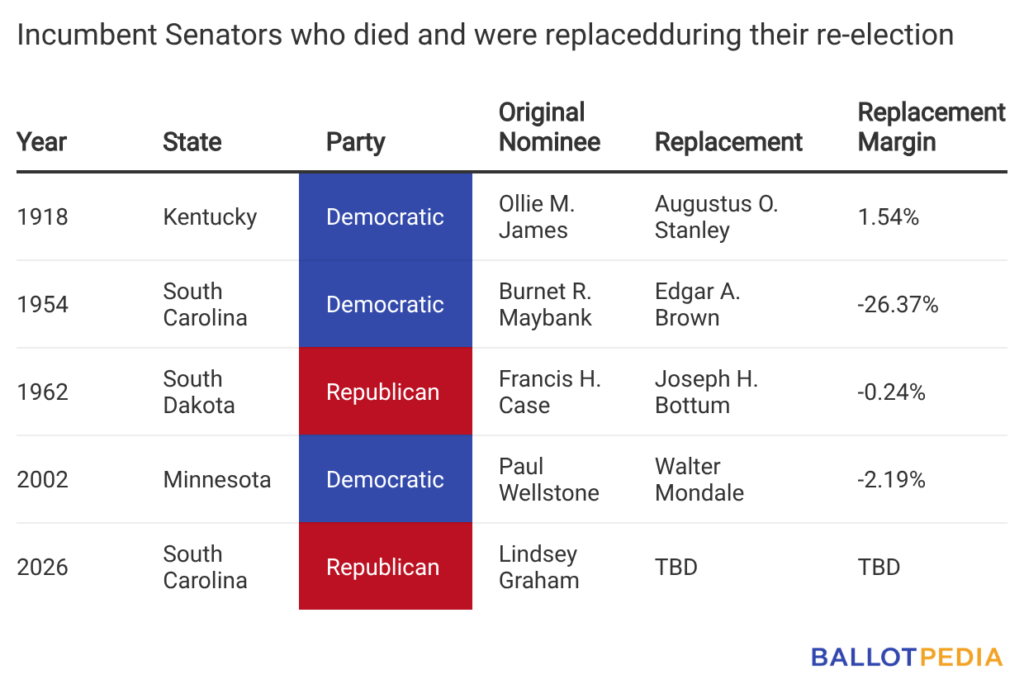
Graham is the first senator to die during a re-election campaign since Paul Wellstone (D-Minn.) died in 2002. The last Republican senator to die during their re-election campaign was Francis Case (R-S.D.) in 1962. Going back to 1918, Ballotpedia found that Graham is the fifth incumbent senator to die during their campaign. South Carolina is also the first state where more than one incumbent died during their re-election campaigns and had to be replaced. In 1954, Burnet R. Maybank (D-S.C.) died and was replaced as nominee by Edgar A. Brown (D-S.C.). Strom Thurmond (D-S.C.) defeated Brown in a write-in campaign by a 26% margin.
Of the four elections in which an incumbent died, their replacement won only once, in 1918. Should Graham’s successor win, it would be the first win of such a nature in 108 years.
Under South Carolina state election law, a special primary election will be held. Candidates can begin filing on July 21 and continue through July 28. The primary will be held on August 11, with a possible runoff on August 25. If the primary went to a runoff, it would be the first Republican Senate primary runoff since 2004. Graham’s elected successor will be only the third person elected to the seat since 1956, as Graham’s predecessor, Strom Thurmond (R-S.C.) served in the Senate from 1956 to 2003.
Graham’s replacement comes as Maine Democratic nominee for Senate Graham Platner (D-Maine) withdrew his candidacy for U.S. Senate. A replacement contest is underway.