


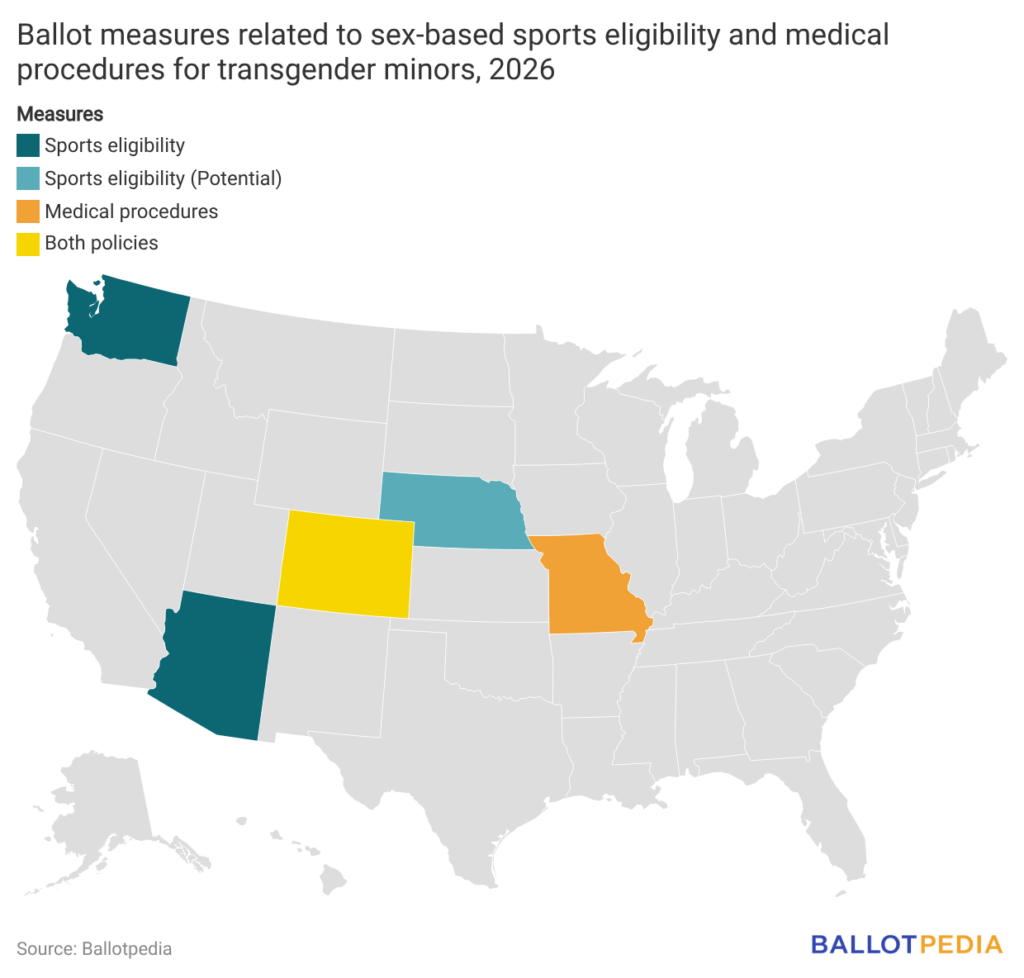
In 2026, voters will decide at least five ballot measures concerning sex-based requirements for school athletics and bans on certain medical procedures for transgender minors, including:
- three ballot measures in Arizona, Colorado, and Washington to establish sex-based requirements for participation on school athletic teams, with the specific regulations and methods for determining sex varying, and
- two ballot measures in Colorado and Missouri to prohibit certain medical and surgical procedures for transgender minors when provided to alter sex characteristics.
Voters in Nebraska could see a citizen-initiated constitutional amendment to prohibit "athletic teams or sports designated for females, women, or girls" from being "open to students of the male sex." On June 30, 2026, the campaign behind the initiative filed signatures, which local officials must review within 40 days of receiving them.
Overview
Both supporters and opponents have grouped these policies together as part of a broader debate over how institutions should address issues of sex and gender involving minors.
Supporters have described the measures as efforts to preserve sex-based categories in school sports so girls have a fair opportunity to compete, and to protect children from irreversible and harmful medical procedures. In Colorado, the political action committee sponsoring two initiatives said the campaign sought to “protect kids from becoming victims of a dangerous and false ideology.” The Trump White House has also described these policies as efforts "safeguarding women’s sports, shielding children from radical gender ideology, and restoring biological truth."
Opponents have described the measures as targeting transgender children by excluding them from athletic teams that correspond with their gender identity and restricting their access to medically necessary and beneficial procedures. Ricardo Martinez, executive director of GLAD Law, described them as a "new wave of anti-LGBTQ+ ballot campaigns... [where] the target is transgender people—specifically transgender youth.” The Ballot Initiative Strategy Center described them as "a growing slate of anti‑trans ballot measures aimed at barring gender‑affirming care for minors, excluding trans students from sports, and more."
States first enacted laws similar to these ballot measures in 2020 and 2021, but voters have never decided either issue at the ballot box until 2026. As of 2026, 29 states had laws, regulations, or interscholastic association rules that limited participation on female school sports teams to students of the female sex, and 27 states had passed laws prohibiting surgical procedures for transgender minors.
States adopted these laws either under Republican trifectas or in divided governments where Democratic governors vetoed the legislation and Republican-controlled legislatures overrode the vetoes, with one exception. In Louisiana, Democratic Gov. John Bel Edwards allowed a school athletics law to take effect without his signature.
As of 2026, every Republican trifecta had enacted laws addressing both sex-based eligibility for school sports and medical procedures for transgender minors. No Democratic trifecta had enacted such laws. Erin Lee, co-president of Protect Kids Colorado, said, "Twenty-seven states have outlawed these issues. They’ve done what we’re now doing through the ballot measures. We’ll be the first blue state and the first by the will of the people to handle these issues to protect kids from gender ideology."[5] Christopher Wiggins, an editor at The Advocate, an LGBTQ media organization, wrote, "Advocates say the shift reflects a strategic pivot after years of legislative battles that stalled or failed. ... groups backing these measures are increasingly turning to ballot initiatives to bypass lawmakers and appeal directly to voters." He quoted Alana Jochum, state policy director at Advocates for Trans Equality, who said, "This harkens back to 2004 and the playbook around marriage equality."
Measures and campaigns
In Arizona, voters will decide on Proposition 318, which would prohibit females from participating on male-designated sports teams and require schools and athletic associations to restrict access to restrooms, locker rooms, showers, and similar private spaces based on sex as recorded on an individual’s original birth certificate. As of 2026, state law prohibited males from female-designated teams but allowed females to participate on male-designated teams. The Arizona State Legislature referred Proposition 318 to the ballot, with unanimous support from Republicans and unanimous opposition from Democrats. As of July 22, there were no PACs supporting or opposing the measure.
In Colorado, voters will decide on two ballot measures related to these policies:
- The Colorado Sex Requirement for School and College Sports Initiative would require student athletes to participate on men's or women's school and collegiate athletic teams that match their sex, based on biological reproductive systems.
- The Colorado Prohibit Surgeries for Treatment in Response to Minors' Perception of Sex or Gender Measure would prohibit healthcare professionals from performing or providing surgeries to persons under age 18 for the purpose of altering biological sex characteristics, defined as “treatment in response to a minor’s perception of sex or gender," and prohibit the use of state or federal funds, Medicaid reimbursements, or insurance coverage to pay for such procedures.
The Protect Kids Colorado PAC is supporting both of the ballot initiatives in Colorado. The PAC has raised $115,943. The largest donor was a 501(c)(4) with the same name, contributing $41,763. Three PACs opposed the two ballot initiatives, including Families Not Politics, which had received the most funding. Together, the PACs had raised $588,336, with $104,776 from the One Colorado Education Fund.
In Washington, voters will decide the Sex Verification Requirements for Female School Sports Initiative. The ballot initiative would require school districts and nonprofit organizations that regulate interscholastic activities to "prohibit biologically male students from competing with and against female students" in sports with separate team or individual competitions for male and female students. It would also require students seeking to participate in athletic activities designated for female students to submit documentation from their healthcare provider verifying the student’s sex, defined by certain biological factors. Let's Go Washington is leading the campaign in support of the ballot initiative. The campaign reported $7.0 million in contributions, including $2.3 million from the group's founder, Brian Heywood. The No Hate in WA State is leading the campaign against the ballot initiative. Opponents reported $1.6 million in contributions, including $250,000 from the National Education Association.
In Missouri, voters will decide on Amendment 3, which would provide that: "No gender transition surgeries shall be knowingly performed on children under eighteen years of age, and no cross-sex hormones or puberty-blocking drugs shall be knowingly prescribed or administered for the purpose of gender transition to children under eighteen years of age." Amendment 3 would also repeal the state constitutional right to reproductive freedom approved in 2024 and prohibit abortion except in cases of medical emergency, fetal anomaly, rape, or incest, with abortions for rape or incest permitted only through 12 weeks of gestation. The Missouri State Legislature referred Amendment 3 to the ballot, with support from 98% of Republicans (one Republican in each chamber voted "No"), and unanimous opposition from Democrats. The Her Health, Her Future PAC is leading the campaign in support of Amendment 3, with $1.6 million in contributions. The largest donor was Donald Ross, who donated $100,000. The Stop the Ban PAC is leading the campaign in opposition to Amendment 3, with $5.2 million. The largest donor was the ACLU Foundation, which donated $2.5 million.
In Nebraska, signatures were submitted for the Sex Requirement for School and College Sports Amendment on June 30. The campaign, Fairness for Girls, reported submitting more than 211,000 signatures. In Nebraska, the signatures required are equivalent to 10% of registered voters at the time of the petition filing deadline. As of July 1, Nebraska had 1,258,210 registered voters, 10% of which would be 125,821. The ballot initiative would require schools to "designate each athletic team or sport as one of the following based on biological sex"—male, female, or co-ed—and prohibit "athletic teams or sports designated for females, women, or girls" from being "open to students of the male sex." As of 2026, Nebraska had a law requiring students participating in public K-12 or collegiate sports to compete on teams designated for their sex. The ballot initiative, however, is a constitutional amendment. The Fairness for Girls PAC reported $3.1 million, with more than 99% from Restore the Good Life, Inc., a 501(c)(4) nonprofit organization. As of July 22, opponents had not organized a PAC.
States with sex-based requirements for school sports
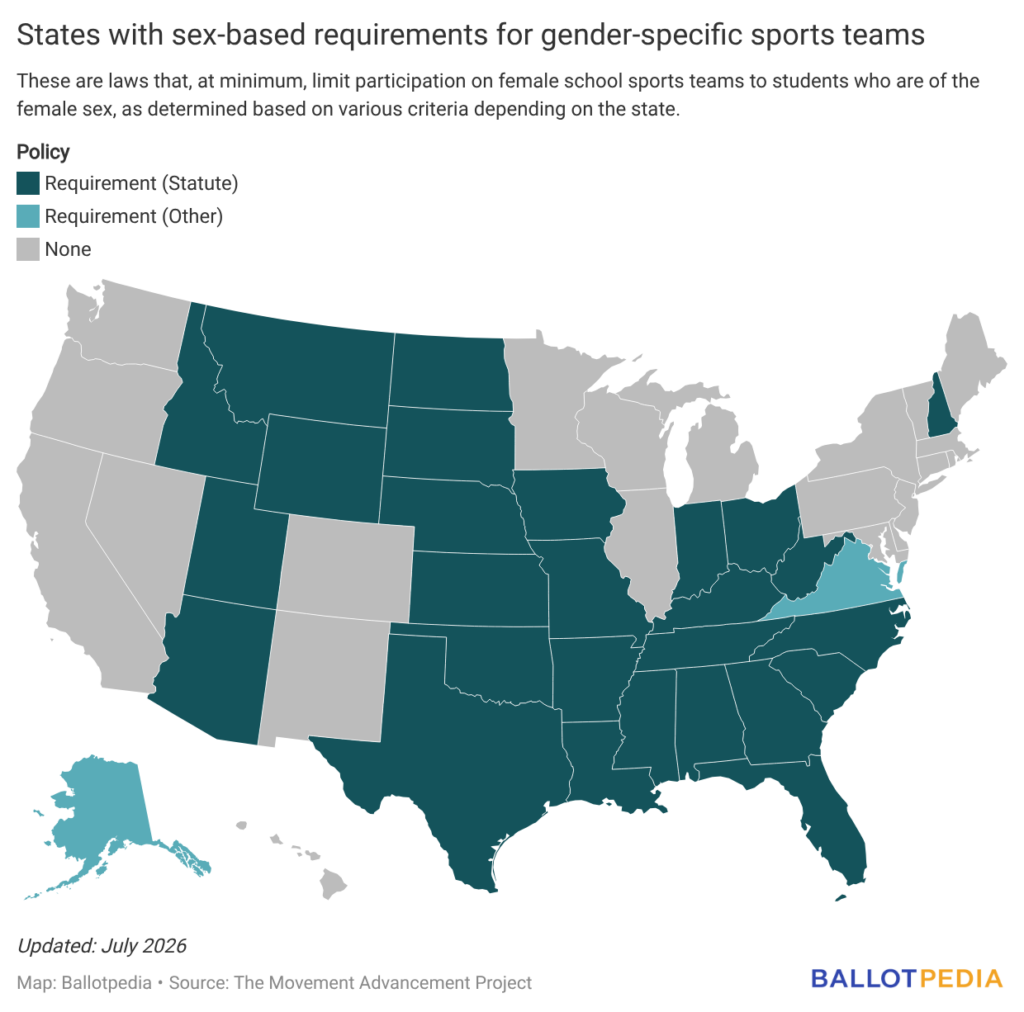
As of July 2026, 29 states had laws, regulations, or interscholastic association rules that limited participation on female school sports teams to students of the female sex, as determined based on various criteria in each state. Some of these states also limited participation on male sports teams to students of the male sex. Twenty-seven (27) states enacted these requirements through statutes. In Alaska, the State Board of Education approved a regulation. In Virginia, the state's nonprofit interscholastic association for high school sports approved a regulation.
The first state to enact such a law was Idaho in 2020. Eight additional states adopted requirements in 2021, 10 in 2022, six in 2023, two in 2024, and two in 2025. Republicans held trifectas in 23 of the 27 states when the laws were enacted. The other four states — Kansas, Kentucky, Louisiana, and North Carolina — had divided governments. Democratic governors vetoed the bills in Kansas, Kentucky, and North Carolina, and Republican-controlled legislatures overrode the vetoes. In Louisiana, Gov. John Bel Edwards (D) allowed the bill to become law without his signature.
Republican governors also vetoed bills in Indiana, Ohio, and Utah, where Republican-controlled legislatures overrode the vetoes. Wyoming Gov. Mark Gordon (R) allowed the bill to become law without his signature. Outside the legislative process, the Alaska State Board of Education adopted a requirement in 2023, and the Virginia High School League adopted one in 2025.
On June 30, 2026, the United States Supreme Court ruled 6-3 in West Virginia v. B.P.J. to uphold several state laws requiring "schools [to] determine eligibility for female sports based on biological sex."
States with laws prohibiting surgical procedures for transgender minors
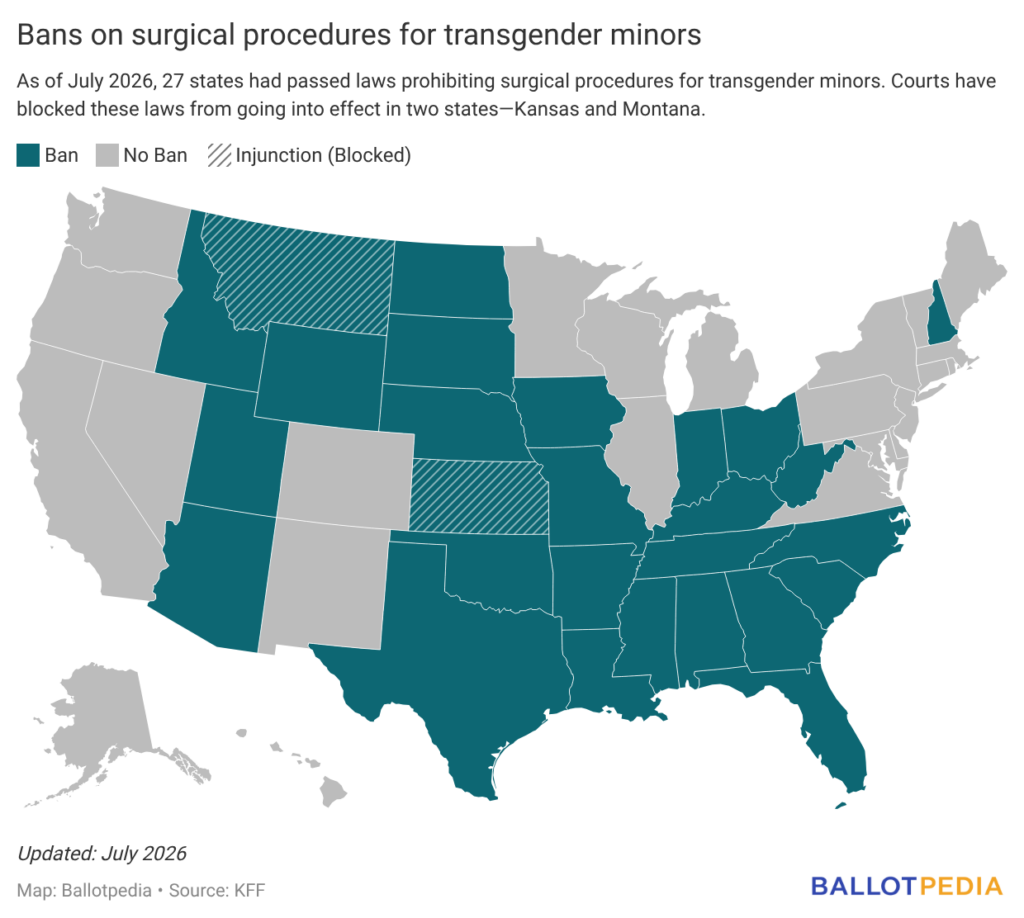
As of July 2026, 27 states had passed laws prohibiting surgical procedures for transgender minors.
The first state to ban these procedures was Arkansas in 2021. Two additional states enacted bans in 2022, 19 states in 2023, four states in 2024, and one state in 2025. Republicans held trifectas in 23 of the 27 states at the time of enactment. The other four states — Kentucky, Louisiana, North Carolina, and Kansas — had divided governments, in which Democratic governors vetoed bills, and Republican-controlled legislatures overrode those vetoes. In Kansas and Montana, state courts have blocked these laws from taking effect.
Additional reading: