Nebraska's U.S. Senate general election will not feature a Democrat after nominee Cindy Burbank (D) withdrew on July 17 — the 17th regular or special U.S. Senate election we identified since 2000 with no Democratic candidate, compared to four with no Republican candidate. Two of those elections with no Republican candidates were due to California's top-two primary system.
Nebraska Secretary of State Bob Evnen (R) announced he would remove Burbank's name from the ballot on July 21. This move makes Nebraska the first state since the direct election of U.S. senators began in 1914 to hold two consecutive regular or special U.S. Senate elections with no Democratic candidate.
In the May 12 Democratic primary, Burbank defeated William Forbes (D) 90% to 10%. On her withdrawal, Burbank said, "I've looked at the numbers. I won't be your next senator. So I have withdrawn my bid for U.S. Senate." The three remaining candidates running in the general election are incumbent Sen. Pete Ricketts (R), Mike Marvin (Legal Marijuana Now Party), and Dan Osborn (Nonpartisan).
Ricketts and Osborn previously ran in separate elections in 2024 for the U.S. Senate in Nebraska. Ricketts defeated Preston Love Jr. (D) in the special election 62.6% to 37.4%. Meanwhile, incumbent Sen. Deb Fischer (R) defeated Osborn in the general election 53.2% to 46.5%. The match-up between Fischer and Osborn was the first U.S. Senate election in Nebraska history not to include both a Democratic and a Republican candidate.
In the 2024 presidential election in Nebraska, Donald Trump (R) defeated Kamala Harris (D) 59.3% to 38.9%. Ricketts outperformed Trump that year, and Fischer underperformed Trump.
Osborn said he will not caucus with either party if elected. Ahead of this year's Democratic primary, Burbank's campaign website stated, "Osborn is a good man, a working man, a strike leader, and someone we can trust. He deserves a fair shot against Ricketts."
Burbank filed the withdrawal paperwork before the Aug. 3 deadline. Following Burbank's withdrawal, a representative for the secretary of state, said Evnen would consult with the Nebraska Attorney General Mike Hilgers (R) on whether Burbank should be allowed to withdraw.
Burbank is the 14th major-party U.S. Senate nominee to leave a race since 1976. In addition to Burbank, two other candidates left U.S. Senate elections this year: Graham Platner (D), who withdrew from the Maine general election on July 10, and then-incumbent Sen. Lindsey Graham (R-S.C.), who died on July 11.
There will be replacement candidates for the major parties in Maine and South Carolina — the most in a single year since 2002. However, it is unlikely that there will be one in Nebraska after the state's Democratic Party endorsed Osborn in August 2025.
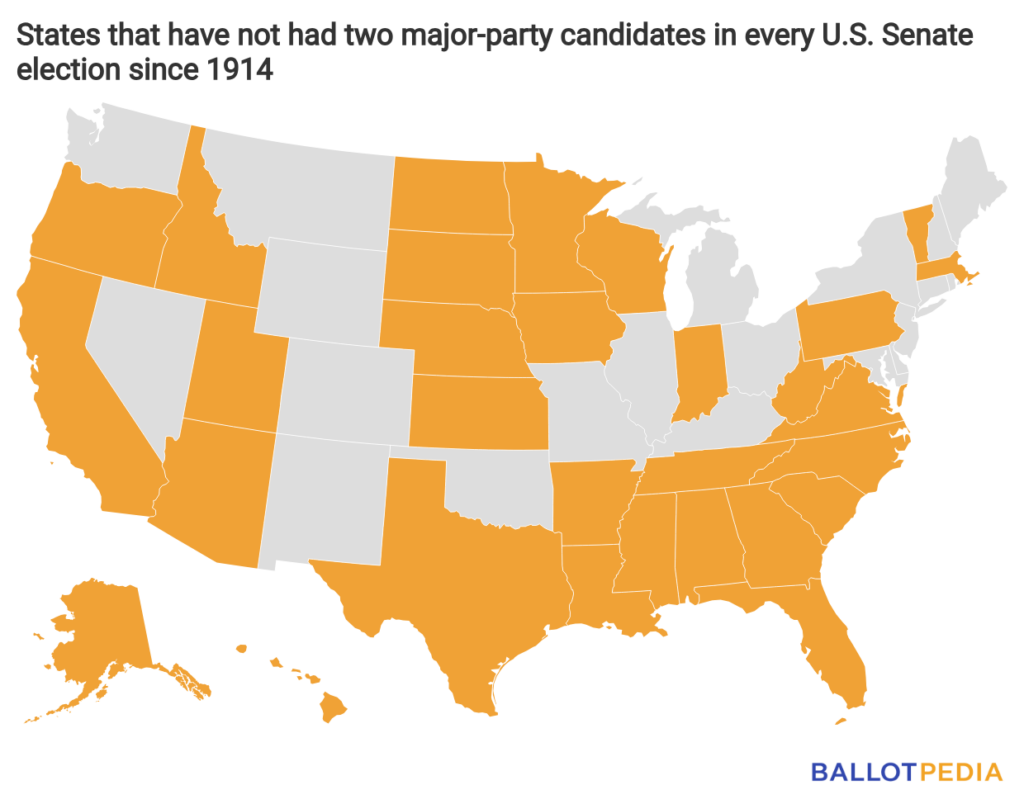
According to Smart Politics' Eric Ostermeier, there are 20 states in which a Democratic and a Republican candidate have run in every U.S. Senate election since 1914. That was the year that the first U.S. Senate elections took place following the passage of the Seventeenth Amendment, which allowed for the direct election of U.S. senators.
In the other 30 states, there has been at least one U.S. Senate election that did not include either a Democratic or a Republican candidate.