


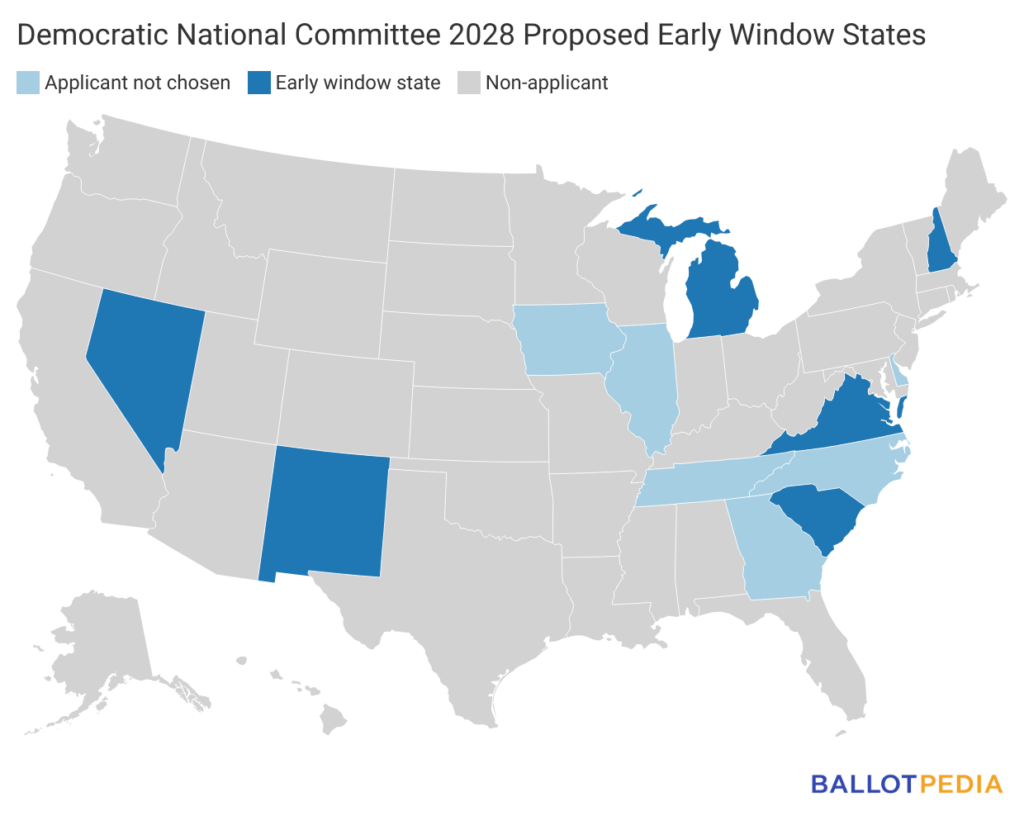
The Democratic National Committee (DNC) announced on July 24, 2026, that its Rules and Bylaws Committee (RBC) had voted to select the first six states for the 2028 Democratic presidential nominating calendar. Those states and their proposed primary dates are as follows:
- South Carolina: Jan. 22, 2028
- Nevada: Feb. 1, 2028
- New Hampshire: Feb. 8, 2028
- New Mexico: Feb. 15, 2028
- Michigan: Feb. 22, 2028
- Virginia: Feb. 29, 2028
The full DNC will vote on the proposal at its summer meeting in mid-August. The proposal follows a months-long process of states applying for the early primary dates, aiming to increase their influence on the candidate selection process by holding their respective primaries earlier in the election cycle. Twelve states applied for the early primary window by the deadline on Jan. 16, 2026.
The six states that applied but were not selected were Delaware, Georgia, Illinois, Iowa, Tennessee, and North Carolina.
The RBC adopted criteria for choosing the early window states in October, and potential early window states were evaluated on rigorousness, fairness, and efficiency. Rigorousness refers to the states' ability to “be a comprehensive test of candidates with diverse groups of voters that are key to winning the general election,” according to the RBC. Fairness refers to the states being affordable and practical for candidates to campaign in without overextending their resources. Efficiency refers to the states’ practical ability to run the primary or caucus.
Based on these criteria and the states’ applications, the RBC chose to amend its rules to select six early window states for 2028, rather than four or five previously allowed under the rules. The DNC's July 24 press release says, "The early window provides a comprehensive test with diverse groups of voters that are key to winning a general election. In fact, it is the most diverse open field early window in Democratic Party history, massively increasing diverse representation from 2020 early window states."
The release also listed media market prices in South Carolina and Nevada, as well as the compact geography of both South Carolina and New Hampshire, as affordability considerations that influenced the decision.
RBC co-chairs Minyon Moore and James Roosevelt Jr. stated: "The Rules and Bylaws Committee has proposed a rigorous, fair, and efficient calendar that will win Democrats back the White House in 2028. After months of hard work and deliberation, we are very proud of the calendar that the RBC has put forward — which is also the most diverse calendar Democrats have ever had for an open nominating contest. We look forward to presenting the proposal to our colleagues across the DNC for their approval in a few weeks."
The RBC voted in June 2026 to increase penalties for states that hold unsanctioned primaries during the early window. Penalties for not following the DNC calendar in 2028 include the state losing delegates, participating candidates being prohibited from DNC debates, and the state receiving a $270,000 fine.
Iowa's presidential caucus came first in the Democratic nominating calendar from 1972 until 2024, when the DNC approved a calendar that put South Carolina's primary first. In 2024, the Iowa Democratic Party held a mail-in primary and released results on Super Tuesday.
Following the release of the RBC proposal, Iowa Democratic Party Chair Rita Hart said, "[W]hen we get to November, and we have some newly elected Democratic officials, they’re gonna have some things to say about that, along with the rest of our Democrats."
New Hampshire law requires the state’s presidential primary to be held at least seven days prior to any other primary contest. In 2024, New Hampshire held its primary first. The DNC chose not to allocate delegates based on the state-run primary, and the New Hampshire Democratic Party instead held a second, party-run primary, which was used for delegate allocation.
New Hampshire Democratic Party chair Ray Buckley said of the RBC proposal, "Today's vote shows that many party insiders have learned nothing from 2024. ... This committee's vote does not change the realities governing New Hampshire’s primary, which are beyond the control of both this committee and our state party."
Additional reading: