


Voters in Colorado will decide on a ballot measure related to the right to hunt and fish on Nov. 3, 2026.
Initiative 302
The initiated constitutional amendment — Initiative 302 — would establish the right of the people to hunt, fish, and otherwise take fish and wildlife, including by traditional methods. It would also specify that the policy of the state of Colorado is that “hunting and fishing are the preferred means of responsibly managing fish and wildlife populations.”
Initiative 302 would exempt endangered species, nongame species, and species that are illegal to hunt under federal law from the right to hunt and fish. Additionally, it explicitly states that it does not authorize trespassing on private property or limit the state's authority to regulate hunting and fishing.
The Colorado Secretary of State's office certified Initiative 302 for the ballot on Aug. 20, 2026, announcing that its proponents submitted 145,299 valid signatures, surpassing the required minimum of 124,238.
Luke Hilgemann, the executive director of the International Order of T. Roosevelt — the organization supporting the initiative — said, "Hunting and fishing is part of Colorado's heritage. It's something that the state traces its roots back to, and we want to make sure that those are forever protected against an onslaught of threats that have come from the anti-hunting and fishing groups, not only in Colorado, but nationwide."
Hilgemann referred to an initiative filed in Oregon that would have criminalized hunting, fishing, and intentional injury to animals. He stated that Initiative 302 is a “proactive measure that allows us to be offensive and prevent these types of radical policies from ever taking hold of an amazing place like Colorado.” The initiative in Oregon did not make the ballot.
David Kane, a member of Protect Colorado's Constitution, the organization opposing Initiative 302, said, "You could probably ask 10 different people what 'traditional methods' are, and you'd get 10 different answers. That's something that could be left to the interpretation of the courts if it was challenged." Additionally, he stated, "This is really not something that falls within democratic principles around constitutions. This would just overload and bloat the Constitution even more. It weakens public trust; it could create potential budgetary chaos, and it kind of creates inequality.”
As of August 2026, 24 states have constitutional amendments proclaiming a right to hunt and fish. Vermont’s constitution has contained these rights since 1777. Voters in the other 23 states approved ballot measures providing for these constitutional rights. Additionally, the state constitutions of California and Rhode Island include amendments guaranteeing the right to fish, but not to hunt.
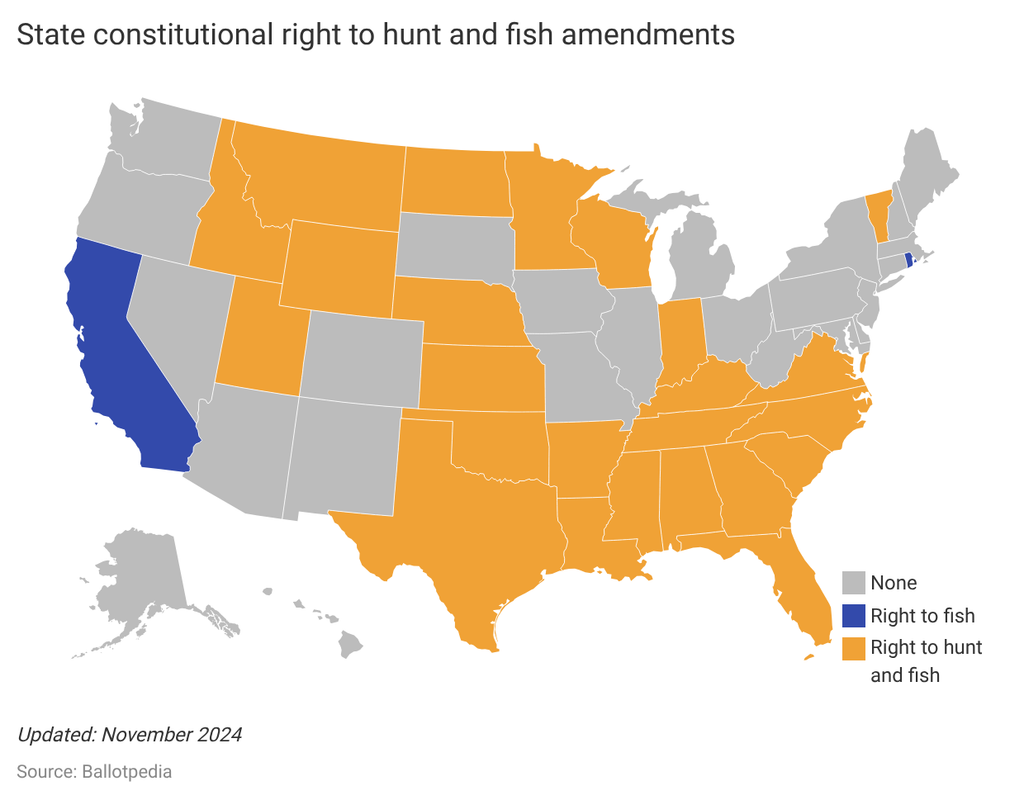
Vermont was the first state to constitutionalize such a right in 1777, but Alabama was the first to adopt it via ballot measure. Voters in Alabama approved the state's Sportsperson's Bill of Rights in 1996 with 81.4% of the vote, thereby establishing the right to hunt and fish.
Between 1996 and 2025, 25 measures concerning the right to hunt and fish have been on the ballot in 24 states. Of the 25 ballot measures concerning a constitutional right to hunt and fish, voters defeated only one. In 2010, 56.7% of Arizona voters rejected Proposition 109, which would have:
- created a constitutional right to hunt and fish;
- stated that wildlife in Arizona belongs to the state and is held in a trust for the benefit of its citizens;
- granted the legislature exclusive authority to enact laws regulating the manner, methods, or seasons for hunting and fishing, thus prohibiting citizens from using the initiative process to enact such laws;
- stated that the constitutional right to hunt and fish would not authorize trespassing;
- stated that lawful hunting is the preferred means of managing wildlife in Arizona.
Initiative 302 is the first ballot measure concerning a right to hunt and fish to be initiated by citizens, rather than referred to the ballot by a state legislature.
Additional reading: