


So far this year, 11 members of the U.S. House of Representatives have lost re-election in a primary. That’s the second-highest number of incumbents who have lost primary elections since 2014.
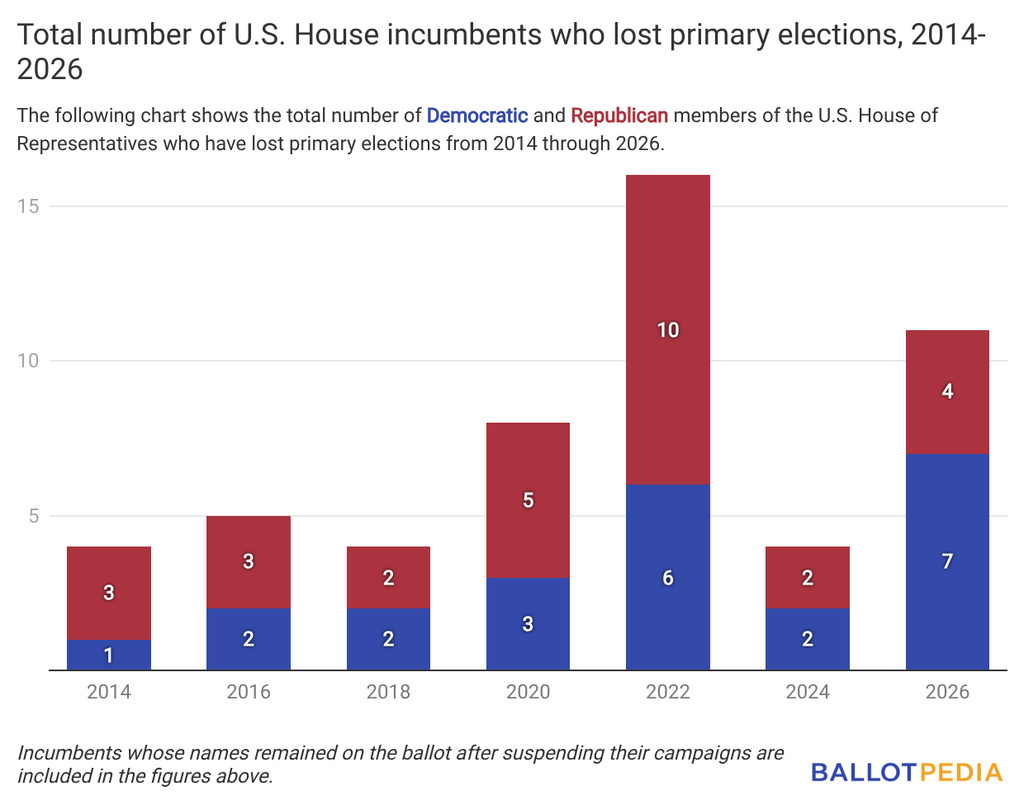
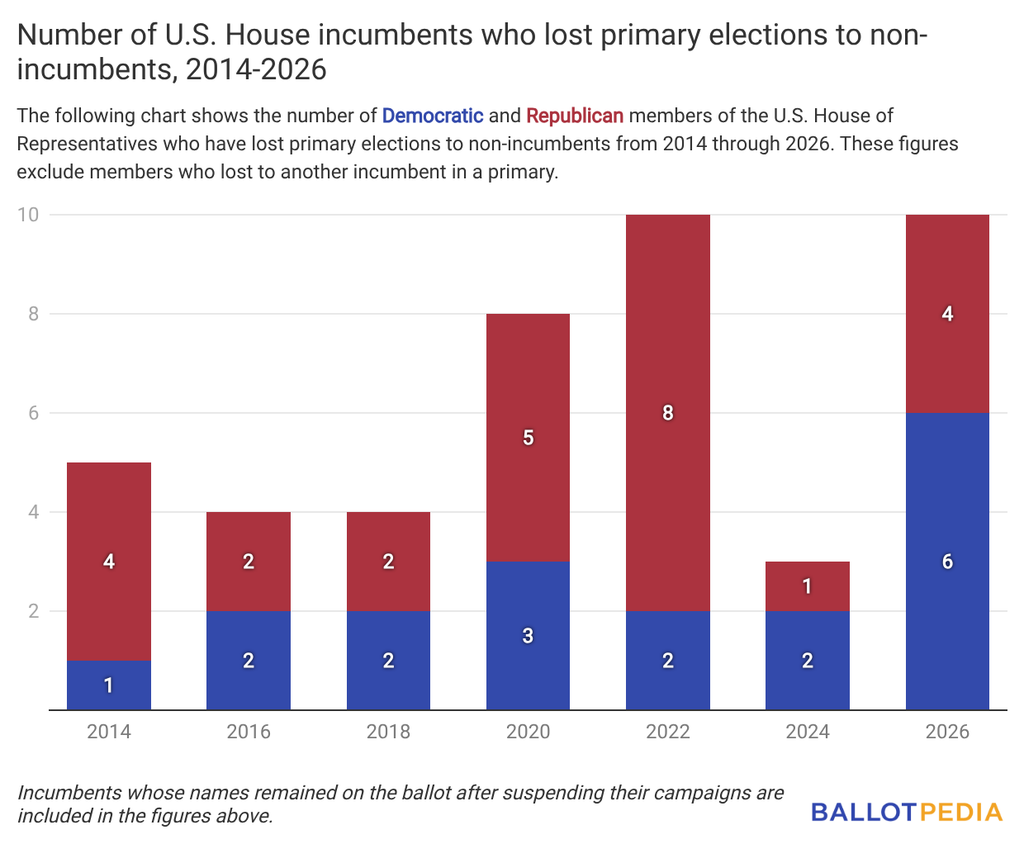
A contributing factor to the number of losses in 2022 was incumbents who ran against other incumbents due to redistricting. Looking at only incumbents who lost to non-incumbents from 2014 through 2026, this year ties with 2022 for the most losses since 2014.
Here’s a closer look at the 11 primaries this year in which an incumbent lost re-election.
Seven Democratic incumbents have lost re-election in primaries this year
Two Texas incumbents lost re-election in the May 26 Democratic primary runoffs. They advanced to the runoffs after no candidate in the March 3 Democratic primaries won at least 50% of the vote. These primaries took place following congressional redistricting in Texas ahead of this year’s elections.
- Rep. Christian Menefee (D) defeated Rep. Al Green (D) in the Democratic primary runoff for Texas’ 18th Congressional District 69.3% to 30.7%. In the Democratic primary, Menefee won 46.0% of the vote, and Green won 44.2% in a field of four candidates.
- Collin Allred (D) defeated Rep. Julie Johnson (D) in the Democratic primary runoff for Texas’ 33rd Congressional District 54.0% to 46.0%. In the Democratic primary, Allred won 44.0% of the vote, and Johnson 33.2% in a field of four candidates.
Three incumbents lost to challengers whom the national chapter or a local chapter of the Democratic Socialists of America (DSA) endorsed.
- In the June 23 Democratic primary for New York’s 13th Congressional District, Darializa Avila Chevalier (D) defeated Rep. Adriano Espaillat (D) 49.4% to 45.9% in a field of four candidates.
- In the June 30 Democratic primary for Colorado’s 1st Congressional District, Melat Kiros (D) defeated Rep. Diana DeGette (D) 49.3% to 43.5% in a field of three candidates.
- In the Aug. 4 Democratic primary for Michigan’s 13th Congressional District, Donavan McKinney (D) defeated Rep. Shri Thanedar (D) 51.9% to 48.1%.
In the June 23 Democratic primary for New York’s 10th Congressional District, Brad Lander (D) defeated Rep. Daniel Goldman (D) 64.1% to 35.9%. This primary was also one of two in which New York City Mayor Zohran Mamdani (D) endorsed a challenger to a U.S. House incumbent. The other was the Democratic primary for New York’s 13th Congressional District.
In the Aug. 11 Democratic primary for Connecticut’s 1st Congressional District, Luke Bronin (D) defeated Rep. John Larson (D) 53.5% to 34.7% in a field of four candidates. According to the Connecticut Mirror’s Lisa Hagen and Ginny Monk, Bronin centered his campaign on the need for generational change. Bronin is 47 and Larson is 78.
Four Republican incumbents have lost re-election in primaries this year
In the March 3 Republican primary for Texas’ 2nd Congressional District, Steve Toth (R) defeated Rep. Daniel Crenshaw (R) 55.8% to 40.7% in a field of four candidates. President Donald Trump (R) did not endorse a candidate in this primary, making Crenshaw the only Republican U.S. House incumbent whom Trump did not endorse.
In the May 19 Republican primary for Kentucky’s 4th Congressional District, Ed Gallrein (R) defeated Rep. Thomas Massie (R) 54.9% to 45.1%. At the time of the election, this primary was the only U.S. House primary in which Trump endorsed a challenger to a Republican incumbent.
In the Aug. 6 Republican primary for Tennessee’s 5th Congressional District, Charlie Hunter (R) defeated Rep. Andy Ogles (R) 53.3% to 46.7%. According to Politico’s Andrew Howard, redistricting and an endorsement from Tennessee Gov. Bill Lee (R) were contributing factors in Hunter defeating Ogles, whom Trump endorsed. Additionally, Invest in Tomorrow Coalition PAC, a renewable energy super PAC, spent $2 million opposing Ogles and supporting Hunter.
In the Aug. 18 Republican primary for Florida’s 7th Congressional District, Ryan Elijah (R) defeated Rep. Cory Mills (R) 47.1% to 34.2% in a field of four candidates. This primary took place against the backdrop of a U.S. House Ethics Committee investigation into allegations of misconduct against Mills. Mills has denied any wrongdoing and said he complied with the investigation.