



On Nov. 3, 2026, voters in Colorado will decide on a ballot initiative that would establish a graduated income tax.
Initiative 195
The measure, Initiative 195, would establish a six-tier structure for state income taxes, ranging from 3.7% to 8.4%, and remove the uniform tax rate requirement from the Taxpayer's Bill of Rights (TABOR).
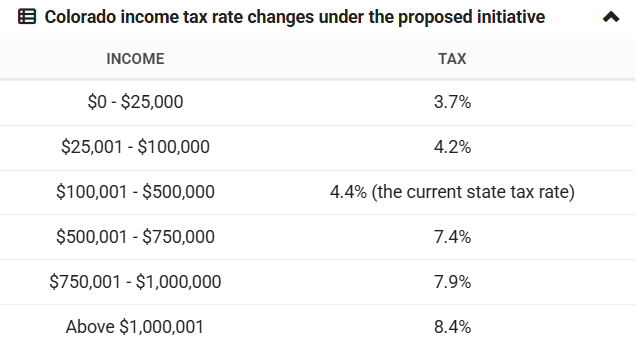
Currently, Colorado has a flat income tax rate — set at 4.4% — that applies to all taxpayers at the same rate, regardless of income.
The Colorado secretary of state's office certified Initiative 195 for the ballot on Sept. 1, 2026, announcing that its proponents submitted 130,938 valid signatures, surpassing the required minimum of 124,238 to qualify for the ballot.
Initiative 195 was filed on Jan. 9, 2026, as a combined initiated constitutional amendment and state statute, which amends both the Colorado Constitution and the Colorado Revised Statutes. The initiative is supported by Protect Colorado's Future, an organization that describes itself as "a diverse group of community, grassroots, and policy organizations working to enact a fair tax code that enables the state to invest in the things families need — education, child care, health care, safety, and economic opportunity." The campaign's biggest supporters include the Bell Policy Center; the Colorado Statewide Parent Coalition; Great Education Colorado and Save the Children; the Colorado Fiscal Institute; and the New Era Colorado Action Fund.
Speaking in support of Initiative 195, Kathy White, the executive director of the Colorado Fiscal Institute, said, "[working families] shouldn’t have to pick up the tab so the wealthiest get a $71,000-a-year gift from Congress — especially when TABOR has already tied our hands for decades.”
Opposing Initiative 195, Advance Colorado, an organization that describes its mission as "[pushing] back on the progressive policies that have put our state on the wrong track", submitted signatures for a measure that would establish an income tax rate cap. Their initiative — known as Initiative 232 — would cap individual and corporate income tax rates at 4.4% of a taxpayer's federal taxable income. Because Initiative 232 is an initiated state statute, the state legislature could amend or repeal the cap, and any potential increases would still require voter approval under TABOR.
Since Initiative 195 and Initiative 232 conflict with one another — with the former establishing rates above 4.4% for certain income brackets, and the latter prohibiting individual and corporate income tax rates above 4.4% — if both measures are approved, the conflicting provisions of whichever measure receives more votes would take effect. According to the Colorado Revised Statutes, "In the case of adoption of conflicting provisions, the one that receives the greatest number of affirmative votes prevails in all particulars as to which there is a conflict." Michael Fields, the executive director of Advance Colorado, said, "This is a clear counter to the far left’s attempt to hike taxes in Colorado, price people out of the state we love, and drive business out. We’ll always fight to protect TABOR and keep our taxes low", and said that, if both passed, the measure receiving more affirmative votes would govern.
Additionally, because Initiative 195 amends both the state constitution and state statutes, the provision removing the constitutional requirement for a uniform tax rate could still possibly take effect if both initiatives are approved by voters. This would mean that, while the 4.4% rate cap would be implemented, there would no longer be a constitutional requirement for a flat tax rate.
The last time voters decided on a statewide ballot measure related to income tax rates in Colorado was in 2018. On Nov. 6, 2018, voters in the state considered Amendment 73, which would have established an income tax bracket system rather than a flat income tax rate, raised taxes for individuals earning more than $150,000 per year, raised the corporate income tax rate, and created the Quality Public Education Fund. Amendment 73 was defeated by voters, with 53.57% of the vote against it.
Alongside Initiative 195 and Initiative 232 in Colorado, seven additional statewide measures across five states — California, Iowa, Missouri, North Carolina, and Washington — related to income and wealth taxes are on the ballot in 2026. Most recently, voters in Missouri decided on Amendment 5 on Aug. 4, 2026, which would have:
- reduced the state individual income tax until it was eliminated;
- reduced personal property and other local taxes;
- prohibited future state individual income taxes; and
- limited expansions of sales and use taxes.
Voters defeated Amendment 5, with 83.32% of the vote against it.
Initiative 195 is the fourteenth measure that Colorado voters will decide on in Nov. 2026, appearing alongside twelve other citizen initiatives and one legislative referral. Initiative 195 would need to receive at least a 55% supermajority of voters for approval.
Additional reading: