



On Sept. 2, 2026, Speaker of the House Mike Johnson (R-La.) swore Rep. Aisha Wahab (D-Calif.) into the U.S. House of Representatives, filling the vacancy in California’s 14th Congressional District.
The vacancy began on April 14, 2026, after Rep. Eric Swalwell (D-Calif.) resigned. In the special general election on Aug. 18, 2026, Wahab defeated Melissa Hernandez (D) 53.1% to 46.9%.
Wahab and Hernandez advanced to the special general election after no candidate received more than 50% of the vote in the special primary election on June 16, 2026. In that election — which included 11 candidates from all parties — Wahab received 42.8% of the vote, and Hernandez received 16.8%.
In California, a candidate running in a special primary election who wins more than 50% of the vote wins outright, and the special general election is canceled.
As of Sept. 2, 2026, Republicans have a 218 to 214 majority in the U.S. House, with two vacancies. Additionally, Rep. Kevin Kiley (I-Calif.) is an independent who caucuses with Republicans.
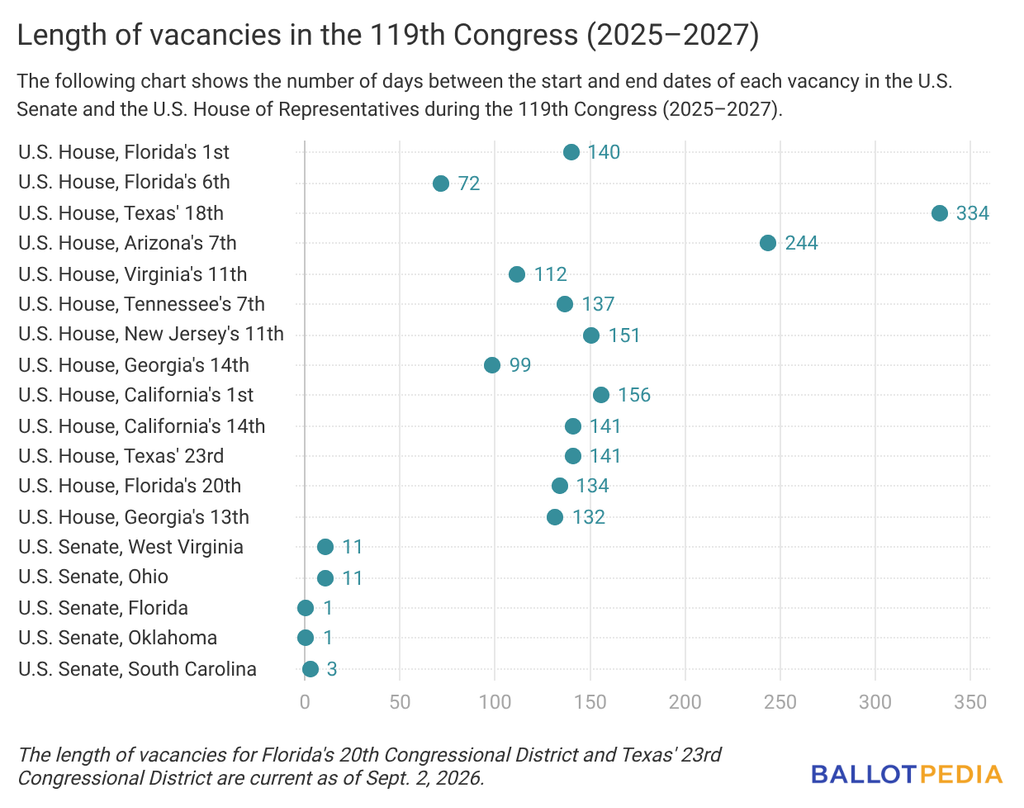
Vacancies in the 119th Congress
So far in the 119th Congress, there have been 13 vacancies in the U.S. House and five in the U.S. Senate. Of those vacancies:
- Four in the U.S. Senate were filled via appointment.
- One in the U.S. Senate was filled when Sen. Jim Justice (R-W.Va.) was sworn into office 11 days after the start of the 119th Congress. Justice delayed his swearing-in in order to fulfill the remainder of his term as governor of West Virginia.
- Eleven in the U.S. House were filled after special election winners were sworn in.
As of Sept. 2, 2026, the vacancies in Florida's 20th Congressional District and Texas' 23rd Congressional District remained unfilled.
Of the 18 vacancies, the longest was in Texas' 18th Congressional District, which became vacant on March 5, 2025, following the death of Rep. Sylvester Turner (D-Texas). The vacancy ended on Feb. 2, 2026, after 334 days.
Congressional vacancies since the 113th Congress
During the 113th through 118th Congresses, there were 88 vacancies in the U.S. House and 16 in the U.S. Senate. The average length of a vacancy in the U.S. Senate during that period was seven days. The average length of a vacancy in the U.S. House during that period was 138 days.
The longest vacancy in the U.S. Senate during that period was in New Jersey. The vacancy occurred during the 118th Congress, when Sen. Bob Menendez (D-N.J.) resigned on Aug. 20, 2024. Following Menendez's resignation, the seat was vacant for 20 days.
The longest vacancy in the U.S. House during that period was in Michigan's 13th Congressional District. The vacancy occurred during the 115th Congress, when Rep. John Conyers, Jr. (D-Mich.) resigned on Dec. 5, 2017. Following Conyers' resignation, the seat was vacant for 359 days.