


Welcome to the Tuesday, Sept. 15, 2026, Brew.
By: Lara Bonatesta
Here’s what’s in store for you as you start your day:
- U.S. House primary candidacies increased in three states after new maps reopened filing deadlines
- Idaho is one of five states in which a U.S. Senate nominee has withdrawn, in year with the most Senate withdrawals in history
- Introducing Ballotpedia's I Voted sticker page
U.S. House primary candidacies increased in three states after new maps reopened filing deadlines
This year, the number of candidates in three states' primaries for the U.S. House of Representatives increased after they reopened their filing deadlines.
Alabama, Louisiana, and Tennessee each adopted new congressional maps after their candidate filing deadlines had passed. Each state then reopened its filing period, giving candidates additional time to file under the new district boundaries. Based on the 2024 presidential election results, each state's new maps would result in Republicans gaining control of one Democratic-held district.
The number of candidates for Alabama's seven districts increased from 25 to 32, resulting in the second-most candidates in the state dating back to 2014.
In Tennessee's nine districts, the number of candidates increased from 36 to 52, resulting in the most candidates in the state dating back to 2014.
In Louisiana, the number of candidates for its six districts increased from 32 to 39, driven mostly by five minor-party and independent candidates. This reflects the state's change back to its majority-vote system, in which all candidates, regardless of party, run on a single ballot rather than in separate party primaries.
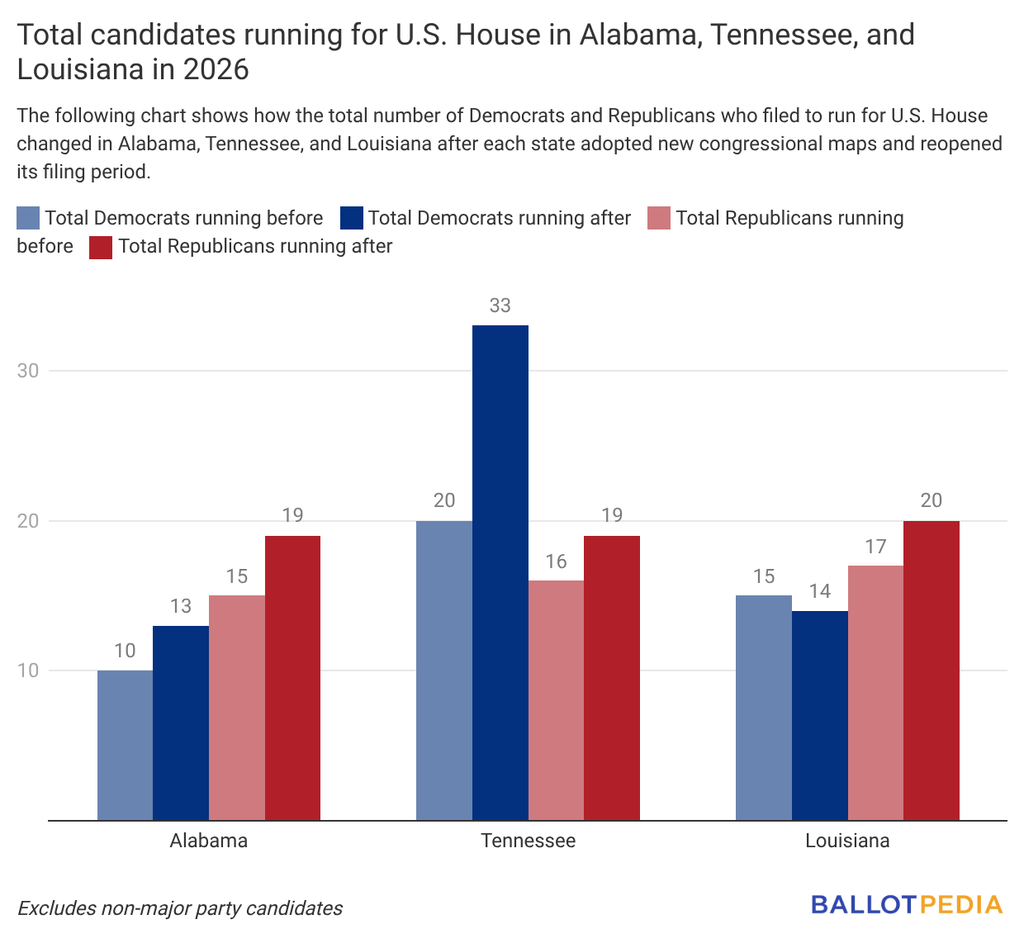
Here's a closer look at how other candidate filing data changed in each state after the deadlines reopened.
Alabama
Alabama moved its filing deadline from Jan. 23 to May 22. Seven more candidates filed to run at the later deadline, increasing the number of contested primaries from six (two Democratic and four Republican) to nine (three Democratic and six Republican.) The number of open districts remained the same at one. The number of incumbents running in contested primaries also remained the same at three Republicans.
The number of Democrats running in Alabama increased from 10 to 13, and the number of Republicans increased from 15 to 19.
The Democratic primary in the 6th Congressional District became contested when the number of Democrats who filed to run increased from one to four. According to the district lines used in 2024, Donald Trump (R) defeated Kamala Harris (D) 69% to 30% in the district. According to the district lines that will be used in 2026, Trump would have defeated Harris 66.8% to 32.1%.
Two additional Republican primaries became contested. In the 2nd Congressional District, where one Republican initially filed, six Republicans filed to run when the deadline reopened. According to the district lines used in 2024, Harris defeated Trump 54% to 45%. According to the district lines that will be used in 2026, Trump would have defeated Harris 56.8% to 42.4%.
In the 7th Congressional District, where no Republicans initially filed, two Republicans filed to run. This means Democrats and Republicans filed to run in all the districts. According to the district lines used in 2024, Harris defeated Trump 61% to 38% in the district. According to the district lines that will be used in 2026, Harris would have defeated Trump 58.5% to 40.7%.
Seven Republicans initially filed to run in the 1st Congressional District, and four filed to run after the filing deadline reopened. According to the district lines used in 2024, Trump defeated Harris 77% to 22% in the district. According to the district lines that will be used in 2026, Trump would have defeated Harris 67.6% to 31.5%.
Tennessee
In Tennessee, contested primaries increased from nine (five Democratic and four Republican) to 12 (eight Democratic and four Republican) after the deadline reopened following redistricting. The filing deadline was March 10 and was reopened until May 15.
The number of Democrats running increased from 20 to 33, and the number of Republicans increased from 16 to 19. Democrats and Republicans filed to run in all districts, both before and after the deadline was reopened.
The number of open districts also increased from one to two after Democratic incumbent Steve Cohen (TN-9) announced his retirement when his district changed from a Solid/Safe Democratic District to a Solid/Safe Republican District, according to major race forecasters. Cohen’s retirement reduced the number of incumbents running in contested primaries from three — one Democrat and two Republicans — to two. Both of the incumbents running in contested primaries are Republicans.
According to the district lines used in 2024, Harris would have defeated Trump 71% to 27% in the 9th Congressional District. According to the district lines that will be used in 2026, Trump would have defeated Harris 59.9% to 38.8%. The number of Democrats running in the district remained the same before and after the deadline reopened, at four. The number of Republicans running increased from two to four.
Louisiana
Louisiana moved its filing deadline from Feb. 13 to Aug. 7. In Louisiana, contested primaries decreased from nine (five Democratic and four Republican) to six. This drop is a result of the state's return to a majority-vote system because there are six primaries out of a possible six rather than nine primaries out of a possible 12.
Due to a law enacted in 2024, Louisiana’s 2026 elections for U.S. House, U.S. Senate, Louisiana Supreme Court, Public Service Commission, and the Board of Elementary and Secondary Education were set to be the first in which Democratic and Republican candidates in the state ran in separate U.S. House primaries scheduled for May 16. On May 14, after the U.S. Supreme Court’s ruling in Louisiana v. Callais, Gov. Jeff Landry (R) signed HB 842. The law moved the state's 2026 U.S. House races from May 16 to the state's majority-vote system election — with the first round on Nov. 3. In future years, U.S. House races will use the semi-closed party primary system.
The number of Democrats running in Louisiana decreased from 15 to 14, while the number of Republicans increased from 17 to 20. The number of incumbents running in contested primaries also increased from three — one Democrat and two Republicans — to four. Among those incumbents are one Democrat and three Republicans. Republican incumbent Clay Higgins (LA-3), who was not running in a contested primary before the deadline reopened, will now face five other candidates.
Democratic incumbent Cleo Fields (LA-6) announced his retirement, bringing the number of open districts from one to two, after his district changed from a Solid/Safe Democratic District to a Solid/Safe Republican District, according to major race forecasters. Fields was initially the only Democrat running in the district. After the deadline reopened, three Democrats filed to run. Four Republicans initially filed to run, increasing to six after the deadline reopened. According to the district lines used in 2024, Harris would have defeated Trump 57% to 42% in the district. According to the district lines that will be used in 2026, Trump would have defeated Harris 64.2% to 34.1%.
As in Alabama, a Republican filed for a district — the 2nd Congressional District — in which no Republicans had filed before the deadline reopened following redistricting. As a result, Democrats and Republicans filed to run in all the districts. According to the district lines used in 2024, Harris defeated Trump 65% to 33% in the district. According to the district lines that will be used in 2026, Harris would have defeated Trump 72.7% to 25.3%.
Click here to learn more about this year's congressional and state-level primaries.
Idaho is one of five states in which a U.S. Senate nominee has withdrawn, in year with the most Senate withdrawals in history

Welcome to our next installment of our 50 states in 50 days series, covering Idaho. To view our archive of past editions, click here.
Idaho is one of five states holding a Senate election this year in which a major or minor party nominee has withdrawn from the general election. Democratic nominee David Roth withdrew on July 28, ahead of the state's Sept. 4 withdrawal deadline. Roth is the first U.S. Senate nominee to withdraw in Idaho.
This year’s total of six Senate nominee withdrawals is the most since the first direct elections of senators took place in 1914. Since then, there have been 41 instances of a nominee withdrawing their bid for the U.S. Senate.
Want to see what’s on your ballot this November? Click here to use our Sample Ballot Lookup Tool. Now let’s take a closer look at what’s happening in Idaho.
Early voting opens Oct. 13 and ends Oct. 30.
Polls open on Election Day at 8:00 a.m. and close at 8:00 p.m.
Voter ID is required. Acceptable forms of ID include an Idaho driver’s license or ID card, a U.S. passport, a tribal ID, and a concealed weapons license. Voters who are unable to present ID may sign a personal identification affidavit swearing to their identity and provide their driver's license number, ID card number, or date of birth. Click here for more information on voter ID in Idaho.
Absentee/mail-in ballots must be requested by Oct. 23 and returned by Nov. 3.
A 2025 law changed the deadline for voters to register online or by mail from the 25th day before the election to 5 p.m. on the 11th day before the election. This year, that date is Oct. 23. Voters may also register at the polls on Election Day.
Current party control
Republicans represent both congressional districts. Both of Idaho’s U.S. Senators are also Republicans.
Republicans have a 29-6 majority in the Idaho Senate and a 61-9 majority in the Idaho House of Representatives. Because the governor is a Republican, Idaho is one of 23 states with a Republican trifecta. Idaho’s attorney general and secretary of state are also Republicans. As a result, Idaho is one of 24 states with a Republican triplex. Republicans appointed four members of the Idaho Supreme Court. One justice joined the court through a nonpartisan election.
Offices on the ballot
Elections are taking place for the U.S. Senate, the U.S. House of Representatives, seven state executive offices, all 35 state Senate seats, and all 70 state House seats.
Idaho is one of 32 states this year in which we are covering all local elections for school boards and municipal offices.
Notable elections
U.S. Senate: Incumbent Jim Risch (R), Matt Loesby (L), Todd Achilles (I), and Natalie Fleming (I) are running. Risch and Achilles lead in media attention, endorsements, and campaign fundraising. As we mentioned in our Sept. 3 edition of the Daily Brew, Risch, 83, is the oldest U.S. Senator running for re-election this year. He first took office in 2009 and previously served as governor, lieutenant governor, and as a state senator. Achilles was a Democratic member of the state House from 2024 to 2025.
On July 28, the Spokesman Review reported that Ada County Democrats sent a letter to Roth on July 8, saying, “We have a real opportunity to defeat Risch, but we’re seriously concerned your campaign isn’t positioned to meet the moment.” Ada County is the state’s most populous county and where Boise is located. On Roth’s withdrawal, Achilles said, “I respect Roth running and making the decision that the campaign just didn’t have the resources it needed to be competitive.” Risch said, “I know people are getting excited all of a sudden because I was running against two Democrats, and now I’m running against one Democrat. I’ve done that all my life.”
Governor: Incumbent Brad Little (R), Terri Pickens (D), John R. Stegner (Unaffiliated), and four others are running. Little first took office in 2019. Previously, he managed his family's farming and cattle operation businesses for 30 years. Pickens, who completed Ballotpedia’s Candidate Connection survey, is an attorney and founding partner of the firm Pickens Law, P.A. Stegner was a judge on the Idaho Supreme Court from 2018 to 2023. Then-Governor Butch Otter (R) appointed Stegner.
Statewide ballot measures
There are four measures on the Idaho ballot this year. Between 1889 and 2025, Idaho voters decided on 229 state ballot measures, an average of three per even year. Of those, voters approved 163 (71%) and defeated 66 (29%).
The Legislature put two of the measures on the ballot, both of them proposed constitutional amendments.
HJR 4 would provide that only the Legislature has the authority to legalize marijuana, narcotics, or other psychoactive substances, removing the ability for citizens to initiate state statutes that would legalize these substances. HJR 4 is one of five ballot measures that would add requirements or restrictions to a state’s initiative and referendum process. It is one of two measures related to marijuana and one of three measures related to drug regulations on statewide ballots this year.
HJR 6 would designate English as the state's official language. While English has been the official language of the state since 2007, it is a statute. The ballot measure would designate English as the official language of Idaho in the state constitution.
Proposition 1 is a citizen-initiated state statute that would provide that, "Every person has the right to reproductive freedom and privacy” and declare that the state can regulate abortion after the point of fetal viability. The initiative would provide for exceptions in cases of a medical emergency, and state that the government can not otherwise interfere with personal decisions about reproductive healthcare. Proposition 1 is one of four statewide measures concerning abortion policy. So far, the measure in Idaho is the only abortion-related measure this year that is a citizen-initiated state statute. Three other states will decide on legislatively referred constitutional amendments, which are more difficult to alter once enacted.
Idaho voters will also weigh in on an advisory question. It will ask voters to select the official state gun of Idaho from six options. In order to designate an official state gun, the Legislature would need to pass a law after the election.
Local ballot measures
We’ll be adding information about local measures in Idaho as they are certified ahead of the Nov. 3 election.
Join us again tomorrow when we'll preview elections in Iowa, the Hawkeye State.
Click here to see every edition of 50 States in 50 Days as we publish them, and here to use our Sample Ballot Lookup Tool.
Nine states are running I Voted sticker contests this year
Ballotpedia has identified nine states running statewide "I Voted" sticker design contests — and many more at the local level.
The "I Voted" sticker is a souvenir handed out to voters across the country as they fulfill their civic duty. The sticker became commonplace sometime in the 1980s, but it is not universal. Distribution varies from state to state and even county to county.
"I Voted" stickers may seem like a routine part of voting, but they serve a purpose. An "I Voted" sticker can promote civic pride in its wearer, serve as an election day reminder for those who have not yet voted, and create social pressure to go to the polls.
Local administrators usually choose and purchase the stickers, so designs vary between and within states. An "I Voted" design may be used for several voting cycles or be a one-time collectible.
To see how your sticker compares to those voters get in other states (or even other cities and counties), check out Ballotpedia's I Voted sticker page.