


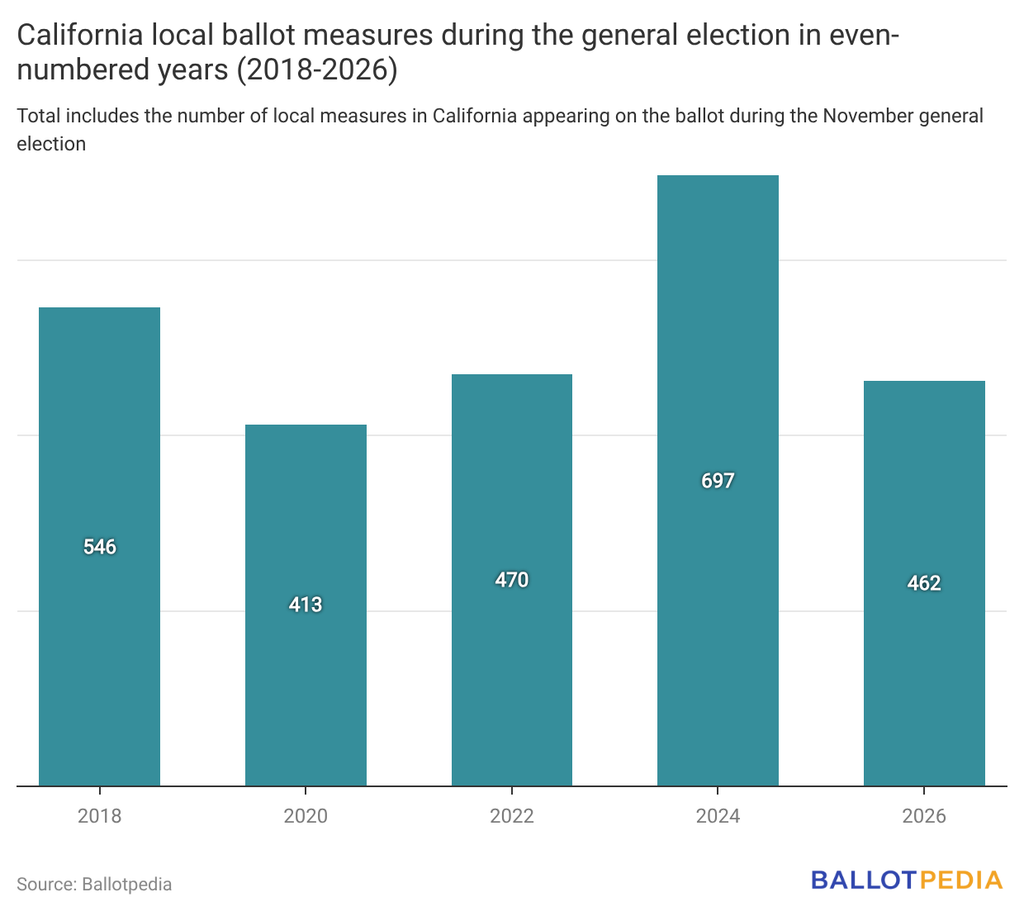
Voters across California will decide on 462 local ballot measures during the general election on Nov. 3, 2026 — the lowest number since 2018. The even-numbered year with the fewest local ballot measures in California during the general election was 2020, at 413.
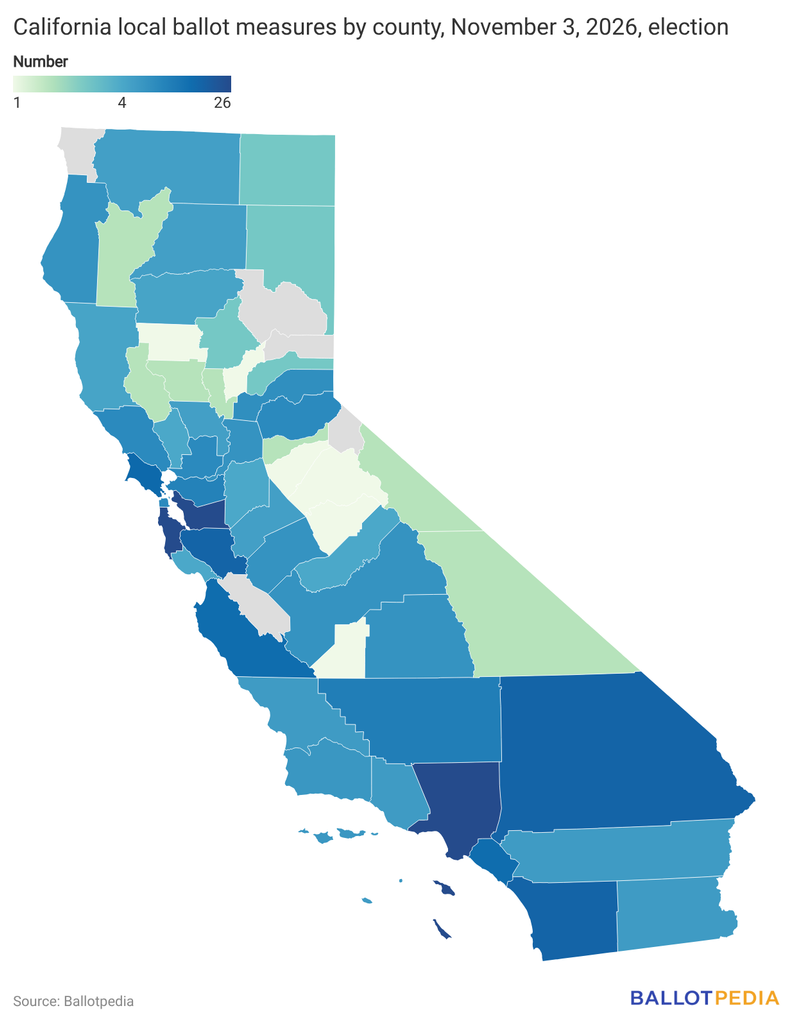
Los Angeles County has the most measures on the ballot, with 68, followed by San Mateo County with 29. The remaining 51 counties have between one and 28 measures. There are no measures on the ballot in the remaining five counties: Alpine, Del Norte, Plumas, San Benito, and Sierra.
Here is a closer look at selected local measures in the state's ten largest cities, along with other notable measures:
Los Angeles
Eight local measures are on the ballot in the city of Los Angeles. Of these, two are related to campaign finance rules in local elections, and one is related to relief for the Palisades Fire in 2025:
- Measure EE would increase the authority of the Police Department Inspector General and the Fire Department Independent Assessor, prohibit ethics commissioners from running for elected office for five years, increase penalties for campaign finance violations, require the city council to meet once per week instead of three days per week, increase the number of signatures required for referendum petitions, "and make other changes regarding ethics, elections and governance."
- Measure SC would clarify campaign finance rules for Board of Education elections and authorize changes to be made by ordinance.
- Measure TE would authorize a one-time exemption from the special documentary transfer tax for residences that were damaged or destroyed by the Palisades Fire and sold within five years.
San Francisco
Ten local measures are on the ballot in the city of San Francisco. Of these, one is related to the local initiative process for ballot measures, and another is related to local appointees:
- Proposition D would eliminate the provision permitting the mayor or four members of the Board of Supervisors to place a measure on the ballot without a vote of the entire board; require 8% of registered voters to sign an initiative petition in order to place a measure on the ballot; require 10% of registered voters to sign a petition calling a special election on the ballot measure; and allow proponents of a ballot measure to withdraw the initiative from the ballot up to 102 days before the election.
- Proposition F would allow nomination boards to recommend one or more names to the mayor for a position, permit appointing officials to remove their appointees in most departments without cause, and permit the mayor to: reorganize executive branch departments; hire deputy mayors; and hire and remove department heads.
San Jose
One measure is on the ballot in the city of San Jose. The measure — Measure A — would increase the city hotel tax from 4% to 6% for general fund services, including police, fire, homelessness response, and park maintenance.
Fresno
One measure is on the ballot in the city of Fresno. The measure — Measure D — would establish a 0.5% city sales tax to generate an estimated $65 million annually for general city services, lasting for 10 years or until the county adopts a transportation sales tax of an equal or higher rate that benefits the city, whichever occurs first.
Oakland
Two measures are on the ballot in Oakland, one on property tax transfers and the other on the powers of the mayor and city council.
The latter measure, Measure EE, would change the city's form of government to a mayor-council system and make the mayor the city's chief executive officer. Under the measure, the mayor would have the authority to veto ordinances and resolutions passed by the city council, with the council authorized to override vetoes with at least six votes. Additionally, the mayor would oversee city departments, agencies, and appointed offices, while the city council could confirm department heads, hold legislative hearings, and issue subpoenas.
Other ballot measures
In Alhambra, Measure DB would amend the city municipal code to prohibit data centers citywide. The measure defines a data center as "facilities used primarily for analyzing, processing, storing, converting, transmitting, distributing, and managing electronic data for on-site or off-site use." Earlier this year, voters in the city of Monterey Park, California, decided on Measure NDC, which also prohibited data centers within its jurisdiction. Measure NDC was approved by voters on June 2, 2026, receiving 88.3% of the vote.
In Berkeley, voters are deciding on Measure AA and Measure Z. Measure AA would replace the existing $0.01-per-fluid-ounce general tax on sugar-sweetened beverage distribution with a $0.02-per-fluid-ounce special tax dedicated to public health, nutrition, and drinking water accessibility programs, retaining existing exemptions, until repealed by voters. Measure Z would establish a six-year parcel tax of $0.06 per square foot of residential improvements and $0.09 per square foot of nonresidential improvements to capitalize and support a public bank financing affordable housing, green energy and infrastructure, and small businesses.
In Culver City, Measure YV would lower the voting age to 16 for city and school district candidates and ballot measures. Currently, the voting age is 18, but 17-year-olds can pre-register to vote.
Additional reading: