


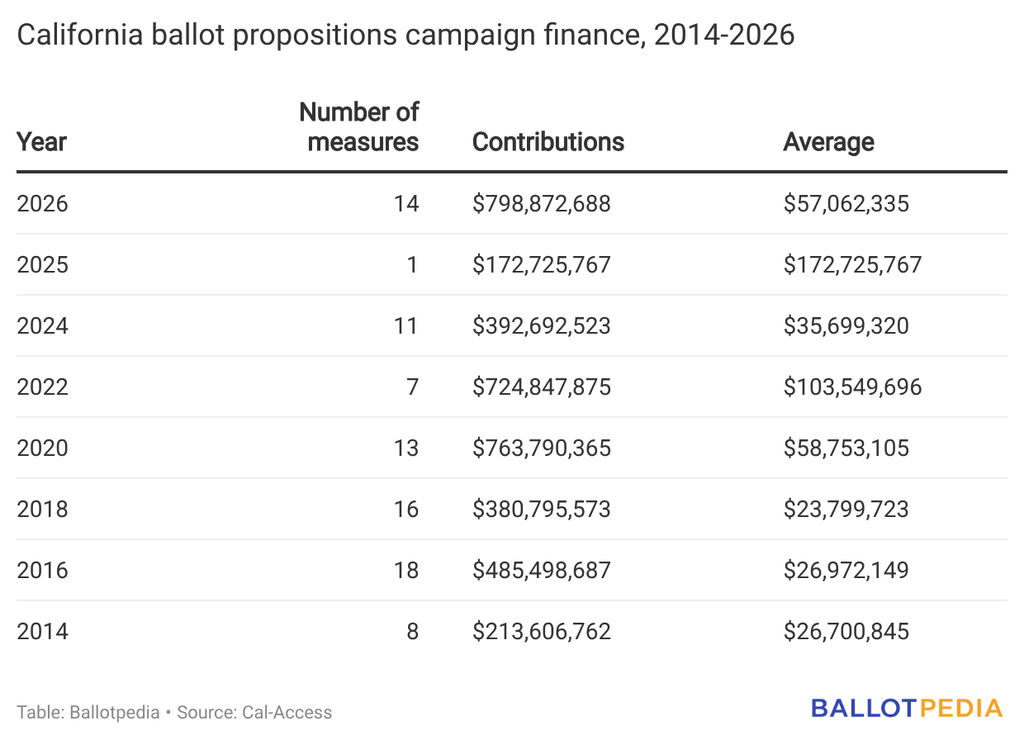
Voters in California will head to the polls to decide 14 ballot propositions on Nov. 3. According to the most recent campaign finance filings submitted Oct. 22, 44 committees reported $798.9 million in contributions — the most on record. The next most expensive year was 2020, which saw $763.7 million.
Campaigns surrounding Proposition 40, the SEIU-UHW-sponsored wealth tax, and the competing measures challenging it on the ballot, Propositions 41 and 42, account for about 45% of that total. Across the three measures, campaigns received more than $360 million in cash and in-kind contributions — putting the measures collectively in the top 10 most expensive ballot measure campaigns in California’s history. The most expensive measures in California were Propositions 26 and 27 in 2022, which would have legalized sports betting in the state. Campaigns raised over $463 million supporting and opposing the issue.
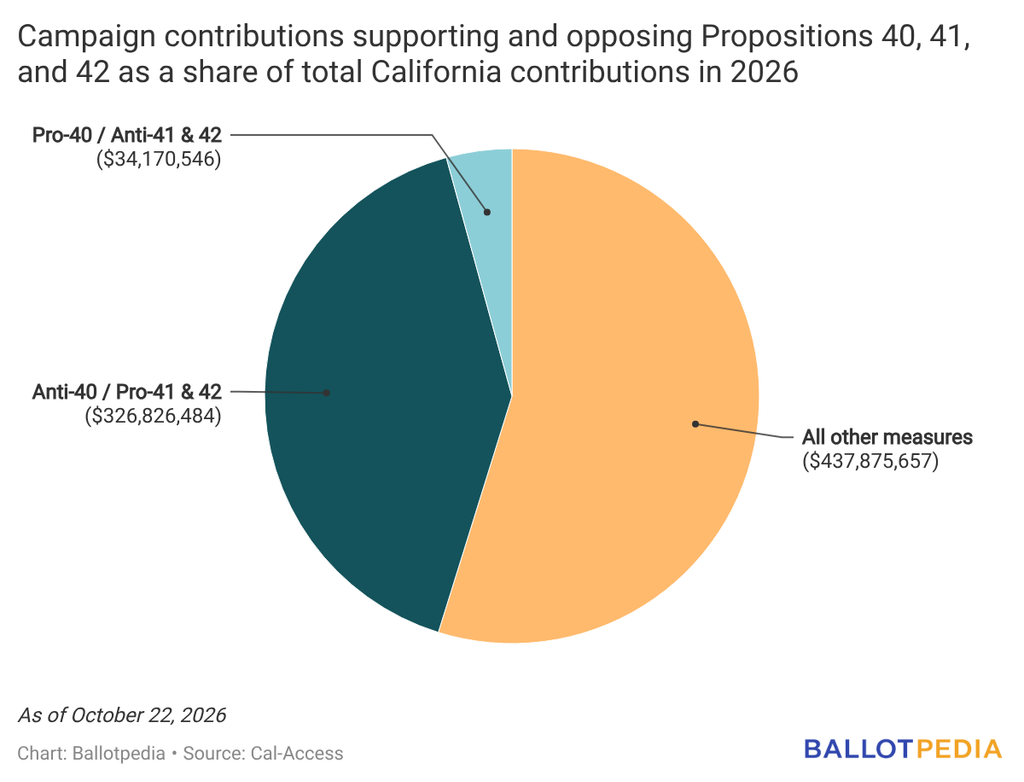
Proposition 40 would levy a 5% wealth tax on the state’s billionaires. Proposition 41 would prohibit excluding new state taxes from the state’s spending limit, which Proposition 40 authorizes, and require special financial and performance audits for tax initiatives. Proposition 42 would prohibit new taxes on retirement holdings, personal assets, and savings.
Opponents of Proposition 40 have outraised proponents 4-to-1. The greatest share of opposition funding was reported by Building a Better California ($333.1 million in cash and in-kind contributions). It registered to support Propositions 1, 37, 41, 42, and 45 and to oppose Proposition 40. The contributions were allocated to other committees supporting or opposing those measures. The top three donors to Building a Better California were Google co-founder Sergey Brin ($102 million), former Google CEO Eric Schmidt ($40.2 million), and L. John Doerr III ($40 million).
Eric Schmidt, a top donor to Building a Better California, which also contributed to the Proposition 45 support campaign, is on the opposite side of the measure from his wife, Wendy Schmidt, who contributed $10 million to the No on Prop 45 campaign. Proposition 45 would make changes to the California Environmental Quality Act (CEQA).
The measure with the closest parity in campaign finance between supporting and opposing sides was Proposition 39, which would require voters to present government-issued identification when casting ballots. The two committees registered in support of the measure reported $39.5 million, while the 10 committees registered in opposition to the measure reported $33.3 million.
Campaigns supporting Propositions 3 and 38 saw the least raised in opposition among measures with registered committees. Proposition 3 would indefinitely extend the top marginal tax rates (ranging from 10.3% to 12.3%) set to expire in 2031, with revenue dedicated to public education. Seven committees registered to support Proposition 3, reporting more than $74.8 million. The top donor to the campaign was the California Teachers Association with $53.8 million in cash and in-kind contributions. One committee, No on Proposition 3, registered in opposition and reported $5,500 in contributions.
Proposition 38 would authorize $8.4 billion in general obligation bonds to fund immunology and immunotherapy research. One committee, funded by Gary K. Michelson, founder of the Michelson Medical Research Foundation, registered in support of the initiative and reported $71.3 million in contributions. The opposition committee reported over $9,900 in contributions from small donors.
Two measures, Propositions 2 and 5, did not have any primary ballot measure committees registered to support or oppose the measures. Proposition 2 would make changes to the state’s Budget Stabilization Account, and Proposition 5 would eliminate the successor election when a state officer is recalled.
To read more about the 14 ballot propositions on the Nov. 3 ballot, click here.