


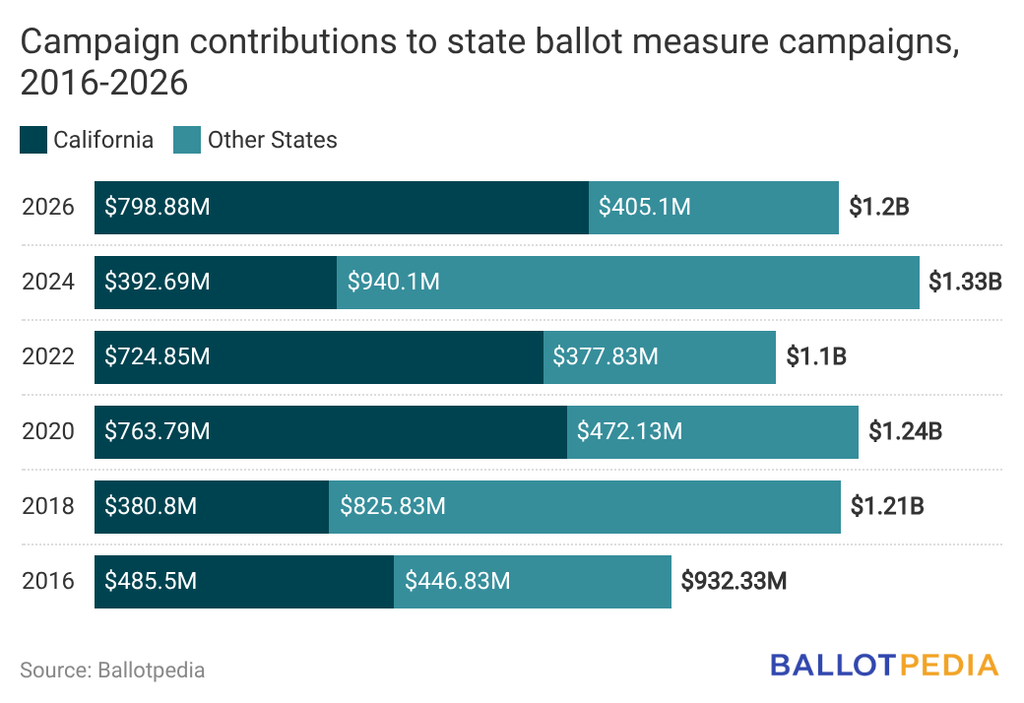
Campaigns supporting and opposing the 164 statewide ballot measures in 2026 raised more than $1.2 billion. Initiative campaigns spent a record $193 million on signature gathering.
Campaign finance
Here's a look at the five states whose ballot measures raised the most as of Oct. 26, 2026:
- The 14 measures in California raised $798.9 million, or over 66% of the 2026 total
- The four measures in Virginia raised $107.6 million, or 8.9%
- The nine measures in Missouri raised $67.9 million, or 5.6%
- The 14 measures in Colorado raised $43.1 million, or 3.6%
- The two measures in Kansas raised $29.4 million, or 2.4%
In 2024, the top three states were California (29.5%), Florida (24.3%), and Missouri (8.2%). In 2022, the top three states were California (65.8%), Michigan (9.3%), and Massachusetts (6.5%).
The two most expensive campaigns in 2026 were both in California.
Proposition 40, which would levy a one-time 5% tax on accumulated wealth to fund state health care, food assistance, and public education programs, was the most expensive campaign. Those supporting the measure raised $33.2 million, and those opposing it raised $140.5 million. The Service Employees International Union (SEIU) - United Healthcare Workers West was the largest donor in support of the measure, contributing $32 million. Sergey Brin, a co-founder of Google, was the top donor to the opposition campaign, contributing $102 million.
Proposition 42, which would ban new taxes on retirement funds, personal assets, and savings beginning Jan. 1, 2026, and prohibit certain retroactive taxes, was the second-most expensive campaign. Those supporting the measure raised $138.5 million, and those opposing it raised $34.2 million. Sergey Brin was the largest donor in support of the measure, contributing $102 million. The SEIU - United Healthcare Workers West was the top donor to the opposition campaign, contributing $32 million.
Signature drives
Since 2010, Ballotpedia has tracked signature costs for ballot initiative campaigns, with 2026 recording the highest total spending to date. A ballot initiative is a citizen-initiated ballot measure. Signatures are collected to place the proposals on the ballot. In 2026, the average cost-per-required-signature (CPRS) decreased to $13.51, down from $14.87 in 2024. However, the total cost for signature gathering rose to a record high of $193.4 million, up from $172.2 million in 2024.
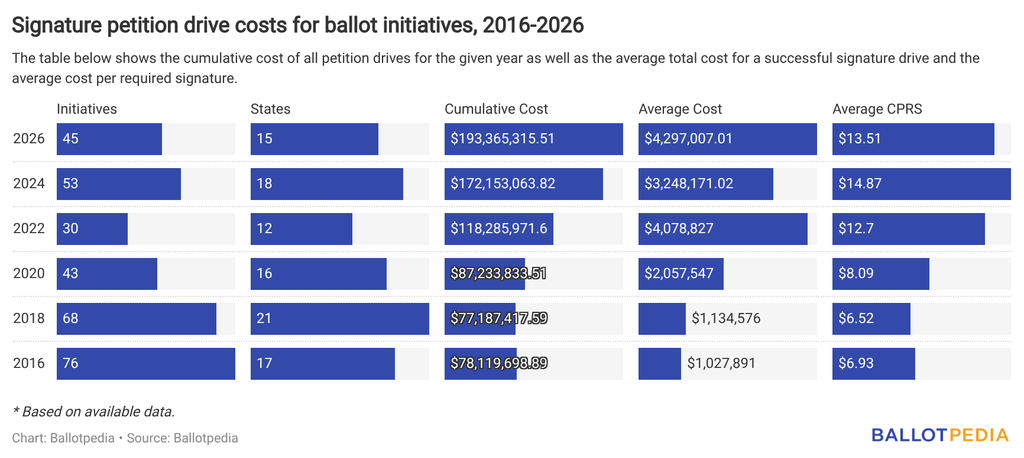
The CPRS ranged from $0 for volunteer efforts to $51.10 for Nebraska Initiative Measure 441, which would authorize online sports betting in the state.
In 2026, 53 citizen-initiated measures were certified for the ballot. This analysis includes 45, as signature cost data was unavailable for six initiatives in Colorado, one initiative in Alaska, and one initiative in Missouri.
The average cost of a successful signature drive this year was $4.3 million — increasing from the average of $3.25 million in 2024 and surpassing the record-high average of $4.08 million in 2022.
The signature-gathering process varies across the 26 states that allow citizen-initiated ballot measures. Each state differs in requirements, such as the number of signatures needed, circulation period lengths, and regulations for signature gatherers. Ballotpedia uses two methods to measure the cost of a petition drive — the total cost and cost-per-required-signature (CPRS).
- The total cost refers to the amount spent to gather enough signatures to qualify an initiative for the ballot.
- The cost-per-required-signature (CPRS) is the total amount spent on gathering signatures divided by the number of signatures needed to qualify the measure. CPRS allows for comparisons of signature-gathering costs across states. For example, if a campaign spends $1 million on a petition drive in a state requiring 100,000 signatures, its CPRS would be $10, meaning $10 per required signature. If the same amount were spent, but 200,000 signatures were required, the CPRS would be $5.
Of the $1.2 billion raised by campaigns supporting and opposing measures as of Oct. 26, 2026, the $193.4 million spent on signature drives represents 16.1% of the total contributions.
Campaigns for all nine initiatives in California spent a combined $152.7 million on signature-gathering efforts, accounting for approximately 79% of all petition drive costs in 2026.
A total of $32.3 million was spent on signature gathering for California Proposition 42, making it the most expensive signature drive of 2026.
Campaigns for five initiatives — Montana I-194, Oregon Referendum 120, Idaho Proposition 1, Wyoming Initiative 1, and Massachusetts Question 9 — used volunteers for signature gathering, resulting in a total cost of $0.
From 2016 to 2026, there were a total of 323 initiatives on the ballot. Campaigns for these initiatives spent a cumulative $728.4 million on signature-gathering drives.
Additional reading: