


Candidate results show who voters chose to hold office. Ballot measure results show how voters decided specific policy questions. Voters can elect a candidate while approving a policy the candidate opposes or rejecting one the candidate supports.
For example, in Nevada, voters approved Question 6, a constitutional right to abortion, with 63.2%, and Question 7, a voter identification requirement, with 62.4%.
Attorney General Aaron Ford (D), who supported Question 6 and opposed Question 7, won the governor’s race with 51.5%. Incumbent Gov. Joe Lombardo (R), who opposed Question 6 and supported Question 7, received 44.2%. Voters elected Ford and approved Question 7, which he opposed.
The following analysis compares statewide ballot measure and candidate results across five policy areas: income and wealth taxes, voter ID, abortion, sex-based requirements for school sports and medical procedures for transgender minors, and criminal justice.
For each state, we compared the governor’s race or, where there was none, the U.S. Senate race. Indiana and Missouri had neither, so we used the secretary of state's race and state auditor’s race, respectively. Washington had no partisan statewide elections.
Results are unofficial and current as of Nov. 5, 2026.
Income and wealth taxes
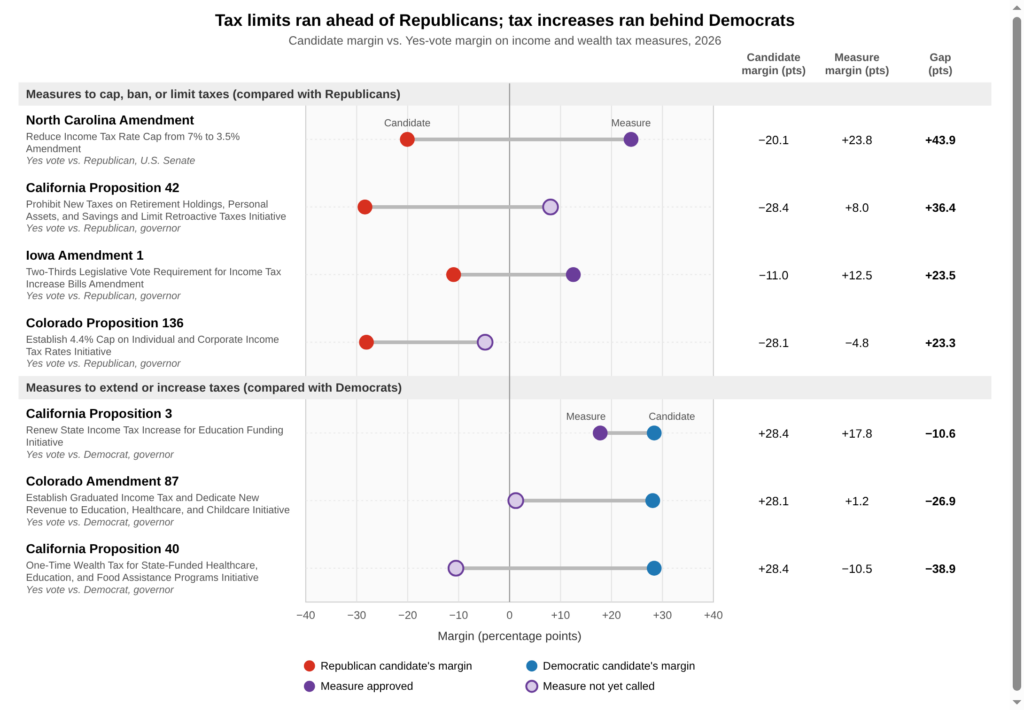
In California, Colorado, Iowa, and North Carolina, measures to limit income or wealth taxes received more support than the Republican candidates in the comparison races. Proposals to raise or extend these taxes in California and Colorado received less support than the Democratic candidates. Democrats won every comparison race: the governor's races in California, Colorado, and Iowa, and the U.S. Senate race in North Carolina.
Iowa voters approved Amendment 1, a two-thirds legislative vote requirement for income tax increases, and North Carolina voters approved an amendment to lower the state's income tax rate cap from 7% to 3.5%. Two other measures remained too close to call: California's Proposition 42, which would restrict new taxes on retirement holdings, personal assets, and savings, and Colorado's Proposition 136, which would cap income tax rates at 4.4%.
California voters also approved Proposition 3, extending an income tax increase for education. The state's proposed one-time wealth tax (Proposition 40) and Colorado's proposed graduated income tax (Amendment 87) remained too close to call.
Washington voters rejected Initiative 645, which would have repealed the tax on household income over $1 million. Washington, a Democratic trifecta, had no governor's or U.S. Senate race for comparison.
Voter ID
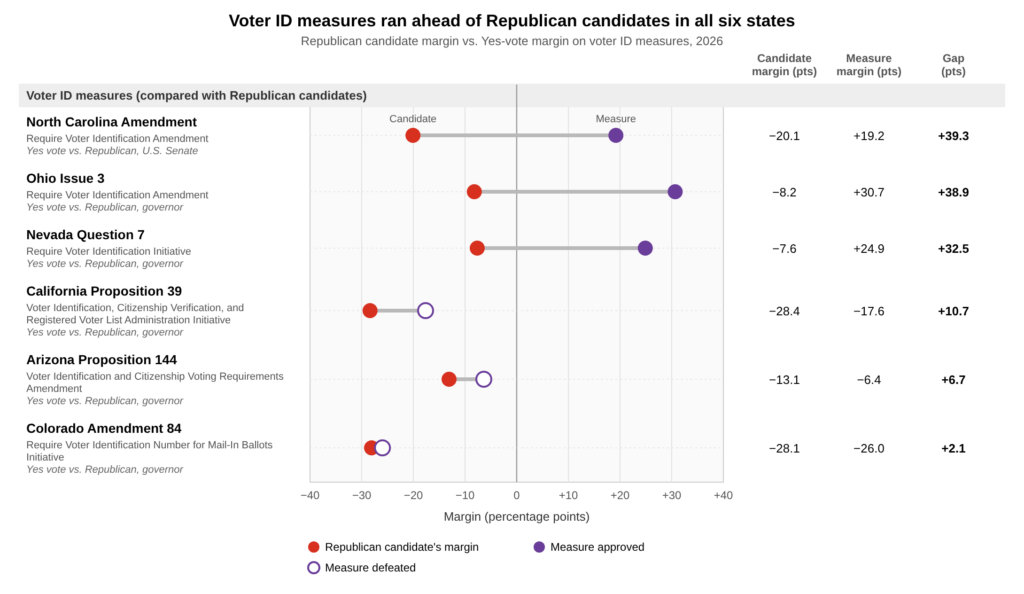
Voter identification measures received more support than the Republican candidates in all six states with comparison races. Democrats won each of those races, while the voter ID measures passed in three states and failed in three.
Voters approved identification requirements in Nevada, North Carolina, and Ohio. They rejected measures in Arizona, California, and Colorado.
Abortion policy
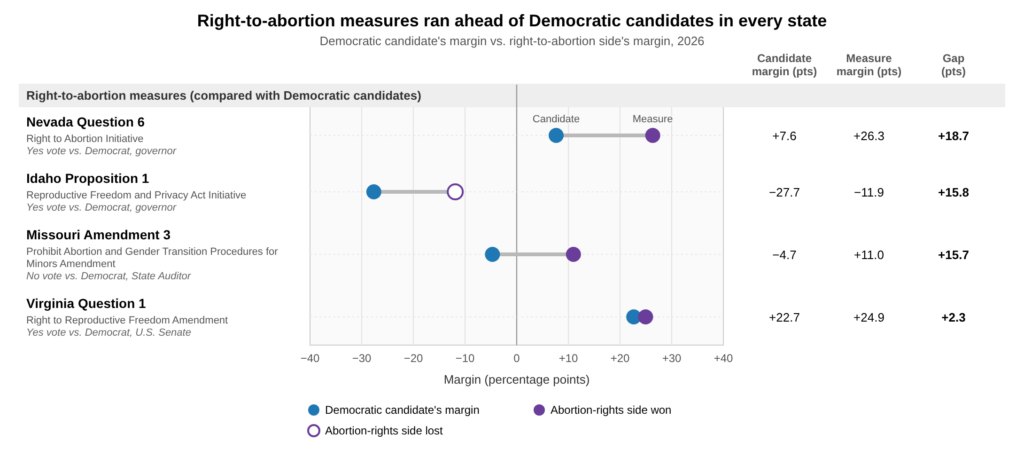
In all four states that decided abortion measures in 2026, the right-to-abortion position received a larger vote share than the Democratic candidate in the comparison race, whether that ballot measure won or lost.
Voters approved constitutional amendments establishing state constitutional rights in Nevada and Virginia and defeated a citizen-initiated statute in Idaho. Missouri voters rejected an amendment that would have repealed the constitutional right to reproductive freedom approved in 2024, prohibited abortion with exceptions, and prohibited gender transition surgeries and certain other procedures for minors.
Sex-based requirements for sports and medical procedures for transgender minors
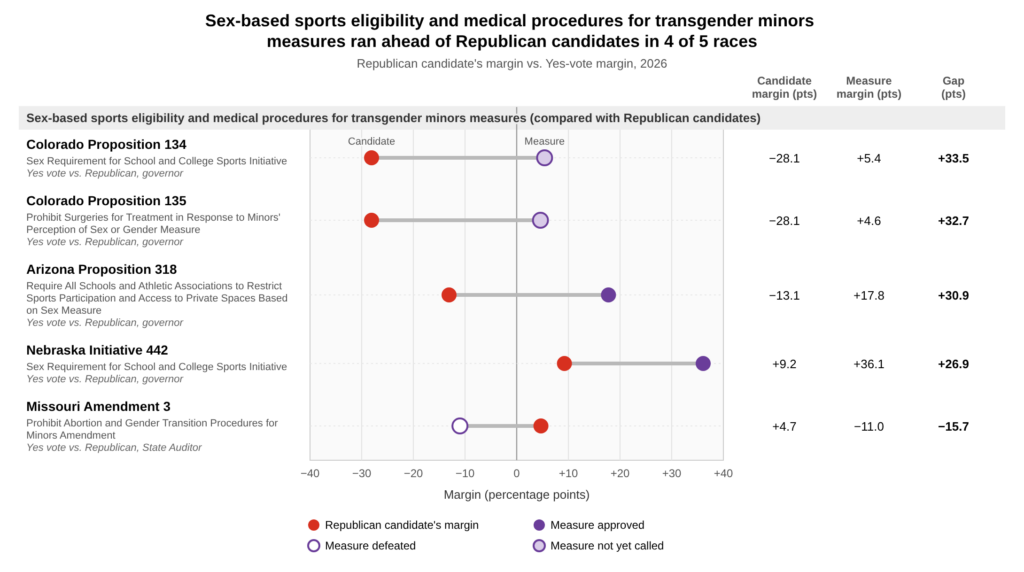
Voters in five states decided six measures in 2026 on sex-based requirements for school sports and restrictions on certain medical procedures for transgender minors.
Measures in Arizona, Colorado (Proposition 134 and Proposition 135), and Nebraska received more support than the Republican candidates in the comparison races. Missouri's Amendment 3, which also addressed abortion, received less support than the Republican candidate. Democrats won the races in Arizona and Colorado; Republicans won in Nebraska and Missouri.
In Washington, voters approved Initiative 638, which requires schools and interscholastic organizations to “prohibit biologically male students from competing with and against female students” in female-designated sports and to require healthcare-provider documentation verifying participants’ sex. Washington, a Democratic trifecta, had no governor's or U.S. Senate race for comparison.
Criminal justice and immigration enforcement
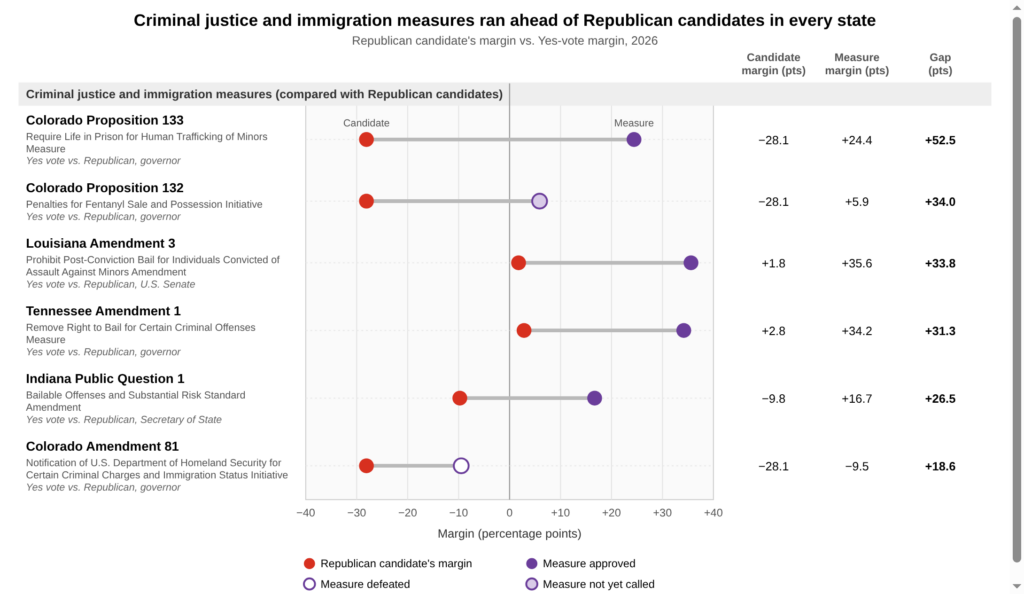
Measures to increase criminal penalties or expand the circumstances for denying bail received more support than the Republican candidates in all four states with comparison races: Colorado, Indiana, Louisiana, and Tennessee.
Colorado voters approved Proposition 133, requiring life in prison for human trafficking of minors. Proposition 132, which would increase penalties for fentanyl sale and possession, remained too close to call. Voters in Indiana, Louisiana, and Tennessee approved amendments expanding the circumstances in which courts could deny or restrict bail.
Colorado voters also rejected Amendment 81. It would have required law enforcement to notify the U.S. Department of Homeland Security after charging someone who was unlawfully present in the country if the charge involved a crime of violence or the person had a prior felony conviction. The amendment received 45.3% of the vote, compared with 34.0% for the Republican candidate for governor.
Additional reading: