


Welcome to the Monday, Nov. 23, 2026, Brew.
By: Briana Ryan
Here’s what’s in store for you as you start your day:
- How states are responding to new Medicaid eligibility rules for noncitizens
- Montana and Ohio supreme courts face possible ideological shifts
- Massachusetts voters will decide a veto referendum on the 2028 ballot, the first ballot measure concerning abortion policy in the state since 1986
How states are responding to new Medicaid eligibility rules for noncitizens
In response to federal changes related to noncitizens' eligibility for Medicaid, Democratic states were more likely to provide state-funded coverage for affected noncitizens, while Republican states were more likely to implement additional steps to verify or report on beneficiaries’ immigration status.
On Oct. 1, new Medicaid eligibility rules took effect that made certain noncitizens ineligible to receive federally funded care through Medicaid. The changes were enacted as part of the One Big Beautiful Bill Act (OBBBA), which President Donald Trump (R) signed on July 4, 2025.
States were required to implement changes by updating eligibility systems, redetermining eligibility, and notifying affected noncitizens by Oct. 1. Beyond these federal requirements, some states took additional actions, such as providing state-funded coverage to affected noncitizens, conducting more extensive outreach, or implementing supplemental procedures to verify beneficiaries' citizenship status.
Ballotpedia research found that the majority of states did not take additional action beyond implementing federal requirements, except in the case of outreach where 31 states took at least one additional step to contact or notify affected noncitizens. Eight states — including six Democratic trifectas — provided state-funded coverage for affected noncitizens. A similar number of states — ten, including eight with Republican trifectas — implemented additional verification procedures or requirements to report instances where the state could not verify an individual's citizenship status to the federal government.
New rules limit the noncitizen categories eligible for Medicaid
Medicaid is a joint federal-state program that provides health coverage primarily for low-income individuals and families. Funding comes from states and the federal government Medicaid, but states administer their own programs within a broad set of federal rules. As of June 2026, roughly 66 million people were enrolled in Medicaid, according to the Centers for Medicare and Medicaid Services (CMS).
Section 71109 of the OBBBA eliminated federal matching funds for full Medicaid coverage for many lawfully present noncitizens.
Under the Oct. 1 changes, states can now generally offer Medicaid only to lawful permanent residents (such as green card holders), Cuban and Haitian immigrants, and individuals admitted as part of the Compacts of Free Association (COFA). Green card holders are eligible following a five-year-waiting period. Federal funding for lawfully residing pregnant women and children remains available, but generally only in states that have chosen to cover one or both groups under section 214 of the Children’s Health Insurance Program Reauthorization Act of 2009 (CHIPRA 214).
The following noncitizens generally no longer qualify for federally funded Medicaid (this list is not exhaustive):
- Refugees
- Asylees
- Certain victims of sex or labor trafficking
- People with special immigrant visas from Iraq or Afghanistan
- Amerasian entrants
There is no national estimate for the affected population, but nine states and D.C. told KFF Health News that they expected more than 281,000 noncitizens could be ineligible for Medicaid as a result of the change.
States have the option of using their own money to cover some or all of the newly ineligible populations of noncitizens. Regardless of their immigration status, noncitizens can still receive emergency medical care through Emergency Medicaid in all 50 states.
State responses
Ballotpedia examined state responses to the Oct. 1 eligibility changes by asking three questions: (1) Did states act to replace Medicaid with state-funded coverage for at least some affected noncitizens? (2) Did states adopt new or expanded protocols for verifying or reporting on enrollees’ or applicants’ immigration statuses that went beyond the federal requirements? (3) Did states go beyond the federal requirements for communicating the Oct. 1 changes to affected populations?
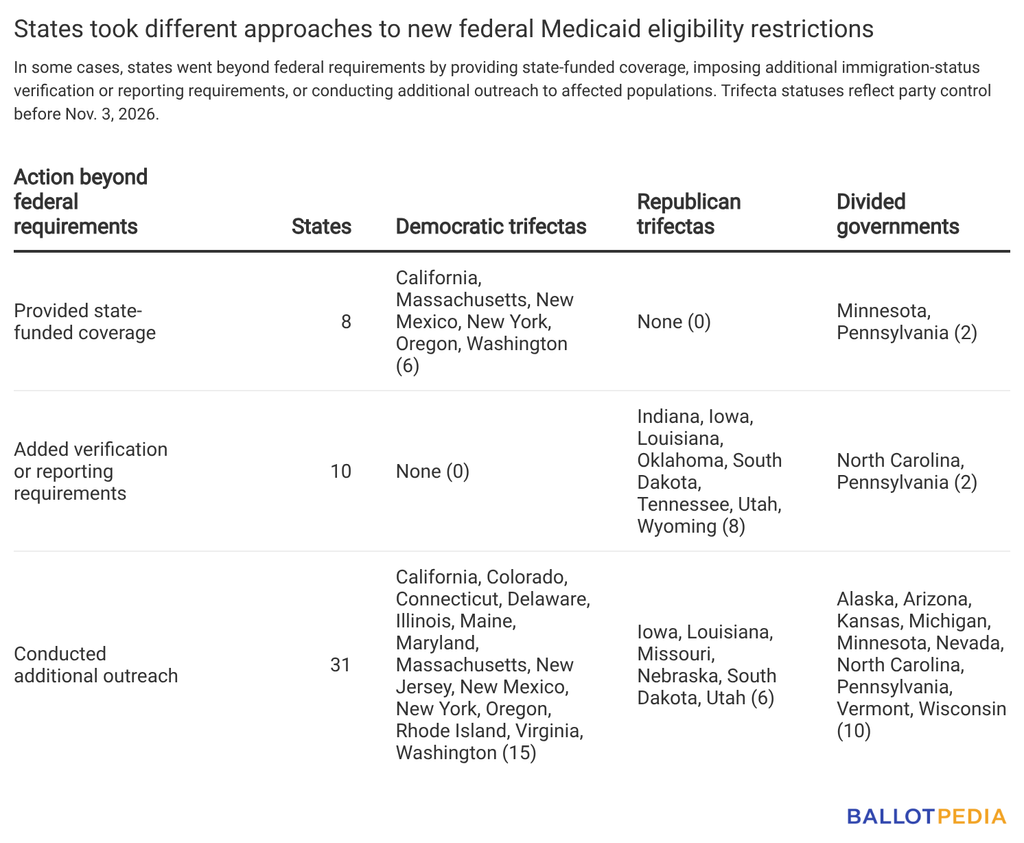
Eight states were providing coverage to some or all newly ineligible immigrants through state-funded programs. Six of the states had Democratic trifectas and two had divided governments. Accounting for the 2026 midterm elections, all eight will have Democratic trifectas in January when new and re-elected lawmakers are sworn in.
Ten states, including eight that had Republican trifectas, implemented verification or reporting requirements, or both, above and beyond the ones required by the federal government.
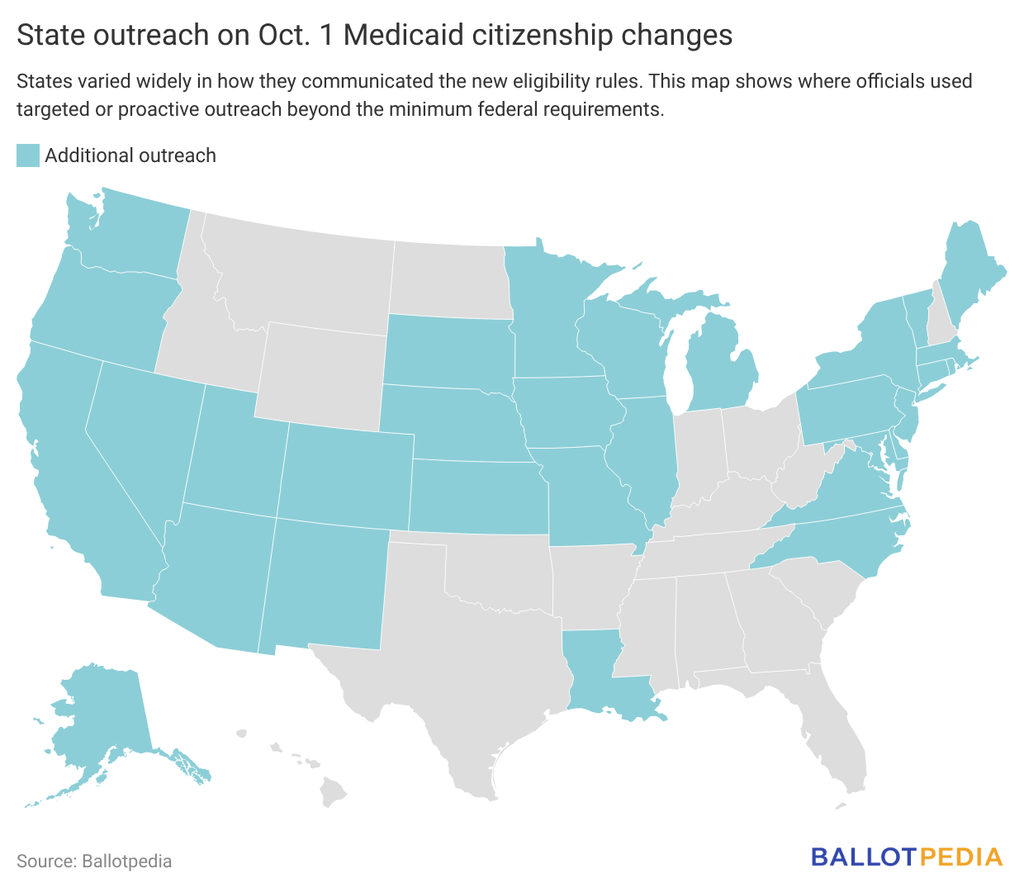
Thirty-one states engaged in outreach that went beyond the federal minimum requirements to affected populations in the run-up to the Oct. 1 deadline. That outreach included mailers, emails, text messages, video outreach, webinars, and public events. Fifteen of the 31 states had Democratic trifectas, six had Republican trifectas, and 10 had divided governments.
State-funded replacement coverage
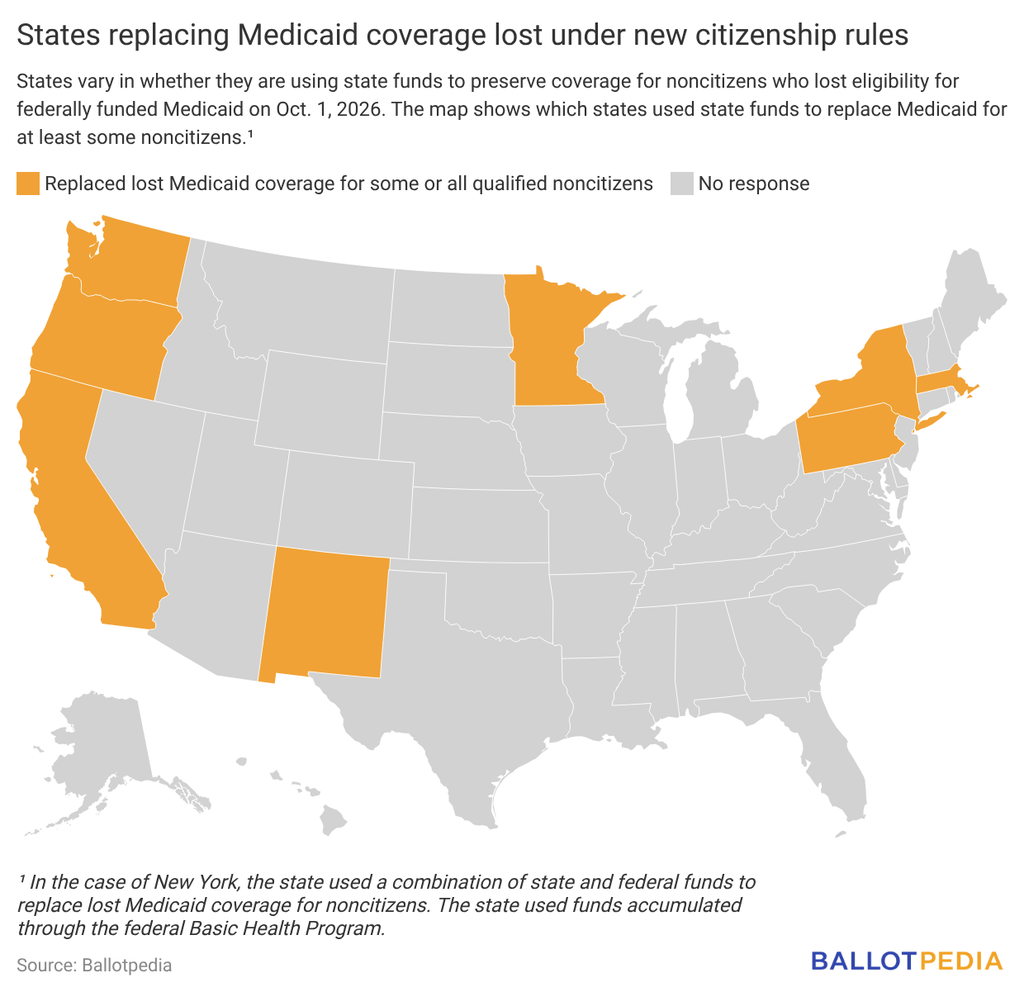
Federal Medicaid dollars can't cover certain noncitizens, but states can use their own funds to replace the coverage for some or all affected beneficiaries. At least eight states did so.
Most or all affected noncitizens
- California, Oregon, New Mexico, New York
- California is fully replacing coverage through June 2027. After that, some people will pay a premium to keep full coverage, and others will move to emergency and pregnancy-related coverage only.
- New Mexico created a new program through BeWell, the state's health insurance exchange.
Narrower groups
- Massachusetts: Placed adults 65 and older and adults with disabilities into MassHealth Family Assistance, a state-funded plan.
- Pennsylvania: Moved noncitizens receiving Supplemental Security Income to a state-funded plan.
- Washington: Appropriated about $18 million for the Limited Benefit Community Access Program, which covers long-term services and supports patients.
- Minnesota: The state is providing state-funded coverage to narrower groups of noncitizens.
Verification and reporting
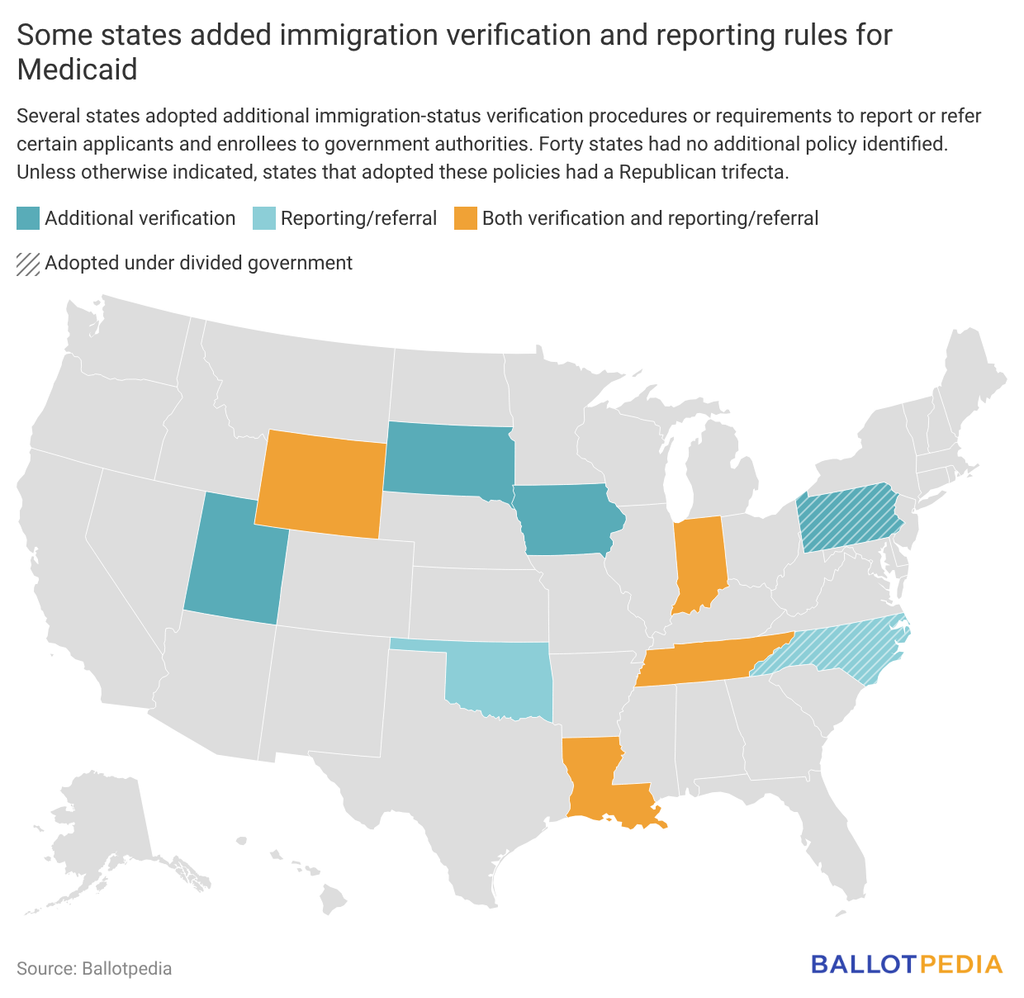
CMS requires states to check immigration status through the federal SAVE database and to ask the individual for more information when SAVE isn’t enough. At least four states added their own verification policies, two added policies on sharing information with the federal government, and four did both.
Verification and federal reporting
- Louisiana: Gov. Jeff Landry (R) signed SB 194 on June 1, 2026. It took effect Aug. 1.
- SB 194 writes the OBBBA’s narrower eligibility categories for Medicaid, SNAP and other public benefits into state law.
- The state can’t extend the federally required 90-day reasonable opportunity period, and it can’t grant additional opportunity periods when eligibility can’t be verified.
- State agencies must report individuals without a qualifying immigration status to ICE.
- Indiana: Gov. Mike Braun (R) signed SB 1 on March 4, and it took effect Oct. 1. It requires the state to verify the citizenship or immigration status of all Medicaid applicants, beneficiaries and identified household members. The state must alert the Department of Homeland Security when a person’s status can’t be established after an opportunity period, or when the person entered the country illegally or overstayed a visa.
Verification only
- Pennsylvania: A March 3 Department of Human Services policy requires County Assistance Offices to check noncitizens’ immigration status when they apply for Medicaid, report a status change or renew coverage. Offices use the federal Verify Lawful Presence platform first and SAVE if that fails. Before this, they only had to verify status when a change was reported or expected.
Outreach
At least 31 states went beyond the federal guidelines in how they told affected noncitizens about the new eligibility rules. Depending on the state, outreach included several rounds of targeted contact, webinars, videos, translation services, and partnerships with local nonprofits that serve immigrants.
Federal requirements
- CMS guidance: “States must attempt to redetermine satisfactory immigration status without the involvement of the beneficiary, if possible, and must contact the beneficiary if they are unable to reverify the satisfactory immigration status without additional information.”
- Notice: Federal law requires states to give affected beneficiaries at least 10 days’ notice before ending their coverage.
- Reasonable opportunity period: People who respond with evidence of eligibility that the state can’t verify keep their coverage for 90 days while verification is pending.
State examples
- Rhode Island: The Executive Office of Health and Human Resources, which runs the state’s Medicaid program, notified “noncitizens who may be impacted by these changes through mailed notices, digital notices in HealthyRhode accounts, emails, and text messages.” The state sent its first set of notices in multiple languages in July 2026.
- Vermont: The Department of Vermont Health Access used several kinds of outreach.
- Vermont sent notices in English, Arabic, Dari, French, Nepali, and Spanish to people whose eligibility couldn’t be established.
- Vermont partnered with the nonprofit Vermont Justice Language Project on a multilingual video explaining the Oct. 1 changes.
- Vermont also launched a webpage listing resources and options for noncitizens who are no longer eligible.
- Iowa: The Iowa Department of Health and Human Services published a Q&A guide to the Oct. 1 changes for refugee resettlement groups, healthcare providers, organizations serving refugees, and community agencies. It also created a checklist to help refugees and other newcomers understand and navigate the changes, along with resources for finding other care options.
Click here for more information on the implementation of Medicaid provisions from the One Big Beautiful Bill Act.
Montana and Ohio supreme courts face possible ideological shifts
On Nov. 3, voters in Montana and Ohio decided elections for their state supreme courts, setting up possible ideological shifts on both courts in the coming years.
In Montana, the court's 4-3 liberal majority will be on the ballot again in 2028. In Ohio, Governor-elect Amy Acton (D) could appoint as many as two justices to the court, which will have a 5-2 Republican majority once its newly elected Democratic justice is sworn in.
Two Montana Supreme Court seats are up in 2028
Amy Eddy defeated Republican-endorsed Dan Wilson 59% to 41% in this year's Montana Supreme Court election. The races for the court are officially nonpartisan, but Bolts described Eddy as a liberal and Wilson as a conservative. Eddy will succeed retiring Justice Beth Baker, who is part of the court's liberal bloc.
As a result, the court will keep its 4-3 liberal majority for at least two more years. Justices Jim Shea and Laurie McKinnon are up for re-election in 2028. Shea is part of the court's liberal bloc, and McKinnon is part of its conservative bloc.
Depending on the results, the court could stay as it is, move to a 5-2 liberal majority, or become a 4-3 conservative majority.
Two Ohio Supreme Court justices are approaching mandatory retirement age
Both Democratic candidates won in this year's Ohio Supreme Court elections. Justice Jennifer L. Brunner (D) defeated Colleen O'Donnell (R) 51.4% to 48.6%. Meanwhile, Marilyn Zayas (D) defeated incumbent Justice Dan Hawkins (R) 51% to 49%. As a result, the court's Republican majority decreased from 6-1 to 5-2.
However, this year's gubernatorial election may further change the court's ideological makeup. Acton defeated Vivek Ramaswamy (R) 52.3% to 44.4%. As a result, she will be able to fill any court vacancies during her term, which runs to January 2031.
Justices Pat Fischer and Joseph Deters will reach the mandatory retirement age of 70 during that term. However, the Ohio Constitution allows them to serve out their terms.
If Fischer serves out his term, which ends in 2028, his seat will be up for partisan election that year. If he retires early, Acton would appoint his successor. Deters' term ends in 2031. Unless he leaves early, his seat will be up for partisan election in 2030.
Click here to read more about this year's Montana Supreme Court election, and here for more about this year's Ohio Supreme Court election.
Massachusetts voters will decide a veto referendum in 2028, the first measure on abortion policy in the state since 1986
Massachusetts voters will decide on a veto referendum concerning abortion policy in 2028. The referendum will challenge House Bill 5595 (H. 5595), the Massachusetts abortion law that permits abortions in the state of Massachusetts after 24 weeks' gestation "based upon the professional judgment of the physician."
On Nov. 17, Massachusetts Secretary of State William Galvin (D) announced that of the 113,477 signatures submitted by the Compassionate Care Coalition, 80,412 signatures were found to be valid. The signature total surpassed the required 37,287 signatures to place H. 5595 on the ballot for voters to uphold or repeal. As such, the measure was placed on the November 2028 ballot.
While the coalition submitted more than the required number of signatures to suspend H. 5595 until the 2028 election, Massachusetts Gov. Maura Healey (D) signed an emergency statement on Nov. 6 blocking that suspension. H. 5595 will remain in effect until voters decide the veto referendum in 2028.
Before H. 5595 took effect, Massachusetts law permitted abortions before 24 weeks' gestation and after 24 weeks' gestation when necessary to preserve the life of the mother, to protect the mother’s physical or mental health, due to a lethal fetal anomaly, or due to a fetal diagnosis that indicates the fetus/baby is unable to sustain life outside the uterus without extraordinary medical interventions.
Massachusetts voters most recently decided a veto referendum when they approved Question 9 on Nov. 3. Question 9’s approval upheld House Bill 4885, which enacted several changes to the state’s firearm regulations. As of Nov. 20, the vote was 67% ‘yes’ (uphold) to 33% ‘no’ (repeal).
History of abortion policy on the ballot
In 2026, voters decided four ballot measures related to abortion policy. Voters in three states (Missouri, Nevada, and Virginia) chose to establish or retain a constitutional right to abortion, while voters in one state (Idaho) rejected a proposal to establish a statutory right to abortion.
Between 1970 and 2026, there were 69 abortion-related ballot measures, and 45 (68%) of these had the support of organizations that described themselves as pro-life. Voters approved 12 (27%) and rejected 33 (73%) of these 45 ballot measures. The other 24 abortion-related ballot measures had the support of organizations that described themselves as pro-choice or pro-reproductive rights. Voters approved 17 (71%) and rejected seven (29%).
Massachusetts voters have decided a ballot measure concerning abortion policy once before in 1986. Question 1, which voters defeated, would have provided that nothing in the Massachusetts Constitution prevents the General Court from regulating or banning abortion or requires public or private funding of abortion.
The 2028 statewide ballot so far
The Massachusetts veto referendum is the seventh statewide ballot measure certified for the 2028 ballot. Six other measures have been certified for the ballot in four states. Three of them are automatically referred questions; voters in Connecticut, Hawaii, and Illinois will see questions that ask whether a constitutional convention shall be held to propose a revision or amendments to the constitution.
The remaining three measures have been certified for the ballot in California:
- A bond measure would issue $7.5 billion in bonds to fund scientific and health research and development;
- An initiated constitutional amendment would create a first-time homebuyer down payment loan program for qualifying staff of state universities; and
- A legislatively referred constitutional amendment would remove higher education admissions and enrollment from the list of state operations that are expressly prohibited from engaging in racial discrimination or granting race-based preferential treatment.
Click here to read more about the Massachusetts Abortion Regulations After 24 Weeks’ Gestation Referendum.