


The Centers for Medicare and Medicaid Services (CMS) announced on Nov. 13, 2026, that states may be able to delay enforcement of new Medicaid work requirements for up to six months, giving them additional time to prepare their eligibility systems and administrative procedures.
The Medicaid work requirements, established under the One Big Beautiful Bill Act (OBBBA) of 2025, are scheduled to take effect Jan. 1, 2027. The requirements apply to certain adults ages 19 to 64 enrolled in Medicaid through the expansion authorized by the Affordable Care Act. They generally require affected beneficiaries to complete at least 80 hours of work, community service or other qualifying activities each month, enroll in school at least half-time, or qualify for an exemption.
The new CMS guidance establishes an optional hold harmless period for work requirements compliance until July 1, 2027. States may temporarily suspend Medicaid coverage denials and terminations for individuals who fail to demonstrate compliance with the work requirements through June 30. States must still assess whether applicants and beneficiaries meet the requirements or qualify for exemptions beginning Jan. 1. States seeking to use the optional period must submit a mitigation plan for CMS approval by Dec. 11.
CMS said the additional flexibility would allow states to address implementation challenges involving eligibility systems, verification procedures and staff training.
States may be penalized for failing implement, or improperly implementing Medicaid work requirements in two ways, both of which will be paused for states that use the hold harmless option:
- CMS can initiate a compliance action for states that fail to implement work requirements, which may result in the withholding of federal funds. Authority to bring compliance actions predates the OBBBA, and they are one of CMS's primary tools for ensuring states comply with federally-approved state Medicaid plans. CMS may still initiate a compliance action unrelated to work requirements during the hold harmless period.
- Beginning in 2030, states will be responsible for repaying at least some Medicaid eligibility-related payment errors if their payment error rate is above 3%. States can incur eligibility-related payment errors by paying benefits to beneficiaries who fail to comply with work requirements. The SSA already included a payment error penalty beyond the 3% threshold, but the OBBBA limited CMS's authority to waive the penalty.
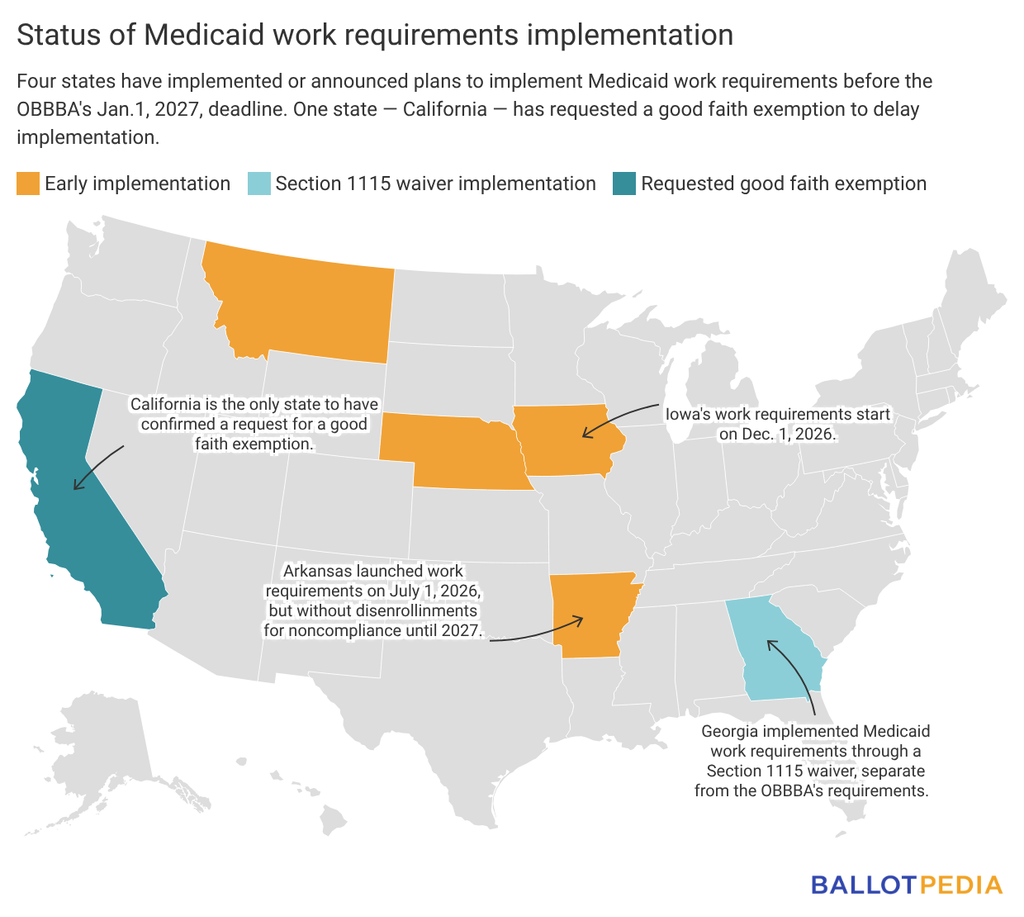
The OBBBA established the first federally mandated Medicaid work requirements, replacing a system in which states generally needed federal approval through Section 1115 waivers to implement such policies. Four states with a Republican trifecta announced plans to partially or fully implement the federal work requirements early: Arkansas, Iowa, Montana, and Nebraska. The OBBBA also included a provision that allows CMS to delay implementation until Jan. 1, 2028, upon request from a state that they determine has made a good faith effort to comply. As of Nov. 23, one state, California, had confirmed that it requested a good faith effort exemption, but CMS had not approved the request. Five democratic governors — in California, Maine, New Mexico, Oregon, and Virginia — sent a letter to CMS on Oct. 1 asking for more time to implement the work requirements.
Democratic lawmakers in Congress praised the option to delay but remained critical of the work requirements. Sen. Ron Wyden (D-Ore.) and Rep. Frank Pallone (D-N.J.) said in a joint statement: "This disenrollment delay is a small step in the right direction, but it does not avert the disaster ahead. As the incoming chairs of the committees responsible for Medicaid, we are preparing to lead a relentless fight to preserve Medicaid coverage and care for every eligible person."
Since the announcement, at least three states — Kentucky, Indiana, and Ohio — said they would not utilize the hold harmless period and would keep Jan. 1 as their target for implementation.
Ballotpedia is tracking the implementation of Medicaid provisions under the OBBBA, including federal rules and guidance, implementation deadlines, state responses, and changes to Medicaid eligibility and funding.
Keep reading: Implementation of Medicaid provisions from the One Big Beautiful Bill Act (2025)
Additional links: Medicaid work requirements, Changes to noncitizen eligibility for Medicaid (2026), Centers for Medicare and Medicaid Services, One Big Beautiful Bill Act