


Welcome to the Thursday, Dec. 18, Brew.
By: Briana Ryan
Here’s what’s in store for you as you start your day:
- Colorado voters will decide on a ballot measure increasing penalties for the sale and possession of fentanyl
- Number of state legislators seeking election to other offices at eight-year low
- Filing deadlines have passed in three states — here’s a look at the state executives not running for re-election
Colorado voters will decide on a ballot measure increasing penalties for the sale and possession of fentanyl
On Dec. 15, the Colorado Secretary of State certified Initiative 85 for the Nov. 3, 2026, ballot. The measure would establish higher felony classifications and mandatory penalties for the manufacturing, dispensing, sale, and possession of fentanyl and certain synthetic opioids.
The measure would also require court-ordered treatment for certain low-level fentanyl possession felon offenses, as well as revise sentencing provisions to limit exceptions for fentanyl-related distribution offenses that result in death.
Initiative 85 is supported by Advance Colorado, an organization that describes its mission as "[pushing] back on the progressive policies that have put [Colorado] on the wrong track."
On the measure, Advance Colorado President Michael Fields said, "Colorado's current laws are far too lenient on fentanyl dealers. We need to hold dealers accountable with tougher penalties, while ensuring people struggling with addiction receive mandated, compassionate treatment."
State Rep. Javier Mabrey (D), who opposes the measure, said it "is an extension of failed policies of the past" and that "it's really important to be clear that increasing criminal penalties for Coloradans who are struggling with substance use disorders will not deter crime."
Advance Colorado is also collecting signatures for another measure, Initiative 95, which would require the Department of Homeland Security to be notified based on whether an individual has been charged with a violent crime, if they have a prior felony conviction, or if law enforcement cannot determine that they are a citizen. The deadline for submitting signatures for Initiative 95 is Dec. 26.
As of Dec. 17, Initiative 85 is the only measure that Colorado voters will decide on Nov. 3, 2026.
Nationally, there is one other measure on drug crime policy, Idaho HJR 4, that voters will decide on in 2026. That measure would provide that only the Idaho Legislature shall have the authority to legalize marijuana, narcotics, or other psychoactive substances. The measure would also remove the ability for citizens to initiate state statutes that would legalize these substances.
Click here for more information on Initiative 85.
Number of state legislators seeking election to other offices at eight-year low
In 2025, 30 officials, including members of the U.S. House of Representatives and state legislatures, ran for a different office than the one to which they were elected. Today, we'll break down which offices these officials ran for and how successful their bids were.
State legislatures
Twenty-six state legislators ran for another office in 2025. That's the fewest number of state legislators running for another office since we began collecting this data in 2018. Of the 26 state legislators who ran for another office, one ran for governor, two ran for other state executive offices, one ran for a judicial office, and 22 ran for a municipal office or a school board.
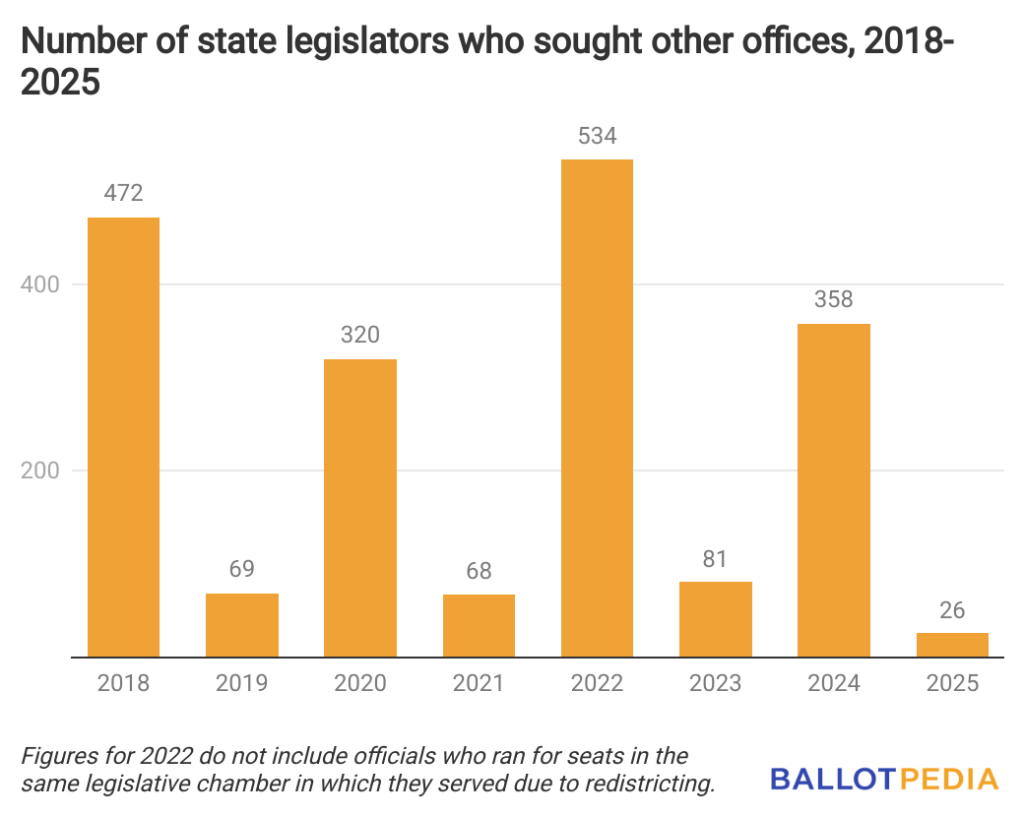
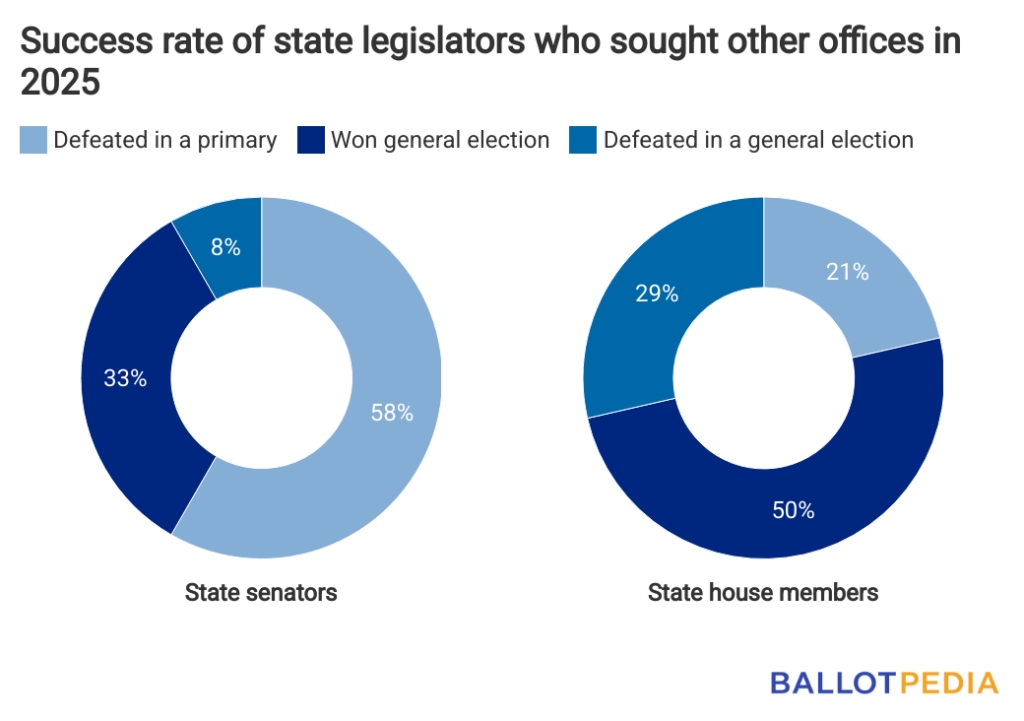
Four (33%) of the 12 state senators who ran for another office were successful, while one (8%) lost in the general election and seven (58%) lost in the primary.
Among state representatives, seven (50%) of those who ran for another office were successful. Four (29%) of them lost in the general election, and three (21%) lost in the primary.
No state legislative Republicans who sought election to other offices in 2025 won. An average of 43% of Republicans who sought other offices from 2018 to 2025 were successful.
Forty-six percent of state legislative Democrats who sought election to other offices in 2025 won. An average of 45% of Democrats who sought other offices from 2018 to 2025 were successful.
The overall success rate of state legislators who sought other offices in 2025 was 42%. That's the second-lowest success rate since 2018. The lowest success rate was in 2021, when 34% of state legislators who sought other offices won.
U.S. House of Representatives
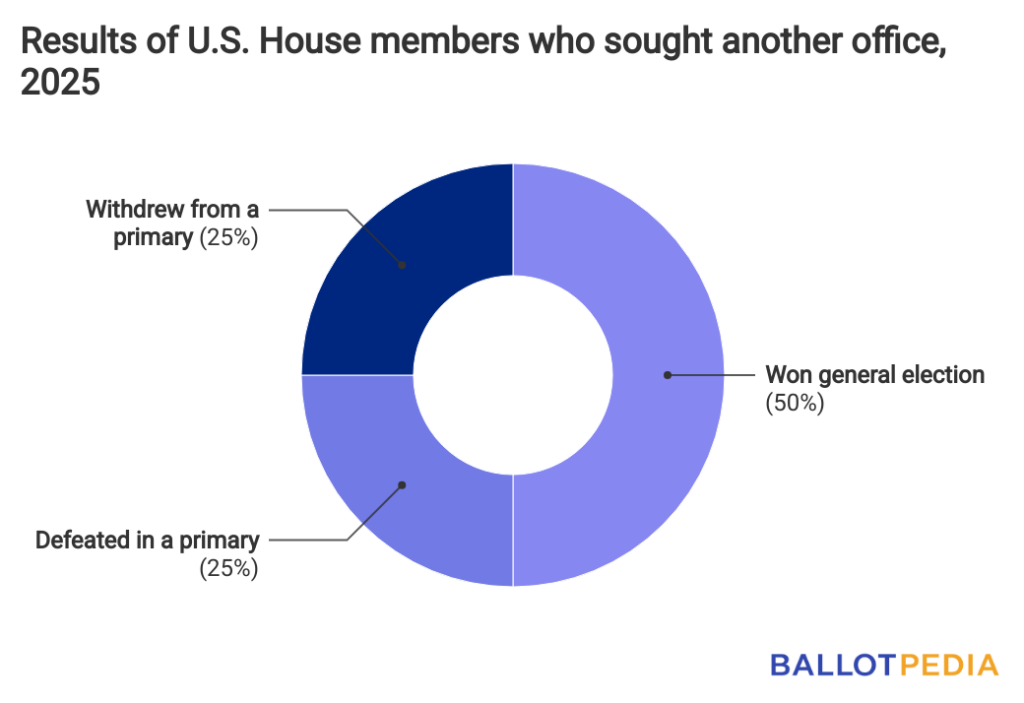
Four Democratic members of the U.S. House in the 118th and 119th Congresses sought election to a different office in 2025. Among the U.S. House members, two (50%) won election to the statewide offices they sought. One (25%) lost in the primary for statewide office, and one (25%) withdrew from the primary for state legislative office.
Click here to read more about the results of elected officials seeking other offices.
Filing deadlines have passed in three states — here’s a look at the state executives not running for re-election
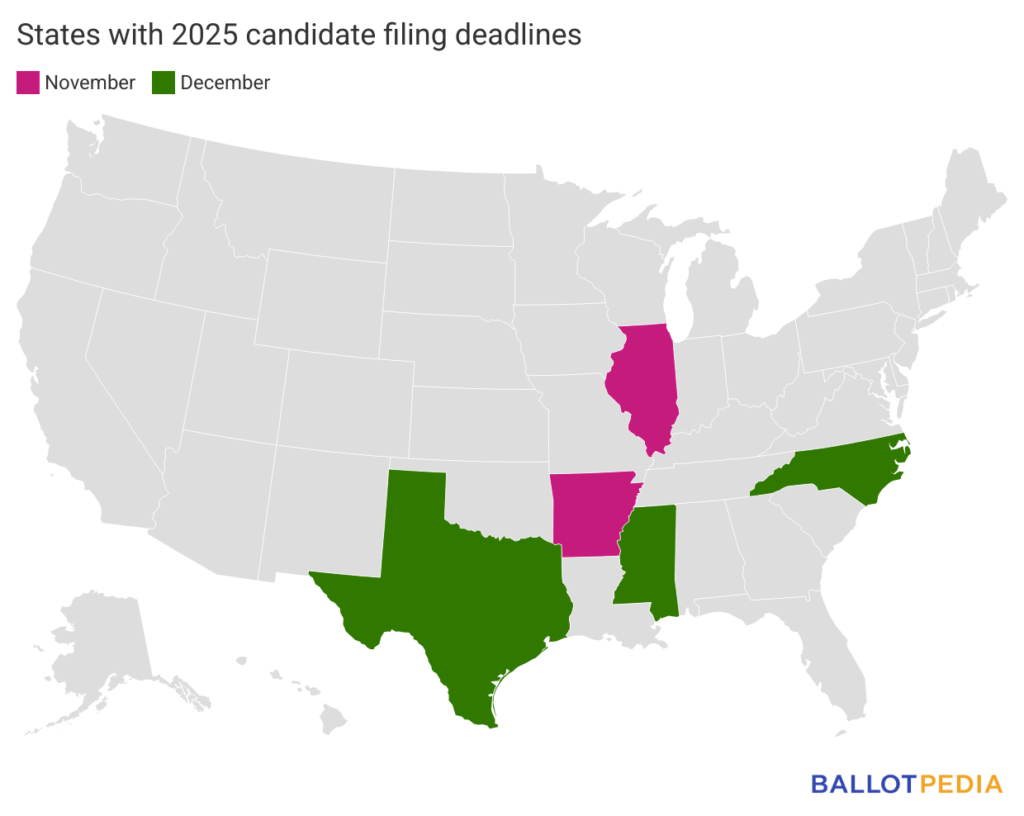
The filing deadline for candidates seeking office in 2026 has passed in three states: Arkansas (Nov. 11), Illinois (Nov. 3), and Texas (Dec. 8). In Illinois and Texas, at least one state executive official is not seeking re-election, while in Arkansas, every incumbent state executive official is running for another term.
In Illinois, six state executive offices will be up for election. Two state executive officials are not seeking re-election to their current offices:
- Lieutenant Governor Julianna Stratton (D) is running in the Democratic primary for the state’s open U.S. Senate seat. She has served as lieutenant governor since 2019.
- State Comptroller Susanna Mendoza (D) announced her retirement from public office on July 16, 2025. She has served as comptroller since 2016.
In Texas, eight offices will be up for election, including the State Board of Education, which has eight seats up for election. That's a total of 15 state executive elections. Five officials are not seeking re-election to their current offices:
- Attorney General Ken Paxton (R) is running in the Republican primary for U.S. Senate against incumbent John Cornyn, Rep. Wesley Hunt, and 12 other candidates. He has served as attorney general since 2015.
- Four members of the Texas State Board of Education did not file to run for another term:
- Rebecca Bell-Meterau (D) did not file to run in District 5.
- Will Hickman (R) did not file to run in District 6.
- Kevin Ellis (R) did not file to run in District 9.
- Evelyn Brooks (R) is not running in District 14 and is instead running in the Republican gubernatorial primary against incumbent Greg Abbott (R) and nine other candidates.
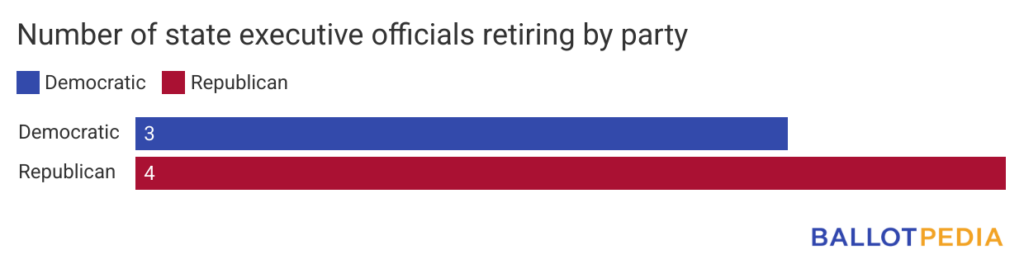
In total, of the state executives not running, four are not seeking another office, two are running for U.S. Senate, and one is running for governor. Additionally, four Republican state executive officials are not running again compared to three Democrats.
Additional states with filing deadlines in December are Mississippi and North Carolina. However, neither state will hold state executive elections in 2026. Those elections will be held in 2027 and 2028, respectively.
Click here for more information about the elections for state executive offices happening in 2026.