


Welcome to the Thursday, Jan. 15, Brew.
By: Briana Ryan
Here’s what’s in store for you as you start your day:
- An early look at state supreme court retention elections this year
- 2025 state legislative special sessions recap
- On the Ballot previews this term's U.S. Supreme Court cases
An early look at state supreme court retention elections this year
This year, 32 states will hold elections for their state supreme courts. Fourteen of these states will hold retention elections, 12 will hold nonpartisan elections, and six will hold partisan elections.
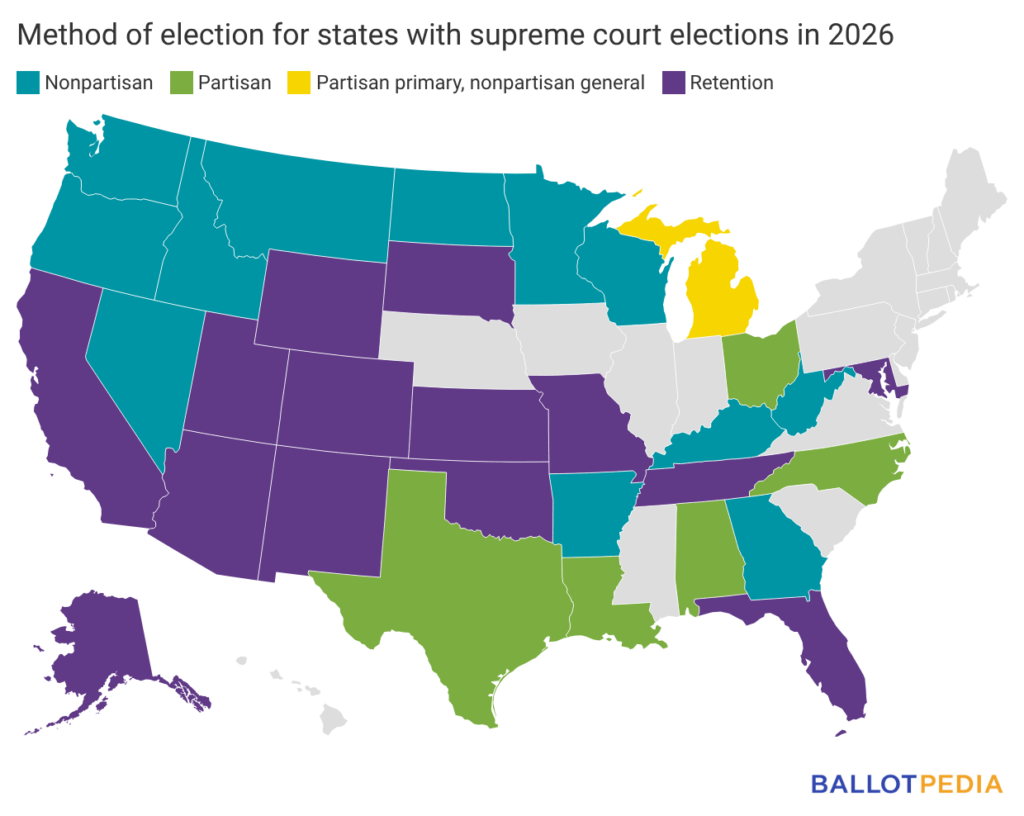
Retention elections are not like traditional elections, as a justice doesn't run against other candidates, but is subject to a yes-or-no vote. The most recent retention elections happened in Pennsylvania in 2025, in which the three justices up for election — Christine Donohue (D), Kevin M. Dougherty (D), and David N. Wecht (D) — won retention with at least 64% of the vote each.
Traditionally, justices win retention elections more often than any other type of election. According to our analysis of retention elections, nine justices in seven states have lost retention elections since 1990. The last time a justice lost a retention election was in 2024, when Oklahoma Supreme Court Justice Yvonne Kauger lost.
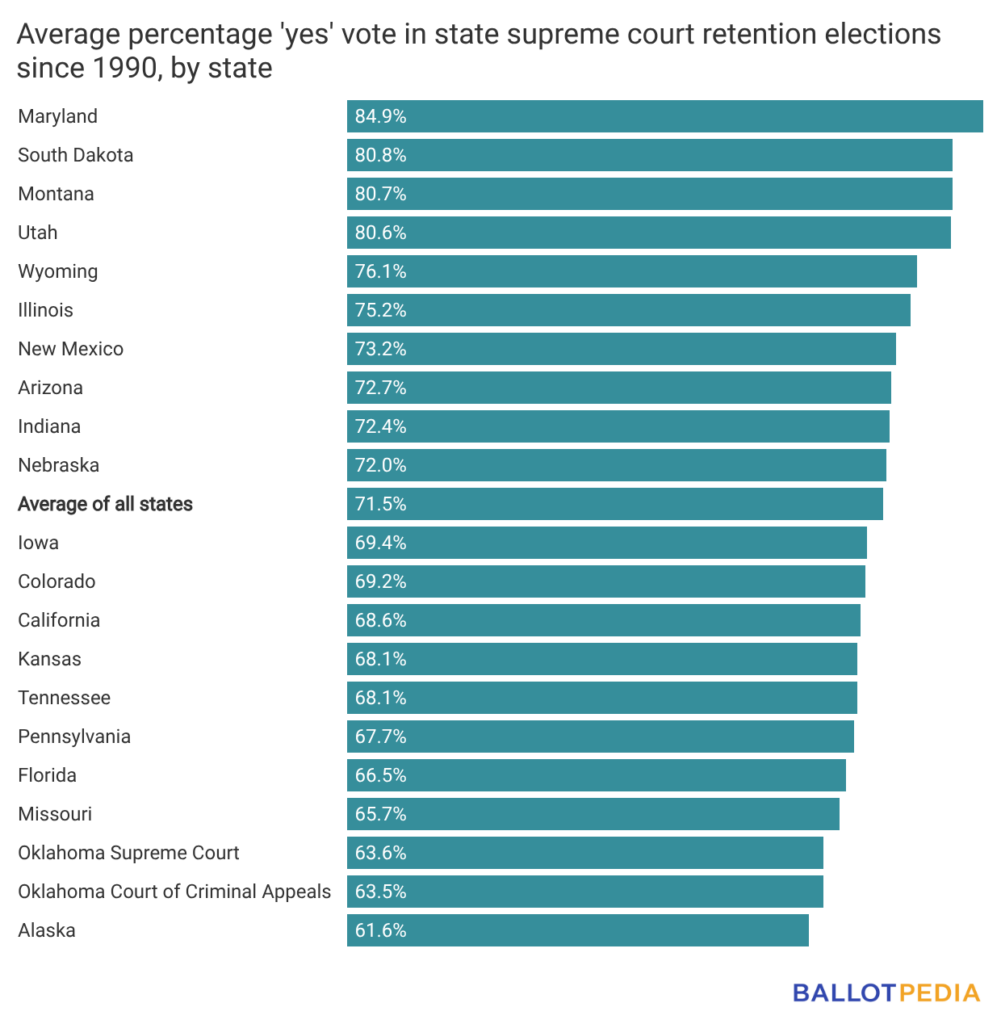
Since 1990, voters have retained state supreme court justices with an average of 71.5% of the vote.
Here are a few states where state supreme court retention elections could be noteworthy to watch.
Arizona: Justice John Lopez IV is standing for retention. Gov. Doug Ducey (R) appointed Lopez in 2016. In Arizona, a justice typically receives an average of 73% of the vote to retain their seat, but in 2022, a justice fell under 60% for the first time since 1990, receiving 56%. In 2024, neither of the justices who faced retention elections received more than 60%, and there was a dedicated anti-retention campaign that year. Ducey appointed all three of those justices who fell under 60%.
Kansas: Justices Eric Rosen and Larkin Walsh are standing for retention. Democratic governors appointed the justices in 2005 and 2025, respectively. In August 2026, Kansas voters will vote on an amendment that, if passed, would make state supreme court elections partisan, making these the last retention elections in the state. Additionally, according to The Center for Politics' Louis Jacobson, the state "has been known for some anti-retention efforts in recent years, but nothing is on the horizon so far this cycle."
Oklahoma: Six justices are standing for retention on Oklahoma's Supreme Court and its Court of Criminal Appeals. Oklahoma is one of two states that have two courts of last resort. Republicans appointed all justices. In 2024, Justice Yvonne Kauger became the first justice in state history to lose a retention campaign, receiving only 49.8% of the vote. Since 1990, Oklahoma justices have received an average of 63% of the vote in retention elections, the second-lowest average among all states.
Utah: Justices Diana Hagen and Jill Pohlman are standing for retention. Gov. Spencer Cox (R) appointed both justices in 2022. Additionally, Cox and legislative Republicans have proposed bills that would add judges to the court and change the state's retention election process, which, if passed, would change future elections.
Click here to read more about the state supreme court elections happening this year.
2025 state legislative special sessions recap
Nineteen states held special legislative sessions in 2025, up from nine states in 2024. Sixteen states held one special session in 2025. Delaware, Missouri, and Texas held the most special sessions, with two each. A special session may also be called over a specific subject matter during or after a regular session.
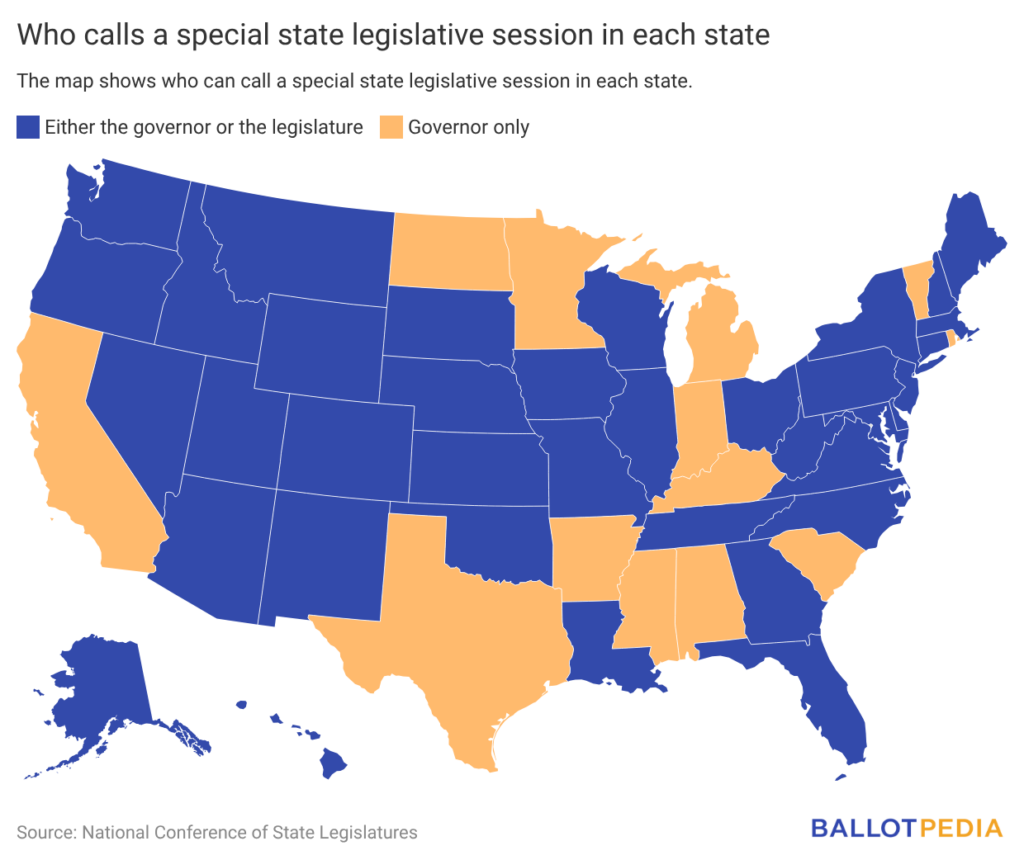
In 37 states, both the governor and the state legislature can call special sessions. In the remaining 13 states, only the governor has that authority. These 13 states are Alabama, Arkansas, California, Indiana, Kentucky, Michigan, Minnesota, Mississippi, North Dakota, Rhode Island, South Carolina, Texas, and Vermont.
Since 2016, an average of 17 states have held special legislative sessions each year. More states tend to hold special sessions in odd-numbered years than in even-numbered years. An average of 20 states held special sessions in odd-numbered years and 14 in even-numbered years.
The highest number of states holding special sessions occurred in 2017 and 2023, when 24 states held special sessions. The fewest occurred in 2019 and 2024, when nine states held special sessions.
Here are the 19 states that held special sessions last year, along with the session dates:
- Alaska: Aug. 2-31
- California: Dec. 2, 2024 - Feb. 3
- Colorado: Aug. 21-26
- Connecticut: Nov. 12-13
- Delaware: Aug. 12, Nov. 13-19
- Louisiana: Oct. 23-29
- Maine: March 25
- Mississippi: May 28-May 29
- Missouri: June 2, Sept. 3
- Nevada: Nov. 13-19
- New Hampshire: June 27
- New Mexico: Oct. 1-2
- North Carolina: Nov. 17
- Oregon: Aug. 29-Oct. 1
- South Dakota: Sept. 23
- Tennessee: Jan. 27-30
- Texas: July 21-Aug. 15, Aug. 15-Sept. 3
- Utah: Oct. 6
- Virginia: Oct. 27-31
No states have held a special session in 2026 thus far.
Click here to read more about the 2025 state legislative sessions.
On the Ballot previews this term's U.S. Supreme Court cases
In this episode of On the Ballot, we're taking a look at some of the cases that the U.S. Supreme Court will hear this term. U.S. Supreme Court scholar Adam Feldman joins our host Norm Leahy to preview those cases and break down the major cases still to be argued, along with decisions expected in the months ahead.
Feldman will also explain internal court dynamics, the role of swing justices, and the emergency docket, also called the shadow docket. Feldman will also explain why some of the most consequential rulings this term could come in areas that directly affect voters and everyday governance.
To listen to this episode and more, click here. Also, don't forget to subscribe to On the Ballot on YouTube or wherever you get your podcast. Plus, click here to check out our full coverage of this term's U.S. Supreme Court cases.