


Welcome to the Thursday, Feb. 12, Brew.
By: Briana Ryan
Here’s what’s in store for you as you start your day:
- Congress considers whether to require voter ID, proof of citizenship for federal elections
- Eight candidates are running in the Republican primary for governor of Georgia on May 19
- Both candidates running in the Democratic primary for Texas land commissioner have completed our Candidate Connection survey
Congress considers whether to require voter ID, proof of citizenship for federal elections
On Jan. 30, Republicans in the U.S. House of Representatives introduced the SAVE America Act, which would require voters in all 50 states to provide documentary proof of citizenship to register to vote and voter ID to cast a ballot in federal elections.
The legislation, introduced by U.S. Rep. Chip Roy (R-Texas), is among several Republican-backed bills that would change national election policies.
The SAVE America Act would prohibit states from accepting voter registration applications for federal elections unless they are accompanied by documentary proof of citizenship, such as a REAL ID, birth certificate, passport, or naturalization certificate.
Voters who register by mail using a federal form would be required to present their proof of citizenship in person to an election official before the election or, if the state allows for same-day voter registration, at the polls on Election Day.
The legislation would also require states check their voter rolls against U.S. Department of Homeland Security data to identify and remove non-citizens who are registered to vote.
In addition, the SAVE America Act would require individuals voting in a federal election to present photo identification. Absentee/mail-in voters would be required to include a copy of their ID with their ballot or provide the last four digits of their Social Security number and sign an affidavit. Eligible forms of ID include documents issued by state, federal, or tribal governments that have a photo of the voter, an identification number, and an indication that the person is a U.S. citizen.
Federal law currently requires individuals in all 50 states who register to vote by mail and who have not previously voted in a federal election in their state to provide documents to establish their name and identity, such as a copy of their driver's license or paycheck.
The U.S. House was scheduled to vote on the SAVE America Act on Feb. 11. Politico's Meredith Lee Hill and Mia McCarthy wrote, "Democrats are certain to filibuster the bill in the Senate, and it's unlikely the GOP is ready to take extraordinary steps to overcome that hurdle."
Separate legislation, introduced by U.S. Rep. Bryan Steil (R-Wisc.), would also require voter ID and proof of citizenship for federal elections. The proposal also requires absentee/mail-in ballots be received by the close of polls on Election Day, bans ranked-choice voting and all-mail voting for federal elections, and requires voting systems to use voter-verifiable paper ballots.
The bills include provisions that are already in place in some states.
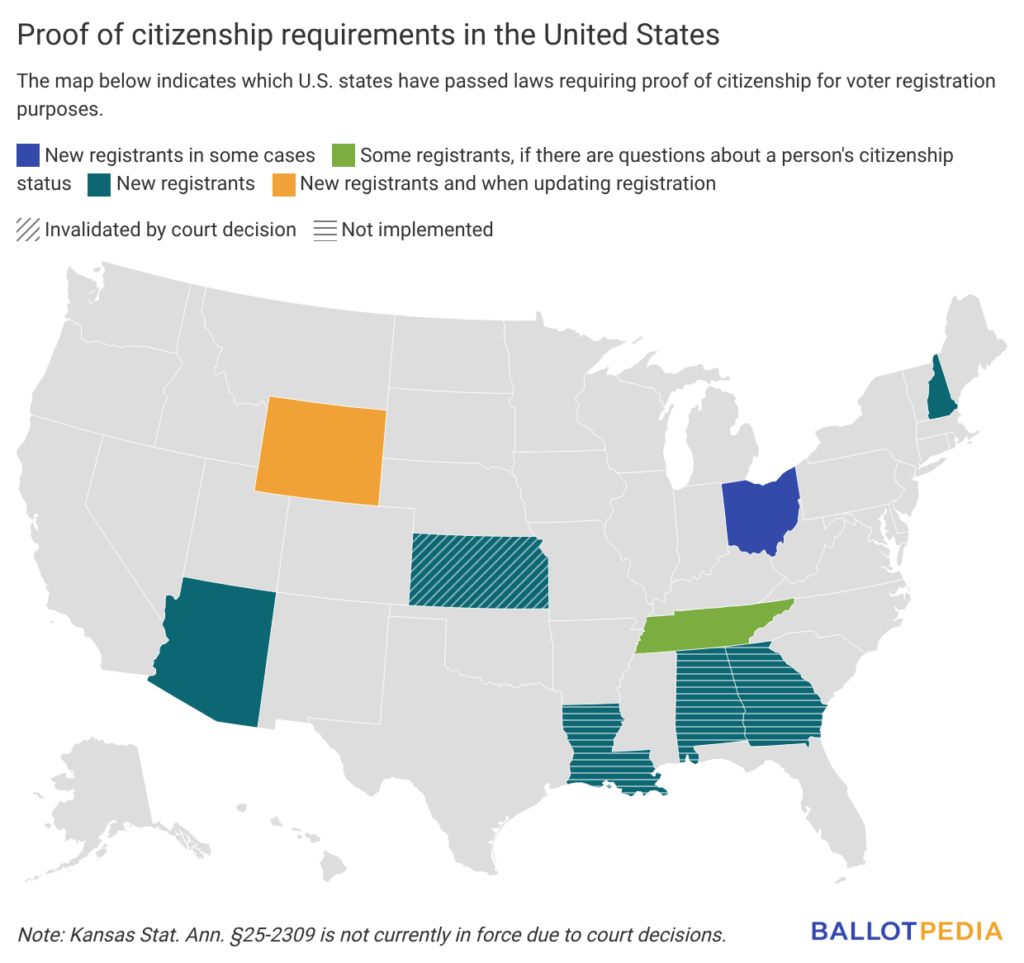
Alabama, Arizona, Georgia, Kansas, Louisiana, New Hampshire, and Wyoming have laws requiring proof of citizenship at the time of voter registration for state or federal elections. Ohio requires proof of citizenship only when registering to vote at a Bureau of Motor Vehicles facility. Court decisions invalidated Kansas' proof of citizenship law. Alabama, Georgia, and Louisiana have not implemented the requirements of their proof of citizenship laws. Alabama, Georgia, Louisiana, New Hampshire, Ohio, and Wyoming currently have Republican trifectas, while Arizona and Kansas have divided governments.
Thirty-six states require voters to present identification to vote at the polls on Election Day. Twenty-four of those states require voters to present identification containing a photograph, with certain exceptions. Twelve states do not require photo identification. Twenty-three states with voter ID laws currently have a Republican trifecta, six states have a Democratic trifecta, and seven states have divided governments.
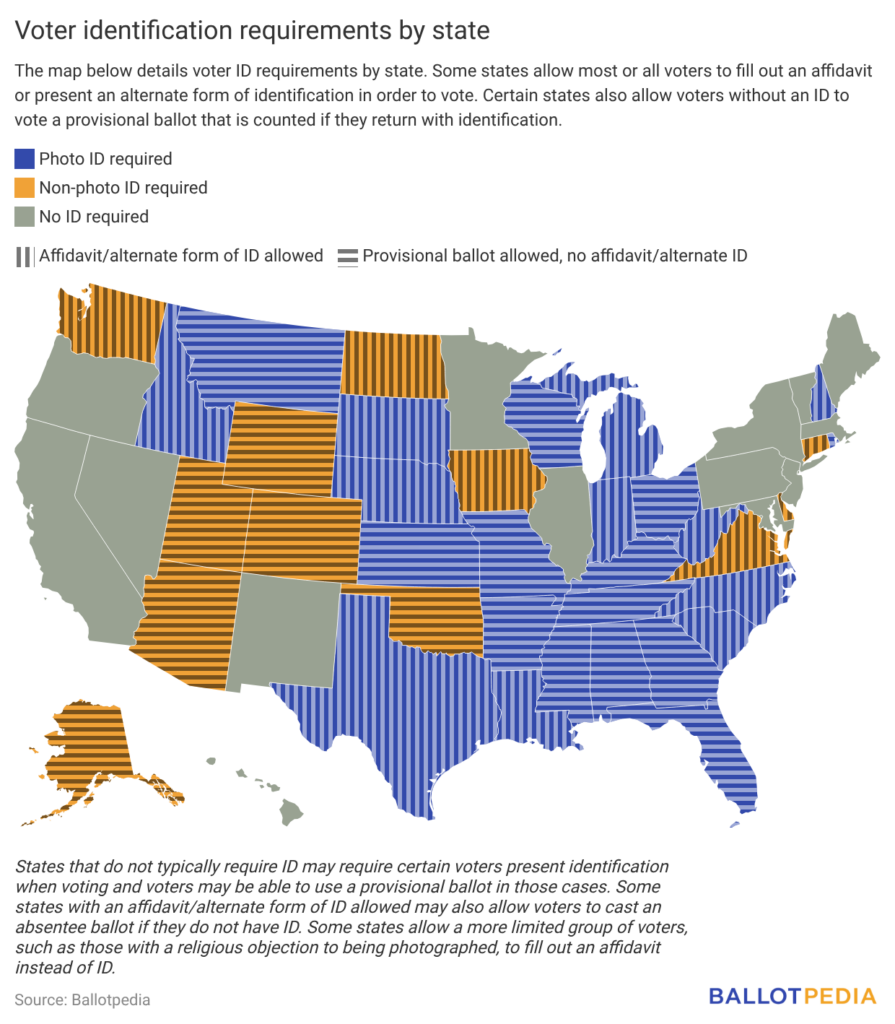
The remaining 14 states do not generally require voters to present identification to vote at the polls on Election Day. Ten of these states currently have a Democratic trifecta, while four have divided governments.
Most states have exceptions in their voter ID law for at least some voters, though nine states have none. In 16 states, some or all voters can sign an affidavit or a form instead of providing identification. Seven states allow election officials or other voters to vouch for a person's identity instead of an ID. In four states, voters who live and vote in state-licensed nursing homes or care centers do not have to provide ID.
In 2026, lawmakers in 17 states introduced 30 bills related to proof of citizenship for voting. One bill requiring proof of citizenship to register to vote for non-federal elections, Utah HB 209, has passed in the state House. Bills requiring states to compare their voter rolls with federal data to identify potential non-citizens have passed in Mississippi and Tennessee.
This year, lawmakers in 25 states have introduced 115 bills related to voter ID, either for in-person or absentee/mail-in voting. Bills that have passed at least one chamber include Arizona HCR 2001, which would amend the state constitution to require voter ID, and HB 323 in New Hampshire, which would remove student IDs and out-of-state driver’s licenses from the list of acceptable forms of ID.
Click here to read more about voter ID laws across the United States.
Eight candidates are running in the Republican primary for governor of Georgia on May 19
Eight candidates are running in the Republican primary for governor of Georgia on May 19. Incumbent Gov. Brian Kemp (R) is term-limited. Four candidates lead in media attention:
- Chris Carr (R), the current attorney general of Georgia, is campaigning on affordability and public safety.
- Rick Jackson (R), a healthcare executive, is campaigning on his outsider status and on passing an income tax cut.
- Burt Jones (R), the current lieutenant governor of Georgia, is campaigning on reducing taxes and improving education.
- Brad Raffensperger (R), the current Georgia secretary of state, is campaigning on jobs and lower taxes.
The Georgia Political Insight Substack wrote after Jackson's entry that the race "is now one of the most expensive and unpredictable statewide contests in the country." According to official campaign finance reports from the Georgia Ethics Commission, Carr raised $4.9 million, Jones $3.9 million, and Raffensperger $864.2k. Fundraising info for Jackson was not available. Observers have noted that Jackson, Jones, and Raffensperger can self-finance their campaigns, and that Jackson and Jones have done so. Satellite spending has also been a factor in the race as a group called Georgians for Integrity has spent $14 million in ads opposing Jones' campaign.
The Washington Post's Patrick Svitek wrote that Donald Trump's legal challenges to the outcome of the 2020 presidential election had become "a stark dividing line in the Georgia governor’s race, where Republicans [who took differing sides]... are now facing off in a major midterm contest." In the aftermath of the 2020 presidential elections, the candidates who held office at the time took differing stances on Trump's lawsuits. Jones, a state Senator at the time, supported the lawsuits and was an alternate elector for Trump, while Carr and Raffensperger did not support the president's lawsuits.
Trump endorsed Jones on Aug. 11. The four candidates have spoken about Trump and the 2020 presidential election in different ways:
- Carr has praised Trump's policies and said his campaign and style were more aligned with Kemp and former U.S. Sen. Johnny Isakson (R-Ga.).
- Jackson said Trump was his inspiration to run for office, and he has aired ads criticizing Raffensperger over his actions following the 2020 presidential election.
- Jones said he supports Trump's agenda.
- Raffensperger says his record has been conservative and would align with Trump's objectives.
If no candidate receives a majority of the vote, the top two candidates will advance to a runoff on June 16.
The election for governor of Georgia is one of 36 gubernatorial elections happening this year. Eighteen of the incumbent governors of those states are Democrats, and 18 are Republicans.
Click here for more information about this Republican primary. Also, if you're a Georgia voter, check out our Sample Ballot Lookup here to prepare for Election Day.
Both candidates running in the Democratic primary for Texas land commissioner have completed our Candidate Connection survey
Both candidates running in the Democratic primary for Texas land commissioner on March 3 — Benjamin Flores and Jose Loya — completed our Candidate Connection Survey.
These survey responses allow voters to hear directly from candidates about what motivates them to run for office. We ask all survey respondents to tell voters what areas of public policy they are personally passionate about. The following are excerpts of their responses:
Flores: "Disaster preparedness and emergency management. It's personal for me. I've completed CERT training and EMT academy in the past because I wanted to be useful when things go wrong. When Hurricane Beryl hit Matagorda County in 2024, I was out helping my neighbors. The Texas General Land Office plays a major role in disaster recovery, and I've seen how much it matters when that system works. Government accountability is the other area. My career was about protecting organizations from failures. Most failures aren't surprises. They're predictable if you're paying attention I want government to work the same way: transparent, accountable, and focused on preventing problems."
Loya: "I'm deeply passionate about supporting veterans and standing with working people. As a Marine Corps combat veteran and union staff representative, I've seen how access to earned benefits, fair wages, and safe working conditions shape families' lives. I'm also committed to strengthening public education, disaster preparedness, and responsible land management—because these policies directly affect workers, veterans, and future generations across Texas."
The land commissioner is a state executive position in the Texas state government, and serves as the elected head of the Texas General Land Office (GLO). The GLO's mission statement states that it "improves the lives of every Texan by preserving our state’s history, restoring and operating the Alamo, maximizing the revenue from our state lands to help fund Texas public education, safeguarding our coast, supporting communities impacted by disasters, and providing essential services to Veterans. "
The incumbent Dawn Buckingham (R) is running unopposed in the Republican primary.
Click here for more information about our Candidate Connection Survey. You can also check out Flores' and Loya's full responses here and here.