


Welcome to the Wednesday, Feb. 18, Brew.
By: Briana Ryan
Here’s what’s in store for you as you start your day:
- A look at this year's gubernatorial battlegrounds
- Voters in 39 states have decided 57 crime victims' rights constitutional amendments since 1982
- Seven candidates are running in the Democratic primary for governor of Georgia on May 19
A look at this year's gubernatorial battlegrounds
This year, gubernatorial elections are happening in 36 states, including 18 where no incumbent is running for re-election. Currently, Democrats and Republicans each hold 18 of the gubernatorial offices up for election. We identified seven as general election battlegrounds:
California: Incumbent Gavin Newsom (D) is term-limited. Currently, 24 candidates are running for governor. Race forecasters have rated the general election for the office as either Solid or Safe Democratic. According to the Cook Political Report, "With several viable Democrats splitting the field, the current polling frontrunners are two GOP candidates — conservative activist Steve Hilton and Riverside County Sheriff Chad Bianco. But Democrats maintain they aren't worried about being locked out of the state's June 2 jungle primary, where the top two finishers regardless of party will advance to the November general election."
Iowa: Currently, seven candidates are running for governor. Incumbent Kim Reynolds (R) is not running for re-election. Race forecasters have rated the general election for the office as either Lean or Likely Republican. NBC News' Adam Edelman wrote that "Iowa voters last elected a Democratic governor in 2006, but the party has been buoyed by a string of strong performances in recent special legislative elections."
Kansas: Currently, nine candidates are running for governor. Incumbent Laura Kelly (D) is term-limited. Race forecasters have rated the general election for the office as either Lean Republican or as a Toss-Up. Kansas is one of two states where one party has a veto-proof majority in the legislature, and the other party holds the governor's office.
Michigan: Currently, 14 candidates are running for governor. Incumbent Gretchen Whitmer (D) is term-limited. Race forecasters have rated the general election for the office as a Toss-Up. Michigan is one of six states that President Donald Trump (R) won in the 2024 presidential election but lost in the 2020 presidential election.
Minnesota: Currently, 15 candidates are running for governor. Incumbent Tim Walz (D) is not running for re-election. Race forecasters have rated the general election for the office Likely Democratic. Minnesota is one of 11 states with a divided government where neither party holds trifecta control.
Nevada: Currently, three candidates — including incumbent Joe Lombardo (R) — are running for governor. Race forecasters have rated the general election for the office as either Lean Republican or as a Toss-Up. Nevada is one of six states that Trump won in the 2024 presidential election but lost in the 2020 presidential election.
Wisconsin: Currently, 15 candidates are running for governor. Incumbent Tony Evers (D) is not running for re-election. Race forecasters have rated the general election for the office as a Toss-Up. Wisconsin is one of six states that Trump won in the 2024 presidential election but lost in the 2020 presidential election.
Nationally, 26 states have Republican governors, and 24 have Democratic governors. The last time there were 36 states up for election, there were a total of 28 Republican governors and 22 Democratic governors. That year, Democrats won three Republican-held offices, and Republicans won one Democratic-held office.
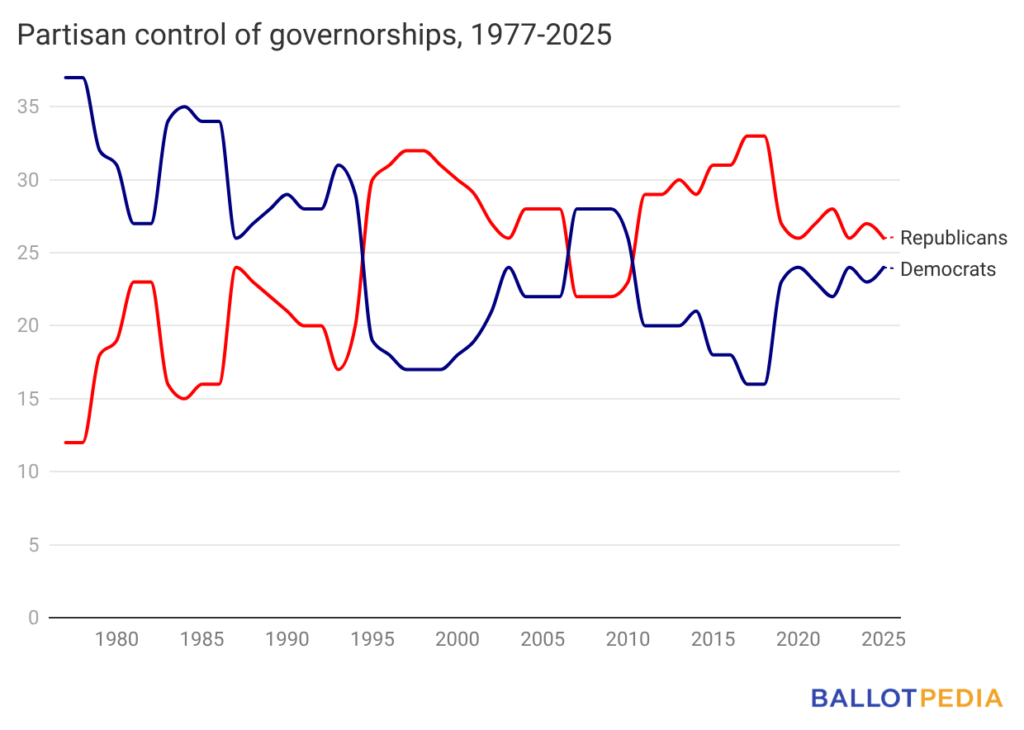
Currently, there are 23 Republican trifectas, 16 Democratic trifectas, and 11 divided governments where neither party holds trifecta control. The last time 36 offices were up for election in 2022, there were a total of 23 Republican trifectas, 14 Democratic trifectas, and 13 divided governments. That year, the trifecta status changed in six states:
- In Maryland, Massachusetts, Michigan, and Minnesota, divided governments became Democratic trifectas.
- In Nevada, the Democratic trifecta became a divided government.
- In Arizona, the Republican trifecta became a divided government.
Click here to read more about this year’s gubernatorial battlegrounds.
Voters in 39 states have decided 57 crime victims' rights constitutional amendments since 1982
This year, Tennessee voters will decide on a constitutional amendment that would add Marsy's Law to the state constitution, expanding the list of rights for crime victims. If approved, Tennessee will become the sixteenth state with Marsy's Law in its state constitution.
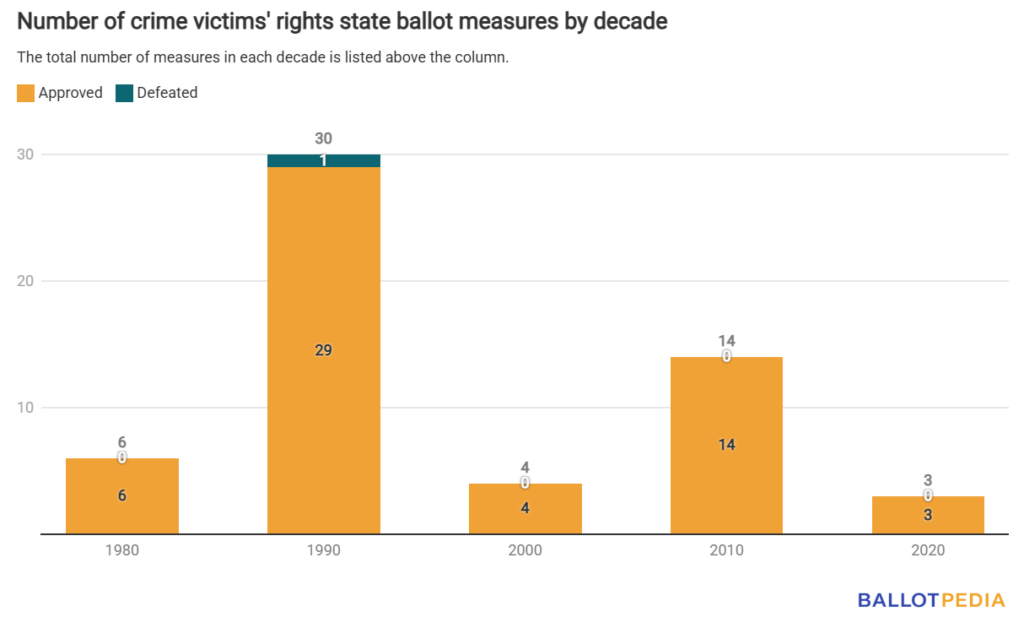
Since 1982, voters in 39 states have voted on 58 ballot measures concerning crime victims' rights. These measures include those related to the legal rights and protections of crime victims. They address restitution, notification, participation in legal proceedings, and victim support services, among other rights guaranteed to crime victims.
Fifty-seven of those measures were constitutional amendments. The measure in Oregon was an initiated state statute.
Only one crime victims' rights measure has been defeated. In 1998, South Carolina voters rejected an amendment that would have permitted the Legislature to exempt victims of certain crimes from the protections included in the Crime Victims' Bill of Rights.
Of the 57 constitutional amendments on the ballot since 1982, 33 added a crime victims' bill of rights. Fifteen added Marsy's Laws. Three added a single right for crime victims. Six amendments altered or would have altered preexisting Marsy's Law or crime victims' bill of rights amendments.
Some common provisions of victims' bills of rights include the right to:
- Be present at criminal proceedings
- Make a victim impact statement at sentencing hearings
- Restitution from their attacker or abuser
- Timely disposition of the case
- Be informed of the release of the accused due to parole or completion of their sentence
- Be treated with fairness, dignity, and privacy during criminal proceedings
Amendments referred to as Marsy's Law are a type of crime victims' bill of rights amendment. The difference is that they follow model language from the organization Marsy's Law for All. The model language includes:
- The right to be notified about and present at proceedings
- The right to be heard at proceedings involving release, plea, sentencing, disposition, or parole of the accused
- The right to have the safety of the victim and victim's family considered when making bail or release decisions
- The right to be protected from the accused
- The right to be notified about release or escape of the accused
- The right to refuse an interview or deposition at the request of the accused
- The right to receive restitution from the individual who committed the criminal offense
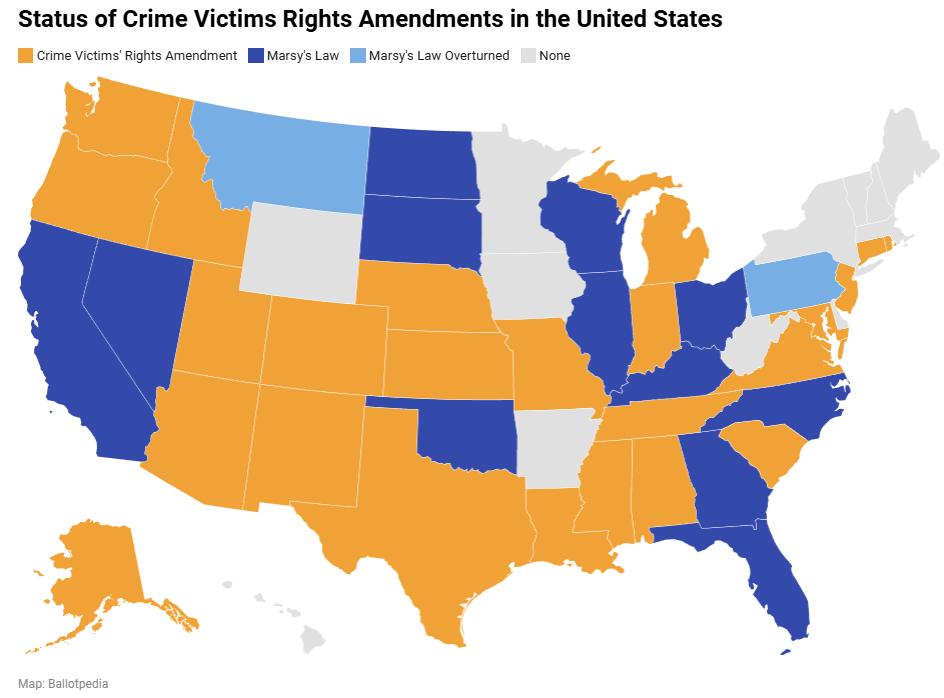
California was the first state to add Marsy's Law to the state constitution when voters approved Proposition 9 in 2008. Proposition 9 passed with 53.8% of the vote and became a model for several subsequent Marsy's Law ballot measures across the country. Of the 15 states that have passed Marsy's Law, eight had previously passed a crime victims' bill of rights.
Constitutional amendments on statewide ballots granting crime victims' rights can be divided into two main time periods. During the first period, spanning 1982 to 1999, 35 constitutional amendments were approved, and one was defeated. Of the 35 constitutional amendments approved, 33 implemented a crime victims' bill of rights.
The second period is defined by the constitutional amendments implementing Marsy's Law. Since 2004, 21 constitutional amendments have been approved. Fifteen of those 21 amendments (71.4%) added Marsy's Law to the state constitution.
In three states, courts have overturned crime victims' rights amendments that voters approved. All were patterned after Marsy's Law. In Montana and Pennsylvania, the amendments were overturned because the courts ruled that the ballot measures violated the states' single-subject rules for constitutional amendments.
In Kentucky, the court overturned the amendment because the secretary of state's office failed to meet the publication requirement in the state constitution for proposed constitutional amendments. In 2020, voters in Kentucky approved Marsy's Law for a second time, with the new ballot measure meeting the publication requirement.
Click here to read more about the history of crime victims' rights ballot measures.
Seven candidates are running in the Democratic primary for governor of Georgia on May 19
Seven candidates are running in the Democratic primary for governor of Georgia on May 19. Keisha Bottoms (D), Geoff Duncan (D), Jason Esteves (D), and Michael Thurmond (D) lead in polling, fundraising, and media attention.
Roy Barnes (D), who was elected in 1998, was the last Democrat to serve as governor of the state. The Current's Craig Nelson wrote that at a Jan. 8 forum, "The candidates hoping to help end that ignominious streak ... gained needed exposure outside the capitol Atlanta, even as most voters are still paying no attention to the race and few even know who they are."
Bottoms was the Mayor of Atlanta from 2018 to 2022. She was also a senior adviser to former President Joe Biden (D) and a member of the Atlanta City Council.
Bottoms said her goals as governor would include expanding Medicaid, improving public education, eliminating state income taxes for teachers, offering free technical and community college, and helping small businesses.
Duncan was a Republican lieutenant governor from 2019 to 2023. On Aug. 5, 2025, he announced that he was switching to the Democratic Party, stating, "My decision was centered around my daily struggle to love my neighbor, as a Republican."
Duncan's campaign website stated, "As governor, Geoff will fight for Georgia families in all 159 counties — bringing down the cost of childcare, healthcare, and housing while ensuring our state rejects extremism and embraces the values of fairness, opportunity, and love thy neighbor."
Esteves was a public school teacher, lawyer, and Georgia state senator. He was also a member of the Atlanta Public Schools school board.
Esteves' campaign website said his priorities included lowering the cost of living, expanding access to healthcare, investing in small businesses, increasing public education funding, and overturning Georgia's abortion ban.
Thurmond is a former DeKalb County executive, state representative, state labor commissioner, and interim DeKalb County School district superintendent.
In a statement announcing his candidacy, Thurmond said, "I'm running for Governor to fight for working families, protect and expand access to healthcare, and build an education system that creates multiple pathways to success."
Olu Brown, Derrick Jackson, and Ruwa Romman are also running.
Click here for more information about this Democratic primary. Also, if you're a Georgia voter, check out our Sample Ballot Lookup here to prepare for Election Day.