


In 2025, just one minor party candidate received more votes than the margin of victory in an election. This is the smallest number in any election since 2020.
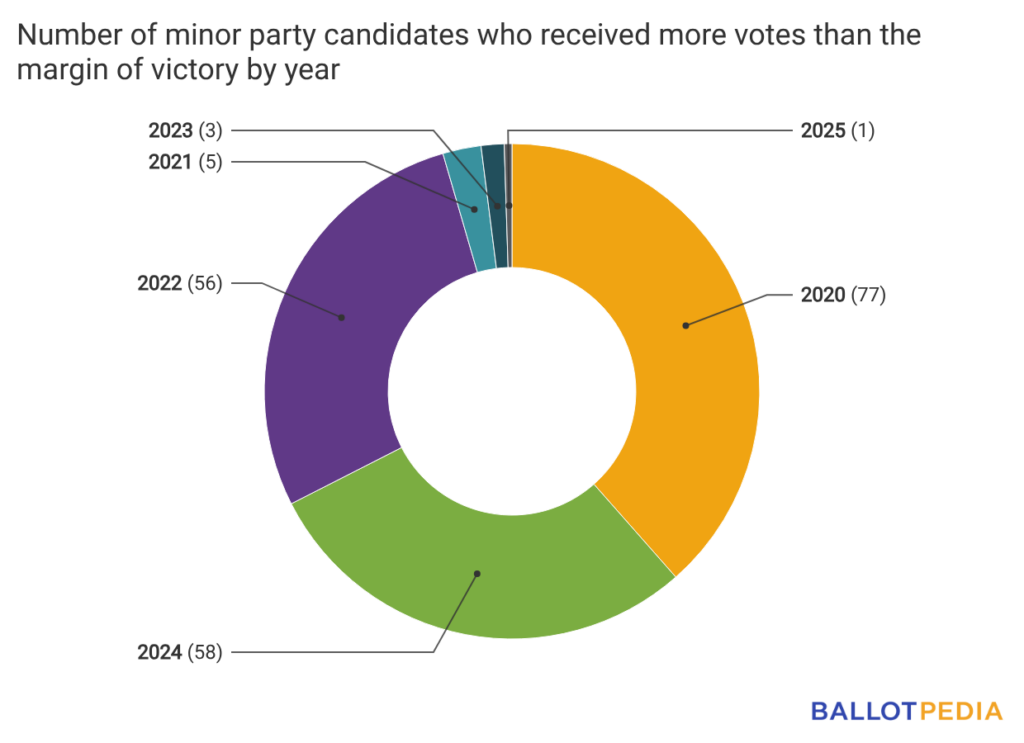
In the three odd-year elections Ballotpedia has covered, five minor party candidates received more votes than the margin of victory in 2021, and three candidates did so in 2023. By comparison, in even-year elections, 77 minor party candidates received more votes than the margin of victory in 2020, as well as 56 in 2022, and 58 in 2024.
In 2025, the only candidate was Valerie Beverly, an independent candidate who ran for District 69 of the Virginia House of Delegates. Beverly received 1,395 votes (3.6%). This was larger than the election’s margin of victory of 1,290 votes. In the election, Mark Downey (D) defeated incumbent Chad Green (R) with 49.8% of the vote to Green’s 46.5%.
In odd-year elections, independent candidates appeared on Ballotpedia’s list of minor parties whose nominees earned more votes than the margin of victory in two years: 2023 and 2025. In even-year elections, 20 independent candidates surpassed the margin of victory in 2020, 15 did so in 2022, and 21 in 2024.
Between 2023 and 2025, independent candidates led all minor parties in the number of nominees who received more votes than the margin of victory. Libertarian Party candidates had the highest totals in 2020 and 2022, while the Conservative Party led in 2021.
The only election in 2025 was for a non-statewide legislative seat, while no federal, statewide, or local election saw a minor-party candidate receive more votes than the margin of victory. In 2023, one state legislative election saw this happen, and in 2021, two state legislative elections did. In 2024, the most recent even-year election, a minor-party candidate received more votes than the margin of victory in seven federal elections, including three races for U.S. Senate and four for U.S. House.