



This year’s filing deadline for candidates running for the U.S. House of Representatives in Ohio was Feb. 4, 2026.
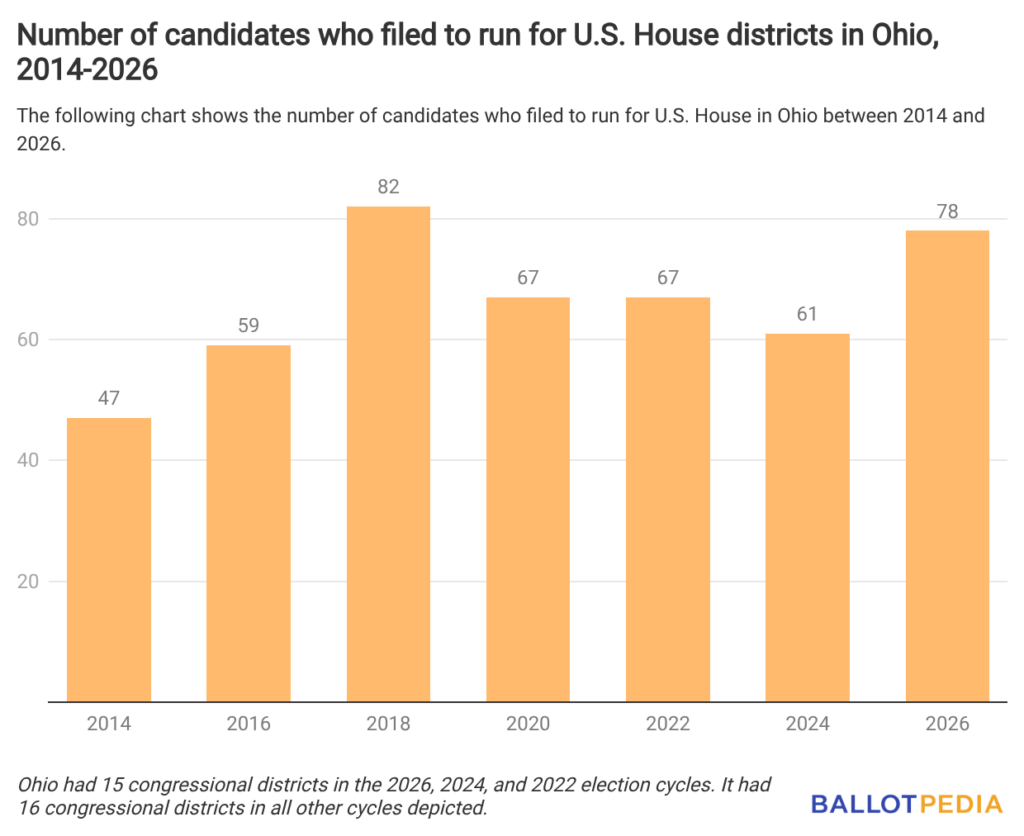
Seventy-eight candidates — 46 Democrats and 32 Republicans — are running for Ohio’s 15 U.S. House districts. That’s 5.2 candidates per district. There were 4.1 candidates per district in 2024, 4.5 in 2022, 4.2 in 2020, 5.1 in 2018, 3.7 in 2016, and 2.9 in 2014. Ohio had 15 congressional districts in the 2026, 2024, and 2022 election cycles. It had 16 congressional districts in all other cycles from 2014 to 2020.
Here are some other highlights from this year’s filings:
- These are the first elections to take place since the Ohio Redistricting Commission voted unanimously to approve a new congressional map. The state was required to redraw its congressional district boundaries ahead of the 2026 elections due to a constitutional amendment that gave shorter expiration dates to maps passed without bipartisan support.
- No districts are open this year, meaning all incumbents — five Democrats and 10 Republicans — are running for re-election. There were two open districts in 2024, one in 2022, none in 2020, two in 2018, one in 2016, and none in 2014.
- Twenty primaries — 12 Democratic and eight Republican — are contested this year. In total, there were 12 contested primaries in 2024, 10 in 2022, 23 in 2020, 22 in 2018, 18 in 2016, and 14 in 2014.
- Rep. Max Miller (R-7th) and eight Democrats are running for the 7th district, the most candidates running for a district this year.
- Seven incumbents — three Democrats and four Republicans — are facing primary challengers this year. There were four incumbents in a contested primary in 2024, six in 2022, 10 in 2020, eight in 2018, four in 2016, and five in 2014.
- Candidates filed to run in the Republican and Democratic primaries in all 15 districts, meaning no districts are guaranteed to either party.
Ohio and one other state — Indiana — are holding U.S. House primaries on May 5, 2026.
In Ohio, primary elections are determined via plurality vote, meaning that the candidate with the highest number of votes wins even if they did not win an outright majority of votes cast.