



Elections for both the governor and the U.S. Senate are happening in 26 states on Nov. 3, 2026. This count includes Florida and Ohio, where special elections for the U.S. Senate are happening alongside gubernatorial elections.
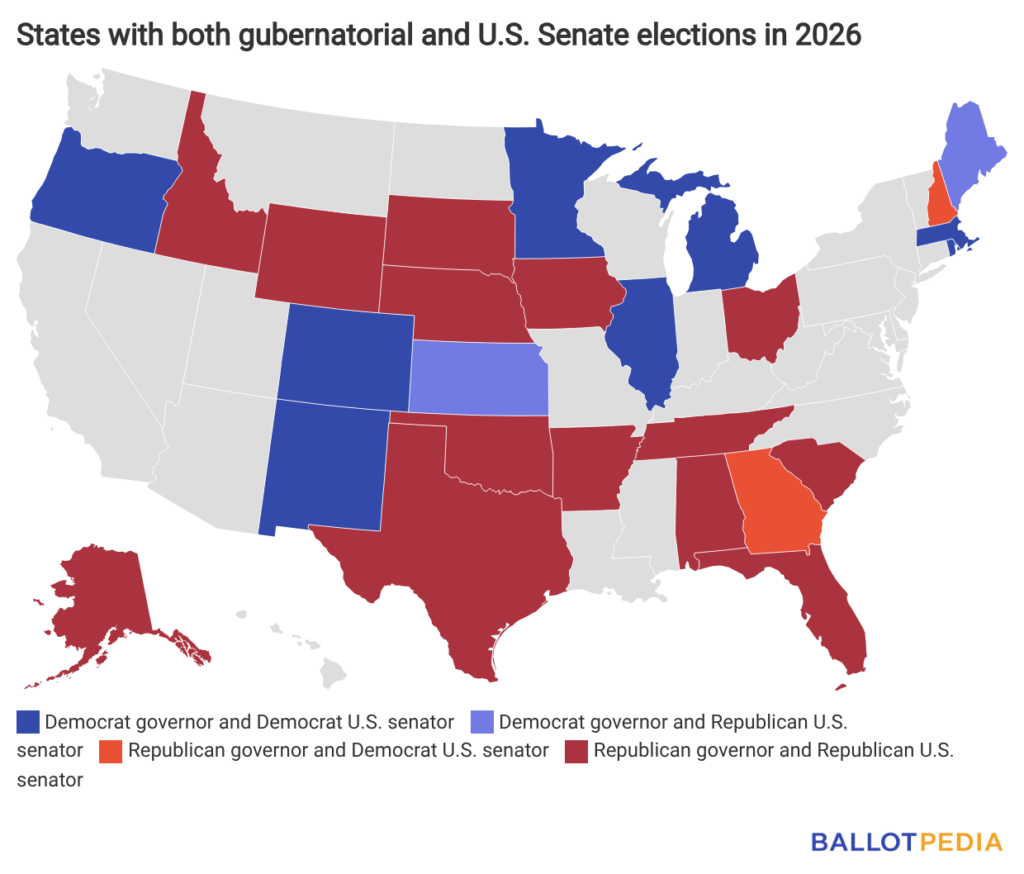
The gubernatorial elections in 16 states are open either due to term limits or because the incumbent is retiring. The U.S. Senate elections in eight states are open due to retiring incumbents. Six of the 26 states — Alabama, Iowa, Michigan, Minnesota, Oklahoma, and Wyoming — are holding open elections for both governor and U.S. senator.
The incumbent governors and U.S. senators in eight states are both Democrats. In 14 states, both are Republicans. The incumbent governors and U.S. senators in four of the 26 states are from opposite parties. In Georgia and New Hampshire, the incumbent governors are Republicans and the incumbent U.S. senators are Democrats. In Kansas and Maine, the incumbent governors are Democrats and the incumbent U.S. senators are Republicans.
In the 2024 presidential election, Donald Trump (R) won 16 states of the 26 states, and Kamala Harris (D) won eight. Two other states split their votes. In Maine, Harris won three electoral votes, and Trump won one. In Nebraska, Trump won four electoral votes, while Harris won one.
In total, 36 gubernatorial offices — 18 Democratic-held and 18 Republican-held — are up for election in 2026. Nationally, Republicans control 26 governorships, and Democrats control 24.
In total, 33 U.S. Senate seats — 13 Democratic-held and 20 Republican-held — are up for regularly scheduled elections in 2026. Another two U.S. Senate seats — both Republican-held — are up for special election. As of March 8, 2026, Republicans have a 53-45 majority in the U.S. Senate with two independents who caucus with Democrats.