


Welcome to the Wednesday, March 18, Brew.
By: Briana Ryan
Here’s what’s in store for you as you start your day:
- Washington voters to decide initiatives related to school sports eligibility and parental rights in public schools
- Sixty-six members of Congress have announced they will not seek re-election this year — the most at this point in an election cycle since 2018
- Delaware voters have decided the fewest ballot measures of any state in U.S. history
Washington voters to decide initiatives related to school sports eligibility and parental rights in public schools
On Nov. 3, Washington voters will decide on two ballot initiatives: one on school sports eligibility requirements based on sex, and one on parental rights in public schools.
Let's Go Washington, a political action committee (PAC), gathered and submitted signatures for both initiatives. Brian Heywood, a hedge fund executive and Republican donor, founded the PAC. According to the PAC’s website, it is "a non-partisan organization that is proud to work with people on the entire political spectrum. [...] We are proud to be working with a diverse coalition of supporters from many different political backgrounds as we fix what’s broken." In 2024, Let's Go Washington submitted signatures for six measures, with the Legislature approving three and rejecting three.
Sports eligibility initiative
The Washington Sex Verification Requirements for Female School Sports Initiative (IL26-638) would "prohibit biologically male students from competing with and against female students." It would also require verification of their sex by a health care provider based on "reproductive anatomy, genetic makeup, or normal endogenously produced testosterone levels."
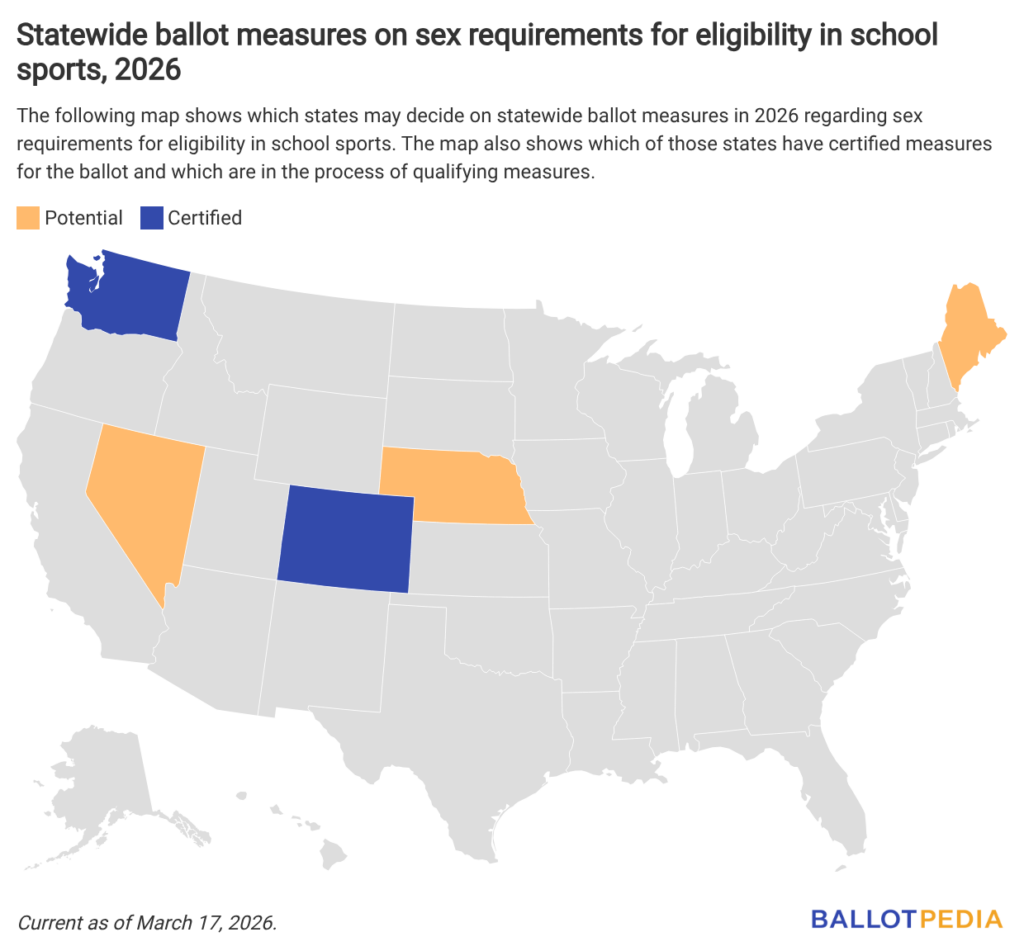
IL26-638 is the first statewide ballot measure on sex requirements for eligibility in school sports to qualify for the ballot in U.S. history. On March 16, after IL26-638 was certified for the ballot in Washington, the Colorado Secretary of State certified a measure for the Nov. 3 ballot in Colorado that would require school- and association-sponsored athletic teams to be classified in one of three categories based on sex: (1) males/men/boys, (2) females/women/girls, or (3) coeducational or mixed.
On March 17, the Maine Secretary of State announced that an indirect initiative in Maine collected enough certified signatures to go before the Maine Legislature for consideration. The initiative would require that public school sports teams designated for girls or boys be limited to students of the corresponding sex, as recorded on their original birth certificate. The Legislature has until the end of the legislative session to approve the initiative. If the Legislature and the governor approve the initiative, it becomes law. If the Legislature or the governor does not approve the initiative, it goes to voters for approval.
Campaigns in Nebraska and Nevada are in the process of qualifying initiatives that would require participation in sports to be based on sex, unless a team is co-ed.
Parental rights initiative
The Washington Parental Right to Review Education Materials, Receive Notifications, and Opt Out of Sexual-Health Education Initiative (IL26-001) would reenact the Washington Declaration of Parental and Legal Guardian Rights, which the Washington Legislature previously approved in 2024, and then partially repealed and amended in May 2025. That law gave parents the right to review educational materials, receive certain notifications, and opt out of sexual health education. The 2025 legislative changes removed from statute the rights of parents to receive prior notification when medical services are offered to their child, except in cases of emergency medical treatment, when medical services or medications are given that could result in a financial impact on the parent or guardian, or when the school has arranged for medical treatment resulting in follow-up care after school hours.
Background for the initiatives
Both measures are Initiatives to the Legislature, a type of indirect initiated state statute where, if there are enough valid signatures, the Legislature can:
- Adopt the initiative as written
- Reject or not act on the initiative, putting it on the ballot for voter approval
- Approve an alternative to the proposed initiative, in which case both the original proposal and the legislative alternative would be on the ballot
Washington is one of nine states that allow citizens to initiate indirect state statutes
Since the Legislature did not act on either initiative before the 2026 legislative session adjourned on March 12, voters will decide on both initiatives.
From 1889 to 2025, Washington voters decided on 34 Initiatives to the Legislature. Voters approved 16 of those initiatives and defeated 18.
Click here to read more about the initiatives that Washington voters will decide on this year.
Sixty-six members of Congress have announced they will not seek re-election this year — the most at this point in an election cycle since 2018
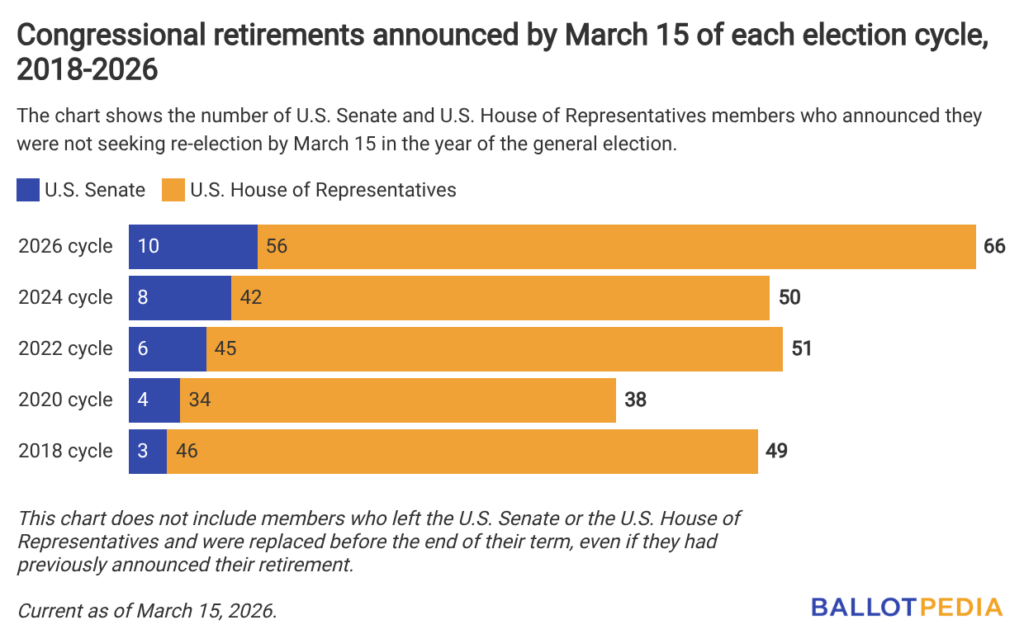
Sixty-six members of the U.S. Congress — 56 U.S. representatives and 10 U.S. senators — have announced they will not seek re-election this year. That’s the most members of the U.S. Congress who have announced their retirements at this point in an election cycle than any other since 2018.
Since our Feb. 10 update, four U.S. representatives and one U.S. senator announced they will not seek re-election. Here’s a list of how independent election forecasters have rated this year’s general election for each district and state these incumbents currently represent:
- Rep. Ryan Zinke (R-Mont.) announced on March 2 that he is retiring from public office. Election forecasters have rated the election for the district as either Solid or Likely Republican.
- Sen. Steve Daines (R-Mont.) announced on March 4 that he is retiring from public office. Election forecasters have rated the election for the seat as either Solid or Likely Republican.
- Rep. Burgess Owens (R-Utah) announced on March 4 that he is retiring from public office. Election forecasters have rated the election for the district as either Solid or Safe Republican.
- Rep. Tony Gonzales (R-Texas), who ran in the March 3 Republican primary, announced on March 5 that he would not run in the May 26 primary runoff and would be retiring from public office. Election forecasters have rated the election for the district as either Solid or Safe Republican.
- Rep. Darrell Issa (R-Calif.) announced on March 6 that he is retiring from public office. Election forecasters have rated the election for the district as either a Toss-up or Tilt Democratic.
U.S. House of Representatives
Fifty-six U.S. representatives — 21 Democrats and 35 Republicans — will not seek re-election. Of the 56 members not seeking re-election:
- Twenty-eight — 13 Democrats and 15 Republicans — are retiring from public office
- Sixteen — seven Democrats and nine Republicans — are running for the U.S. Senate
- Eleven — one Democrat and 10 Republicans — are running for governor
- One Republican is running for state attorney general
At this point in the last four election cycles, there were 42 retirement announcements in 2024, 45 in 2022, 34 in 2020, and 46 in 2018.
Seven of the 56 retiring U.S. representatives — two Democrats and five Republicans — won by 10 percentage points or fewer in 2024. Three U.S. representatives — Jared Golden (D-Maine), Don Bacon (R-Neb.), and David Schweikert (R-Ariz.) — won by fewer than five percentage points.
U.S. Senate
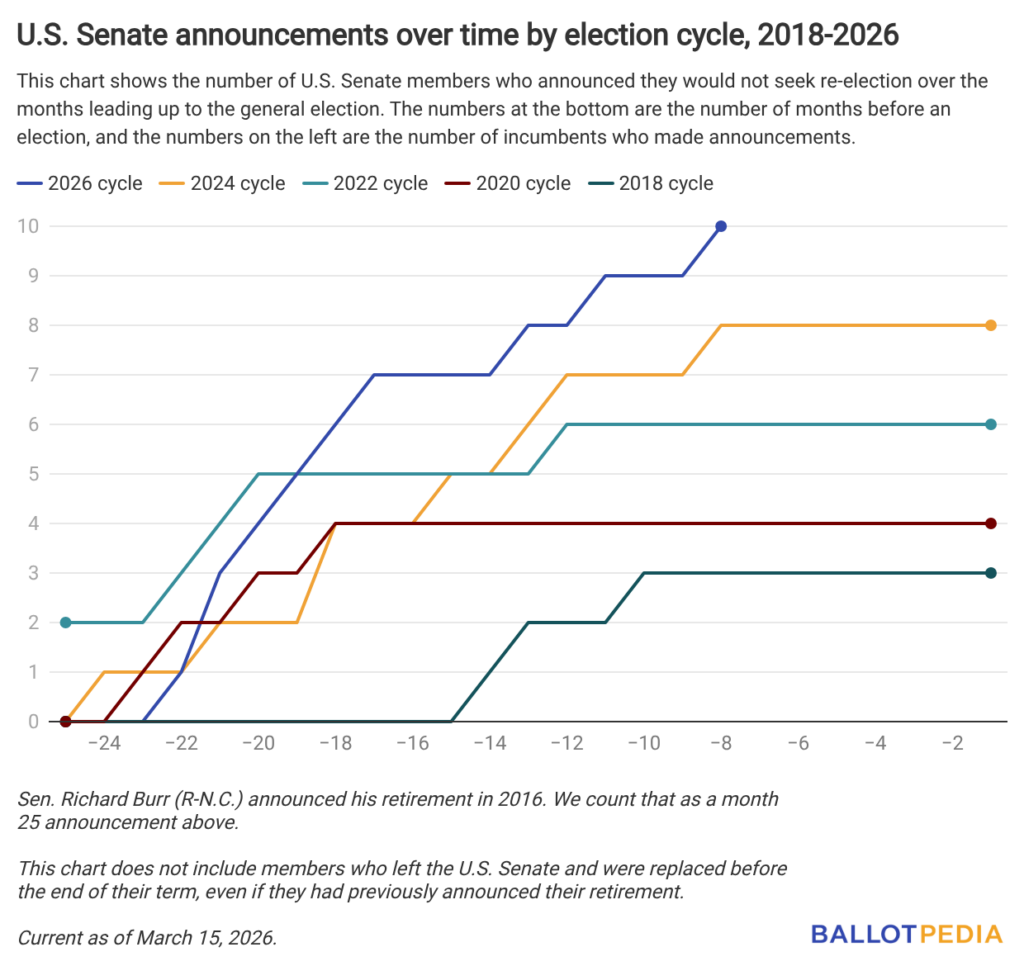
Ten senators — four Democrats and six Republicans — announced they will not seek re-election. Senators Daines, Cynthia Lummis (R-Wyo.), Joni Ernst (R-Iowa), Thom Tillis (R-N.C.), Dick Durbin (D-Ill.), Mitch McConnell(R-Ky.), Jeanne Shaheen (D-N.H.), Tina Smith (D-Minn.), and Gary Peters (D-Mich.) are retiring from public office. Sen. Tommy Tuberville (R-Ala.) is running for governor of Alabama.
At this point in the last four election cycles, there were eight retirement announcements in 2024, six in 2022, four in 2020, and three in 2018.
Looking at the last time those 10 U.S. senators ran in 2020, five of them — two Democrats and three Republicans — won by 10 percentage points or less. Tillis and Peters won by less than five percentage points.
Click here for a full list of all members of the U.S. Congress who are not running for re-election this year.
Delaware voters have decided the fewest ballot measures of any state in U.S. history
Ballotpedia's Historical Ballot Measure Factbook will document nearly 200 years of direct democracy in the United States. This ongoing research effort will provide an unparalleled resource for researchers, reporters, and the public on how ballot measures have evolved, the issues they have covered, and their role in our civic life.
Today, let's look at historical ballot measures in Delaware. Our comprehensive inventory spans from 1850 to 2025. During that time, Delaware voters decided on five measures — the fewest of any state. Delaware is one of 24 states without any form of citizen initiative. Additionally, Delaware is the only state that does not require voter approval for state constitutional amendments. Those two factors contribute to Delaware's status as the state with the fewest number of statewide ballot measures.
Of the five measures, voters approved three measures and defeated two — a 60% approval rate. Delaware has the eleventh-highest approval rate of the 20 states for which we have completed Factbooks. Connecticut has the highest, at 91%, and South Dakota has the lowest, at 44%.
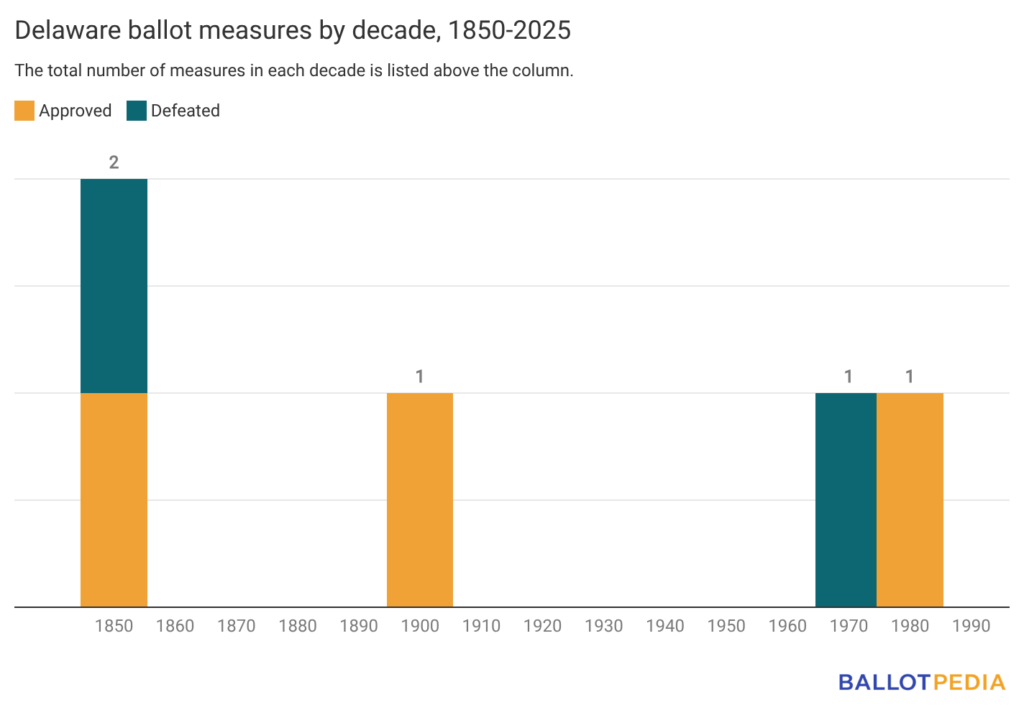
Here are the five measures on the ballot in Delaware between 1850 and 2025:
- Constitutional Convention Question (1851) allowed the Delaware General Assembly to call a state constitutional convention. Voters approved the measure 73% to 27%.
- Constitution of 1853 Ratification Measure would have ratified the new state constitution proposed by the constitutional convention. Voters defeated the measure 64% to 36%.
- Initiative and Referendum Advisory Question (1906) directed the General Assembly to pass legislation that would create an advisory initiative and referendum process. Voters approved the measure 89% to 11%. However, the question was non-binding, and the General Assembly elected not to create an initiative and referendum process.
- Slot Machines Advisory Question (1976) would have advised the General Assembly to pass legislation permitting the use of state-regulated slot machines. Voters defeated the measure 57% to 43%.
- Charitable Gambling Advisory Question (1984) advised the General Assembly to pass legislation allowing the state to license volunteer fire companies, veterans organizations, religious or charitable organizations, and fraternal organizations to conduct lotteries. Voters approved the measure 73.51% to 26.49%.
Click here to view our full Historical Ballot Measure Factbook for Delaware.