


Welcome to the Wednesday, March 25, 2026, Brew.
By: Lara Bonatesta
Here’s what’s in store for you as you start your day:
- Senate takes up SAVE America Act to require voter ID, proof of citizenship for federal elections
- U.S. House committees announce initial Red to Blue and MAGA Majority candidates
- Kentucky Legislature overrides veto of bill opting into federal school choice tax credit scholarship program
Senate takes up SAVE America Act to require voter ID, proof of citizenship for federal elections
On March 17, the U.S. Senate began debate on the SAVE America Act, which would require individuals to provide documentary proof of citizenship to register to vote and voter ID to cast a ballot in federal elections. As of March 24, debate continued in the Senate, and a final vote had not been scheduled.
On Feb. 11, the U.S. House passed the SAVE America Act 218-213 with 217 Republicans and one Democrat voting in favor and 213 Democrats voting against.
On March 17, the Washington Post's Theodoric Meyer wrote, "Republicans, who control the Senate, do not have the 60 votes they need to overcome a Democratic filibuster. Nor do they have enough votes to attempt a riskier gambit that some Republican senators favor: attempting to exhaust Democrats by forcing them to speak on the Senate floor for weeks to block the bill, known as a 'talking filibuster.'"
The bill would prohibit states from accepting voter registration applications for federal elections unless accompanied by documentary proof of citizenship, such as a passport, military ID, or an enhanced REAL ID. Applicants could also present a different government-issued photo ID plus another document, such as a birth certificate or naturalization certificate.
Voters who register by mail would be required to present their proof of citizenship in person to an election official before the election. In states that have same-day voter registration, voters could provide such proof at the polls on Election Day.
Individuals who have changed their name would need to provide proof of citizenship with their old name, as well as either "additional documentation as necessary to establish that the name on the documentation is a previous name of the applicant" or an affidavit attesting that the name on the documentation is their previous name.
For reference, individuals currently applying for a U.S. passport must submit either a certified birth certificate, naturalization or citizenship certificate, consular report of birth abroad, or a valid and undamaged passport. Passport applicants must also provide a photo ID.
The legislation would also require states to check their voter rolls against U.S. Department of Homeland Security data to identify and remove non-citizens who are registered to vote.
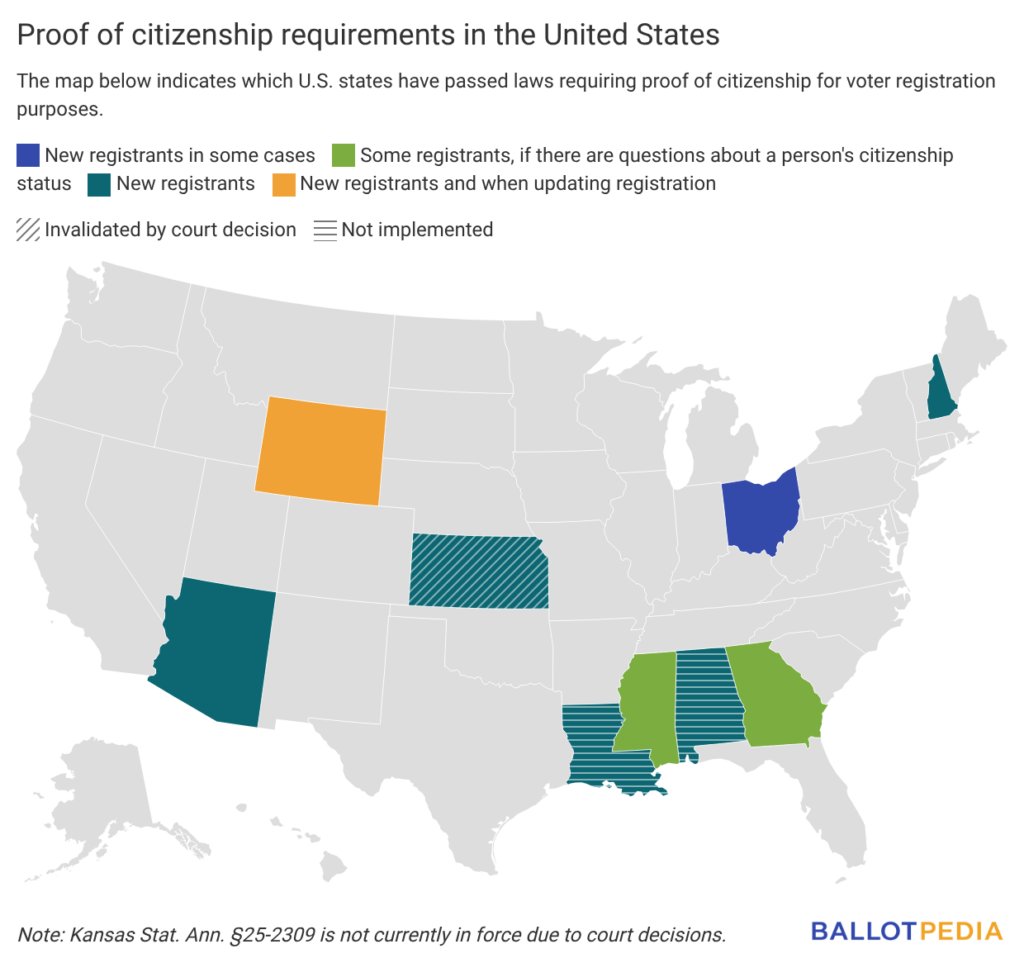
Some states have laws similar to the SAVE America Act’s documentary proof-of-citizenship requirement.
Nine states — Alabama, Arizona, Georgia, Kansas, Louisiana, Mississippi, New Hampshire, Ohio, and Wyoming — have laws requiring proof of citizenship to register to vote in at least some cases. Alabama and Louisiana have not implemented their proof-of-citizenship laws. A U.S. District court blocked Kansas' proof-of-citizenship law in 2018.
Seven of the nine states with laws requiring proof of citizenship have Republican trifectas, while Arizona and Kansas have divided government. Of the states without documentary proof of citizenship laws, 16 have Democratic trifectas, 16 have Republican trifectas, and nine have divided government.
Fifteen states have introduced legislation requiring documentary proof of citizenship for registration. In Florida, South Dakota, and Utah, proof-of-citizenship bills have passed both chambers of the state legislature. In Iowa and Mississippi, a proof-of-citizenship bill has passed in one chamber.
Additionally, the SAVE America Act would require individuals voting in federal elections to present photo identification in order to cast a ballot. Absentee/mail-in voters would be required to include a copy of their ID when requesting and returning their ballot or provide the last four digits of their Social Security number and sign an affidavit. Eligible forms of ID include driver’s licenses, state-issued ID cards, passports, or tribal or military IDs.
Federal law currently requires individuals in all 50 states who register to vote by mail and who have not previously voted in a federal election in their state to provide documents to establish their name and identity, such as a copy of their driver's license or paycheck.
Currently, 36 states require voters to present identification to vote at the polls on Election Day, though many states provide exceptions to these rules. Six of those states have Democratic trifectas, 23 states have Republican trifectas, and seven states have divided government.
Of these states, 24 require voters to present identification containing a photograph, with certain exceptions.
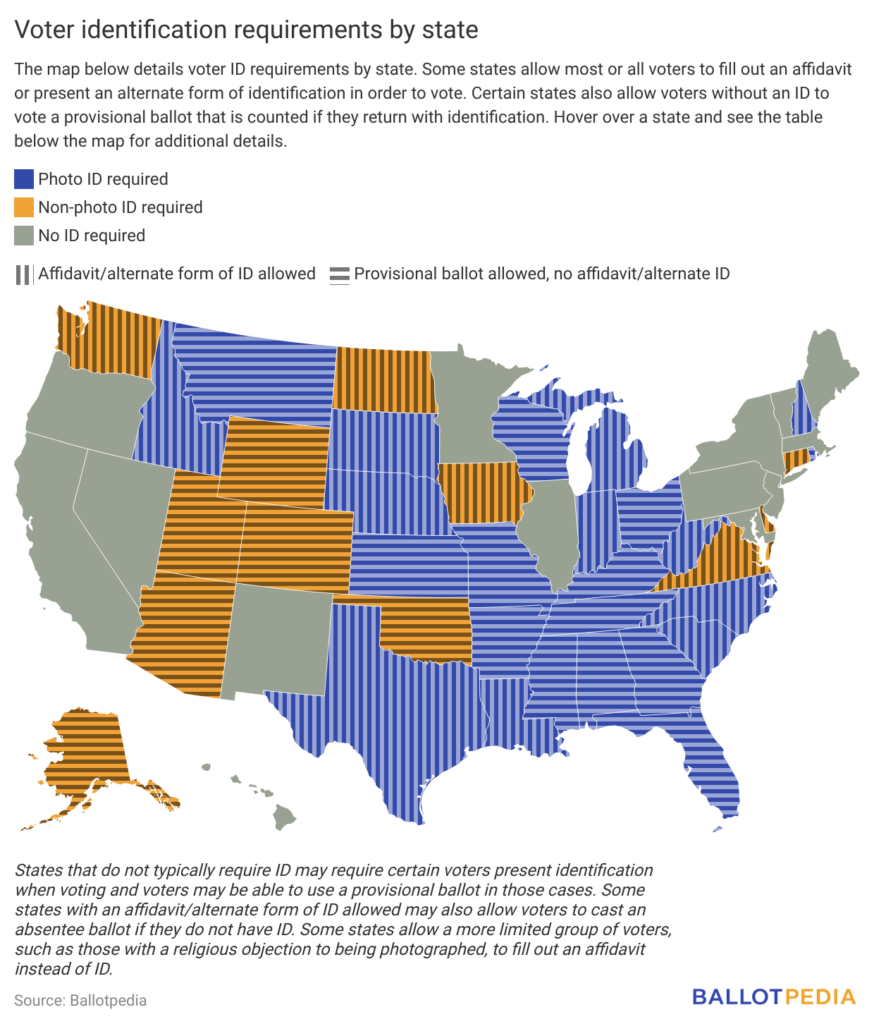
The remaining 14 states do not generally require voters to present identification to vote at the polls on Election Day, aside from what is required in federal law. Of the states without voter ID laws, 10 states have Democratic trifectas, and four states have divided governments.
Lawmakers in Arizona and Oklahoma have advanced bills this session to require a photo ID instead of a non-photo ID. Florida and New Hampshire have advanced bills prohibiting certain forms of identification from being used for voting.
Read more here for information on documentary proof of citizenship laws across the country. Read more here for information on voter ID laws in each of the 50 states.
U.S. House committees announce initial Red to Blue and MAGA Majority candidates
On March 17, the National Republican Congressional Committee (NRCC) released an initial list of nine candidates who are participating in its MAGA Majority program, formerly known as Young Guns, in the 2026 election cycle.
The release of the NRCC list comes approximately a month after the Democratic Congressional Campaign Committee (DCCC) released its initial list of 12 candidates who are participating in its Red to Blue program in the 2026 election cycle.
The candidates selected to participate in these programs must meet certain fundraising and organizational thresholds. Once selected, the candidates receive funding and guidance from their respective committees.
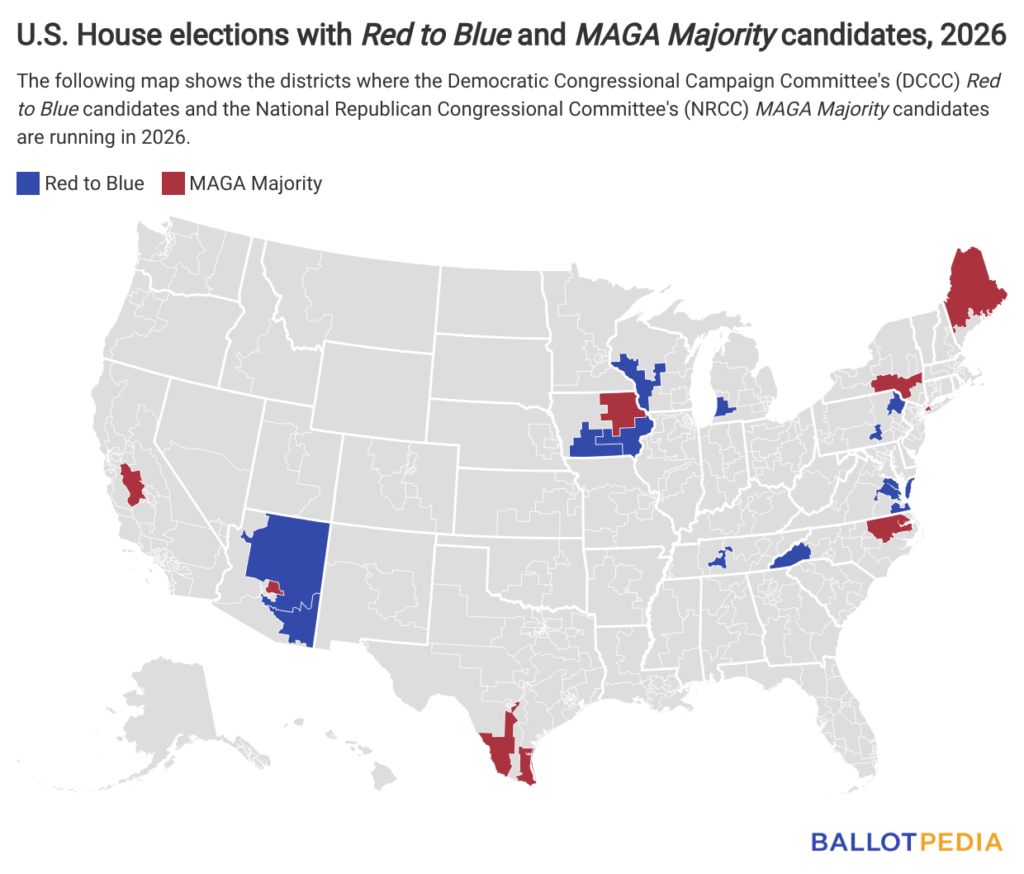
A breakdown of these candidates' districts
Two MAGA Majority candidates are running in open Republican-held districts, and seven are running in Democratic-held districts. One of those Democratic-held districts is open.
Of the seven Democratic-held districts, incumbent Rep. Adam Gray (D) in California's 13th Congressional District had the narrowest margin of victory (MOV) in the 2024 general election. Gray defeated incumbent Rep. John Duarte (R) by 187 votes. The boundaries of California’s 13th district changed in 2025 due to redistricting. Under the new boundaries, Kamala Harris (D) would have defeated Donald Trump (R) 48.84%- 48.38% in the 2024 presidential election in the district. Incumbent Rep. Tom Suozzi (D) in New York's 3rd Congressional District had the largest MOV in the 2024 general election. Suozzi defeated Michael LiPetri Jr. (R) 51.7% to 48.1%.
Of the two Republican-held districts, incumbent Rep. David Schweikert (R) defeated Amish Shah (D) in the 2024 general election in Arizona's 1st Congressional District 51.9% to 48.1%. Incumbent Rep. Ashley Hinson (R) defeated Sarah Corkery (D) in the 2024 general election in Iowa's 2nd Congressional District 57.1% to 41.5%.
In the 2024 presidential election, considering redistricting ahead of the 2026 elections, President Donald Trump (R) won four of the districts, and Kamala Harris (D) won five.
Of the five Harris-won districts, her narrowest MOV was in New York's 19th Congressional District, in which she defeated Trump by one percentage point. Harris' largest MOV was in Texas' 34th Congressional District, in which she defeated Trump by 15.5 percentage points.
Of the four Trump-won districts, his narrowest MOV was in Arizona's 1st Congressional District, in which he defeated Harris by three percentage points. Trump's largest MOV was in Iowa's 2nd Congressional District and Maine's 2nd Congressional District, in which he defeated Harris by 10 percentage points, respectively.
Looking at the past electoral success of Young Guns candidates, 17.1% won their respective general elections in 2024, 31.9% won in 2022, and 49.1% won in 2020.
Districts where Red to Blue candidates are running
All 12 Red to Blue candidates are running against incumbents in Republican-held districts.
Of the 12 Republican-held districts, incumbent Rep. Mariannette Miller-Meeks (R) in Iowa's 1st Congressional District had the narrowest MOV in the 2024 general election. Miller-Meeks defeated Christina Bohannan (D) 50% to 49.8%. Incumbent Rep. Andy Ogles (R) in Tennessee's 5th Congressional District had the largest MOV in the 2024 general election. Ogles defeated Maryam Abolfazli (D) 56.9% to 39.5%.
In the 2024 presidential election, considering redistricting ahead of the 2026 elections, Trump won all 12 districts.
Trump's narrowest MOV was in Virginia's 2nd Congressional District, in which he defeated Harris by 0.2 percentage points. Trump's largest MOV was in Tennessee's 5th Congressional District, in which he defeated Harris by 18 percentage points.
Looking at the past electoral success of Red to Blue candidates, 36.4% won their respective general elections in 2024, 41.7% in 2022, and 2.6% in 2020.
Click here for more information about the National Republican Congressional Committee (NRCC) and here for more about the Democratic Congressional Campaign Committee (DCCC).
Click here to read more about the 2026 U.S. House elections.
Kentucky Legislature overrides veto of bill opting into federal school choice tax credit scholarship program
On March 17, the Kentucky Legislature overrode Gov. Andy Beshear's (D) veto of House Bill 1, making it the second state to pass legislation to opt into the federal school choice tax credit scholarship program. House Bill 1 requires the Secretary of State to annually opt the state into the program.
Kentucky is one of two states, along with Kansas, where one party has a veto-proof majority in the legislature, and the other party holds the governor's office. It is one of 11 states with a divided government.
Beshear vetoed the bill on March 13. On March 16, the Kentucky House voted to override the veto 77-14, with eight representatives not voting and one abstaining. All 77 supporting votes were Republicans, and all 14 opposing were Democrats. On March 17, the Kentucky Senate voted 31-5 to override the veto, with two senators not voting. All 31 supporting senators were Republicans, and all five opposing were Democrats.
Kentucky is the 28th state to elect to participate in the program, either through submitting the official participation election form, a governor's statement, or legislation. Of these states, 23 have Republican trifectas, two have Democratic trifectas, and three have divided governments.
Kentucky has historically rejected school choice programs.
- In 2022, the Kentucky Supreme Court struck down a school choice tax credit program, citing a state constitutional provision requiring voter approval to use public funds for private education.
- In 2024, Kentucky voters defeated a constitutional amendment 64.8%- 35.2% that would have allowed public funds to be used for private educational expenses.
- On Feb. 19, the state supreme court struck down a 2022 law that established charter schools in the state.
President Donald Trump (R) signed the One Big Beautiful Bill Act on July 4, 2025, establishing the federal school choice tax credit. Under the program, individuals can receive federal tax credits for donations they make up to $1,700 to authorized scholarship-granting organizations (SGOs), which then disburse scholarships to students for either public or private school expenses. States must submit a list of eligible SGOs to the U.S. Treasury by Jan. 1 of each year to participate in the program.
Click here to learn more about state participation in the program.